 1 month ago
59
1 month ago
59
Eve Middleton was sitting on a picnic blanket in a park, sharing out vegan biscuits with six fellow activists, when she saw a squad of police bearing down on them. About 30 officers, she said, surrounded the seven young people, and one officer told them: “Don’t run or you’ll be cuffed.”
Another officer focused on gathering evidence. “Whose Oreos are these?” they asked, seizing the biscuits.
“It was pretty farcical, but it’s still frightening when you see that amount of officers running towards you. It’s pretty scary,” said student Bridie Leggatt, another of the seven.
The seven activists had gathered for a “nonviolence training event” – meeting in the park to enjoy the sunny weather.
Leggatt, 22, and Middleton, 25, were among 13 people arrested last weekend in Salford and London as part of a national police crackdown on a new civil resistance group called Take Back Power.
A further 15 arrests had been made in March when police raided a “nonviolence training” event, this time at the Grade II-listed Quaker House in Westminster.
They were all held on suspicion of conspiracy to commit theft, police said, linked to Take Back Power’s campaign of “mass shoplifting” in supermarkets across Britain in a protest against inequality.
On TikTok, the group’s videos show activists of all ages “liberating” rice, pasta, beans, nappies, stock cubes and tinned fruit from supermarkets in Cornwall, London and Manchester.
They pile the goods into cardboard boxes branded with the message: “These things are going to those who need them.” The items are then distributed at local food banks – if they manage to get past security.
Even by today’s standards of shoplifting, when supermarket thefts have reached record highs, the mass looting is quite brazen.
Steph Parker, an assistant chief constable at Greater Manchester police, said forces would take “robust action to disrupt this type of organised criminality and it will not be tolerated”.
Middleton and her six comrades were held in custody for 24 hours before being released on Monday. For Middleton, like many of the activists, this is not her first encounter with the law.
Many of those involved with the group are seasoned activists – despite being in their early 20s – having taking part in actions with Extinction Rebellion, Just Stop Oil, Animal Rising and other groups in recent years. Neither Middleton or Leggatt wanted to say how many times they had been arrested as they feared a telling off from their parents.
Take Back Power announced itself in December when activists threw custard and apple crumble at a case containing the crown jewels at the Tower of London.
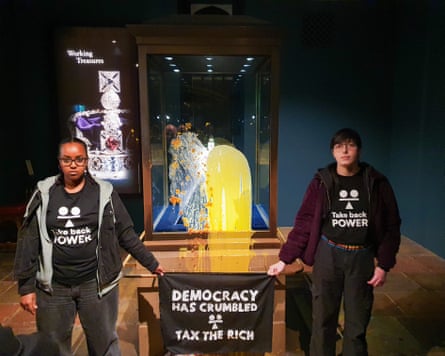
Eight people were charged with criminal damage over the stunts, with four due to appear before Westminster magistrates court on Monday. The group said a total of 50 people had been arrested since December, with the majority detained while taking part in “nonviolence training” events.
On its website, activists are invited to join upcoming action in London “targeting the luxury lifestyle of the super-rich” by “occupying where they play and shop”.
A spokesperson for Take Back Power, who would only give his name as James due to the risk of arrest, said the group planned further headline-grabbing stunts this year with the aim of focusing attention on Britain’s deepening inequality.
James said the organisation, which wants to see higher taxes levied on the rich and a legally binding citizens’ assembly, had no leader “as such”. It has raised more than £65,000 in donations in the past four months, according to a fundraising page.
Another of those arrested last weekend, who would only give his name as Mark, said mass shoplifting would have “no real effect” on supermarkets who make billions of pounds in profit.
“Supermarkets are profiting off other people’s misery and we can’t put up with that,” said Middleton, pointing out that Tesco’s chief executive, Ken Murphy, was paid £9.2m last year, about 400 times that of the shop’s typical worker.
What about the effect on low-paid staff? Will they not risk losing their jobs if mass shoplifting has an effect on company profits?
“It shouldn’t be staff that get cut,” said Mark, 44, who works in education. “What should get cut are the obscene profits and salaries of the chief executives.”
The vegan picnic raided by police last weekend was in Salford’s Peel Park – named after Sir Robert Peel, the founder of modern law enforcement whose philosophy of “policing by consent” is a guiding principle of forces today, recognising that those in uniform operate on the basis of public trust rather than fear or force.
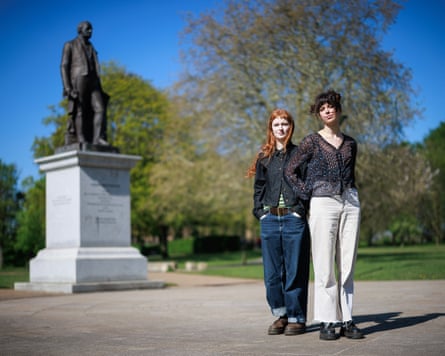
Yet the arrests of activists at a training event – rather than for a specific act – appears to run counter to that principle, said Middleton.
Parliament’s joint committee on human rights has condemned legislative changes in recent years that it said (pdf) have had “a chilling effect” on the right to protest in England and Wales.
Middleton said the arrests on suspicion of being involved in a conspiracy was part of a wider “repression” of civil resistance in Britain.
“Other groups were able to take part in training without everyone getting arrested,” she said. “For doing not as much, the risk of prison is a lot higher.”
James, the Take Back Power spokesperson, said the group planned to build up its action with the aim of pushing inequality to the top of the agenda by the next general election, which has to be held by August 2029.
Middleton believes the police crackdown is a sign that the authorities are scared.
“They can see that Take Back Power does speak to a lot of this country’s people [who are] fed up with inequality. They are scared of what it could become.”