
 4 hours ago
7
4 hours ago
7
Visual artists and dancers have long taken cues from each other. Pablo Picasso constructed sets and designed costumes for the Ballet Russes in Paris. The Bauhaus painter Oskar Schlemmer’s Triadisches Ballett – first staged in 1920s Stuttgart, Germany – is considered a prototype of performance art. Andy Warhol pumped helium into mylar pillows for the backdrop of Merce Cunningham’s RainForest dance, a piece depicting Cunningham’s childhood home of the Pacific north-west.
But only one artist danced on roller skates.
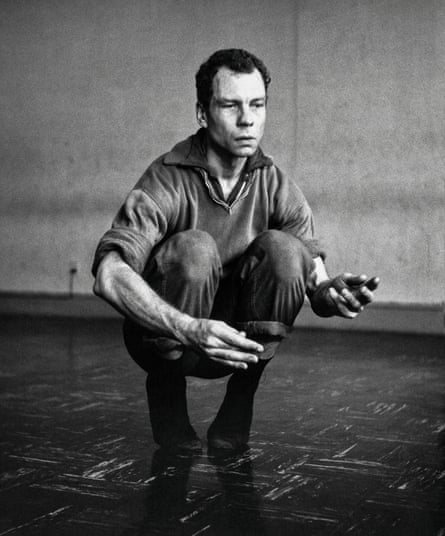
Robert Rauschenberg, who died in 2008 at age 82, is best known for what he called his “combines” – painting-sculpture hybrids made up of found and repurposed trash picked up on New York streets. He also orbited the dance world, palling around with Cunningham and Trisha Brown, two giants in the downtown New York postmodern scene.
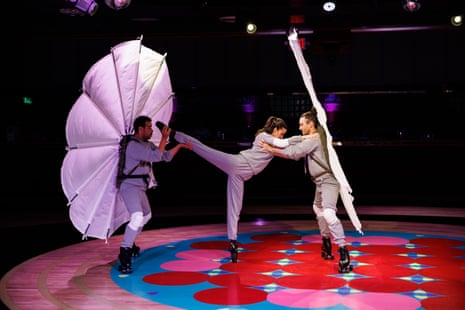
Rauschenberg’s 1963 piece Pelican – named for the 8ft parachute the dancers’ wear on their backs like wings – holds an almost mythic space in some imaginations. Only a short video clip and few black-and-white photos survive of the original dance, which was performed by two men on roller skates and one ballerina on pointe. It’s an audacious concept, one that could only be conjured during the freewheeling days of 1960s Greenwich Village.
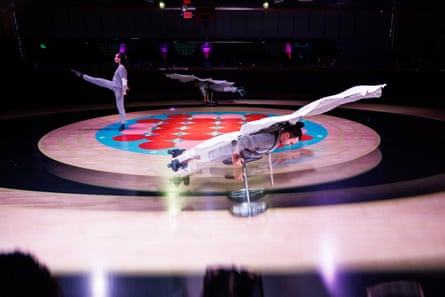
Last week, the Trisha Brown Dance Company reimagined Pelican for the first time, fusing what is known from archival research with new additions by choreographer Tara Lorenzen and the piece’s three dancers, Ashley Hod, Rashaun Mitchell and Silas Riener.
The event took place at a benefit for the company staged at Xanadu, a roller skating rink in Brooklyn. “No one has ever reconstructed Pelican before, and everyone’s always wanted to,” Mitchell told the Guardian. “This work is not pedestrian at all. It’s pretty virtuosic in a way, and very high stakes.”
Pelican’s existence is entirely accidental, born out of a typo in a 1963 arts festival program that erroneously credited Rauschenberg as a choreographer. He had never staged a dance but decided to give it a go, presenting Pelican later that year.
The painter performed in the piece himself, later saying he learned how to skate for the occasion. “Since I didn’t know much about actually making a dance, I used roller skates as a means of freedom from any kind of inhibitions that I would have,” Rauschenberg said. Merce Cunningham company dancer Alex Hay, the other dancer on skates, would later succinctly put it: “We didn’t collide or fall down or anything like that. I guess that was good.”
Much of what was performed at Xanadu in 2026 was created after the team sifted through photos and notes left behind in Rauschenberg and Brown’s archives. “We approached it in a forensic way,” Riener said. “We all came to it with the shared sensibility of, let’s get as much out of what we know to exist, and then fill in the gaps.”
Pelican is a trust exercise. The dancers must rely on themselves and their training to stay upright on four wheels. They also put faith in each other during the dance’s climax, when all three bodies join together. The two skaters hold hands and encircle the ballerina; the effect is like watching a music box come to life.
Mitchell and Riener are a couple. The pair met Hod on the plane down to Florida where they rehearsed Pelican at the Rauschenberg Foundation headquarters, which comprises the artist’s former home and studio. (Rauschenberg spent the last years of his life on the secluded Captiva Island.)
“There was this rapid attempt at building some rapport together,” Riener said. “You feel a lot about a person through their contact when you’re partnering with them, and Ashley is a rock solid, calm person, which she probably developed through being in the New York City Ballet.” (Hod is a soloist in the company.)
Pelican’s one-night-only revival took place on a Monday night during a sweltering heatwave; the audience sat in folding chairs placed on the perimeter of the rink. Mitchell and Riener gamely strapped on their 8ft parachutes. There was a heaviness to their costumes – the pair wore bulky gray sweatsuits, kneepads, and, oh yes, the skates – but they moved as if levitating.
The dance is an absurdist love story: these three people are totally looking out for each other, on skates. It’s joyful to watch something succeed when all logic suggests it should fail. It recalls something Rauschenberg said in a 1982 interview with Brown: “Dance has an energy that makes you glad you’re alive one more minute.”