 2 months ago
62
2 months ago
62
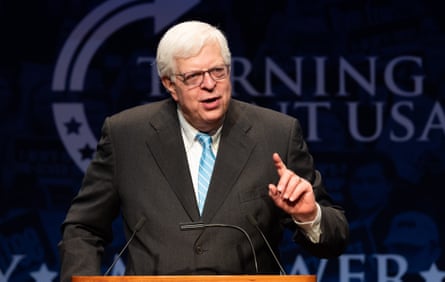
In the fall of 2013, a silver-haired conservative radio host named Dennis Prager flew to Texas to woo a pair of rightwing billionaires. A few years earlier, Prager had co-founded a digital education non-profit, Prager University, which created snappy five-minute videos that promoted capitalism and “Judeo-Christian values”. The billionaires, fracking tycoons Dan and Farris Wilks, were big fans.
Inside Farris Wilks’ home theater, the brothers and more than 20 members of their family sat transfixed as Prager outlined a plan to transform PragerU from a niche internet oddity into a mainstream media empire. He just needed a lot more cash.
The brothers liked the pitch, and they agreed to donate $1m for each of the next seven years, PragerU co-founder Allen Estrin, who attended the meeting, told the Guardian. “It really did make it possible for us to do some things that otherwise simply would have taken us a lot longer to do.”
And then, five years later, the partnership “came crashing to an end”.
That January, the non-profit published a video from Fox News contributor Guy Benson, in which Benson declared that he was both conservative and gay – part of PragerU’s effort to broaden its appeal. It was a surprising message coming from Dennis Prager’s brainchild. In the 1980s and 90s, Prager had made a name for himself arguing, among other things, that gay rights posed a threat to western civilization.
But by 2018, his views on homosexuality had somewhat softened, and PragerU had moved on to other causes, such as “radical Islam”, the dangers of gender “confusion” and advocacy for the use of more fossil fuels.
The Wilkses’ views had not softened. “They said, ‘You have to do something about this, or we’re pulling out our money,’” Estrin recalled. PragerU declined to remove the video, and the partnership dissolved. (The Wilks brothers did not respond to requests for comment.)
By then, though, PragerU no longer needed its billionaire backers. The year before the Wilks meeting, in 2012, it had raised just $491,000 in donations and grants; by 2018, its annual revenue climbed to $18.6m. By 2024, it would rise to almost $70m, more than prominent non-profits such as the Parkinson’s Foundation, the Electronic Frontier Foundation, and Evidence Action. (PragerU says it has more than 400,000 lifetime donors.)
That money has brought Prager’s master plan to life. Despite its name, it is not in fact a university, but rather a prolific content generator that has often been accused of spreading misleading information. PragerU’s goal is to attract young people to its ideology, and it is increasingly making inroads in America’s educational systems.
Teachers tap PragerU’s library of free lesson plans and videos, some of which have become approved classroom materials in a dozen states, including Texas, Florida and Arizona. Middle and high schoolers flip through its books about the perils of socialism and “the human cost of reducing emissions”. College students at Southeastern University in Florida can earn credit by taking a PragerU history course.
And though the non-profit originally focused on reaching students and the general public, it has expanded its target audience to small children with cartoons and picture books, such as The ABC’s of America, which it says is designed “for babies and toddlers”.
Similar to other rightwing groups with a vested interest in young Americans’ education, such as Moms for Liberty and Turning Point USA, PragerU has also found an ally in the White House. In June, the Trump administration unveiled a partnership with PragerU centering on the founding fathers and the US’s 250th anniversary – an announcement that immediately raised its profile.
“Our vision has always been to undo the damage of America’s education system and to provide a wholesome, patriotic education to Americans who seek to understand our country and seek to defend her from within,” PragerU CEO Marissa Streit said in a video call.
A growing number of academics and education experts, however, are alarmed by the non-profit’s rise.
“I think the problem comes when people don’t understand the nakedly political objectives of PragerU,” said Clifford Lee, a teacher who sits on the board of the South Carolina Education Association. (PragerU materials are sanctioned for use in classrooms across the state.) “It commits the ultimate educational sin of having an outcome that it wants to present and then trying to substantiate that perspective … rather than look at the evidence, think about the evidence, and then come to a conclusion.”
Indeed, PragerU’s approach does not always seem rooted in academic inquiry. For instance, in one 2022 video blaming leftists and “elites” for perpetuating systemic racism – part of PragerU’s stated effort to discredit social justice movements – the narrator asserts that students in many New York City schools are “separated by color during the school year”. Her phrasing seems to imply segregation akin to the Jim Crow south.
Upon closer inspection, the video’s citation links to a New York Post story about a single middle school that allowed students to attend an optional affinity group meeting about their racial identity.
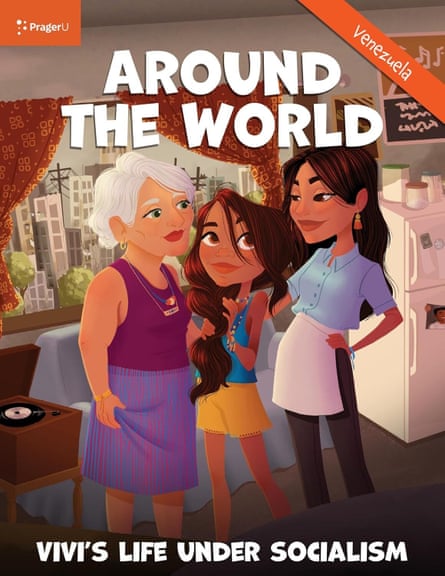
In another video about Islam, a PragerU host argues that “the word ‘moderate’ as we understand it does not really apply” to most Muslims. In a colorful font, the video declares that “the values of the West and the values of Islam are not compatible”.
Much of PragerU’s content is not partisan. To cynical eyes, that is an intentional strategy, imbuing the group with a patina of credibility that makes students more likely to accept its fringe ideas.
“Once you see them as a trustworthy site … they’ve kind of reeled you in,” said Ryan Corso-Gonzales, an assistant professor at Central Michigan University who wrote his master’s thesis on the group.
PragerU’s ascent comes as traditional educational institutions are disintegrating, and not by accident, as Republican officials work to dismantle what they have described as vectors of “woke” ideologies. PBS faces huge budget cuts, the Corporation for Public Broadcasting ceased operating in January, and the Department of Education is slashing its staff.
“I really do worry that PragerU material might potentially be used even more,” said Jonathan Jarry, a science communicator at McGill University’s office for science and society who has written about the group. “It’s almost like they’re filling the void.”
That certainly seems to be the goal. Thanks to its deep reserves, PragerU can afford to give away its digital materials for free, unlike most curriculum providers. Last year, PragerU’s videos were viewed more than 2bn times, said Streit, and nearly 4 million parents and educators have expressed interest in its materials for children, such as by signing up for kids’ newsletters. (The Guardian could not independently verify these figures.) With newfound momentum, it is arguably angling to become a conservative replacement for PBS, Time for Kids, and Sesame Street simultaneously, helping shape young minds from infancy.
PragerU is a tax-exempt non-profit and therefore cannot engage in political campaigning or related activity; but it can legally advance its political agenda. To Estrin, PragerU’s slant is necessary to counterbalance leftist narratives that he says have “taken over” schools for decades.
“In a perfect world, would everything be presented in some kind of neutral way? Yeah, probably. That would be ideal,” he said. Then he hesitated. “Maybe,” he hedged, before hesitating again.
“I do think that the philosophy of conservatism is better for the country … I’m not sure that neutrality would be the best thing we could do for our children.”
For most of PragerU’s 17-year history, Dennis Prager has been its public face. Seventy-seven years old, he dresses neatly, often in a jacket and tie, and has a booming Brooklyn accent that would have made him a natural color commentator for the Mets.
Instead, Prager has spent recent decades stoking the country’s culture wars, telling his radio listeners and conservative groups to stay vigilant against what he considers America’s many internal and external threats.
That includes the non-religious: “There is no such thing as a secular institution with wisdom,” he proclaimed at a 2023 event hosted by Moms for Liberty, a group with similar beliefs to PragerU and a champion of Florida’s “don’t say gay” law for classrooms.
During the same speech, Prager described leftwing political leaders as universal liars and made unfounded claims about transgender women showing their penises to girls. Children “are arrested if they object”, he said. (PragerU, which declined an interview on Dennis Prager’s behalf, also declined to provide evidence to support this claim.)
But then, in the fall of 2024, Prager slipped in his bathroom and crashed to the ground, damaging his spinal cord and leaving him a quadriplegic. The accident forced him to step away temporarily from his radio program and thrust Marissa Streit, the CEO, further into the spotlight.
Streit, who is in her mid-40s, speaks softly and dresses in warmer colors than her boss, though she shares Prager’s rigid politics. She, like Prager, took a circuitous route into education. Born in California, she moved to Israel as a child and later served in the Israeli military. She returned to the US at 21 years old and attended UCLA, followed by an education program at American Jewish University.
According to Streit, after graduating, she worked as an assistant principal at a parochial school in Los Angeles, then rose to become head of another nearby school for approximately four years. In between, she said, she taught kindergarten through eighth grade.

The Guardian sought to speak with some of Streit’s former students to understand her pedagogical instincts, but her credentials couldn’t be confirmed. Streit declined to name the schools she worked at, lest they be subject to political “attacks”, though she said the names of the institutions could probably be found on her LinkedIn profile. In fact, they aren’t listed on LinkedIn, and the Guardian was unable to find any record of her teaching at or running a school in Los Angeles. (PragerU declined to provide the names of the schools even if the Guardian agreed not to identify them.)
In any event, Streit says her work as a teacher informed her current worldview.
She recounted showing her students An Inconvenient Truth, former vice-president Al Gore’s documentary about the climate crisis. At the time, she viewed it as politically neutral. Later, she said, she reflected and had a change of heart. “I was like, ‘Oh my God, the politicians used me.’”
Streit’s political evolution coincided with a pivot in Estrin’s career path as well. For years, he worked as a Hollywood screenwriter on such shows as Touched by an Angel and The Practice. He later began producing Prager’s radio program.
Then, in around 2009, on a “Dennis Prager listener cruise” in the Indian Ocean, a couple of Prager’s fans approached him and Estrin with an idea to launch a brick-and-mortar university that would promote “Judeo-Christian” ideals.
Estrin quickly realized the idea was “completely impractical” and unlikely to convert many minds. The internet, however, offered an infinitely scalable alternative. Few people would tune into long lectures about conservative values. But anyone would watch a five-minute video.
They settled on a name, Prager University, which connoted a sense of legitimacy and gravitas. (They later switched to an abbreviation that “sounded cooler”, PragerU, and clarified in tiny text at the bottom of the website that PragerU was not in fact an “accredited university”.)
Prager and Estrin just needed someone to run the thing. They recruited Streit, who by then was working at a non-profit, the Israeli-American Council, and had years of classroom experience listed on her resumé.
“Congratulations,” Estrin announced to Streit when they hired her in 2011. “You are now George Washington.”
Streit was confused.
“When George Washington was appointed the head of the Continental Army in [1775], there was no army,” Estrin said. Likewise, Streit was in charge of PragerU, but “she didn’t have any soldiers.” She would need to build the group from scratch.
Under Streit’s watch at PragerU headquarters in Los Angeles, the non-profit settled on its guiding principles. Namely, that Americans – particularly young Americans – had lost their zeal for civics and patriotism, had begun overapologizing for the country’s historical sins, and had become needlessly pessimistic about the future.
“You have this notion that you should be ashamed of your country because of its past, what it did to Black people and to Indians,” Estrin said. Meanwhile, people believe that “the world’s going to end in 12 years or 20 years or 40 years because of global warming. And then you wonder why children are subject to all kinds of psychological issues.”
Interestingly, in describing PragerU’s reason for existence, Estrin outlined his own doomsday scenario. Specifically, that “western civilization is in danger.” But perhaps not, he continued, if enough people subscribe to PragerU’s vision. “We’re hoping to instil values in people so that we can save it,” he said.
This kind of apocalyptic rhetoric closely mirrors far-right and Christian nationalist talking points, said Adrienne McCarthy, a researcher at Kansas State University who has studied PragerU. PragerU and its peers are seeking to infiltrate America’s education system to spread their messaging, she said. (Most Republicans believe public schools are slanted toward liberal ideas, while most independents and Democrats believe schools are politically neutral.)
Streit makes a similar argument to Estrin. “We’re under attack,” she said. The enemy, as she depicts it, is an amorphous and invisible boogeyman, “a Marxist agenda in our schools [intended] to divide us”.
“Our focus used to be e pluribus unum,” she said. “Now, it’s like multiculturalism and let’s all not identify as Americans.”
Part of PragerU’s aim, Streit said, is to reverse America’s educational decline. She noted, accurately, that national test scores and literacy rates have been dropping for years.
Streit rattled off a series of buzzwords she thinks are contributing to the decline: anti-racist training, critical race theory, DEI initiatives, helping students understand “whether they were born in the right body”, teaching young people to see themselves as activists. “Things that frankly have been a huge distraction instead of teaching,” she said.
“Do you know how many hours of total instruction a teacher gets on how to teach math when he or she is going through teaching school?” she asked. “Fourteen hours.” (Streit appears to be referring to analyses such as a 2025 study from the National Council on Teacher Quality, which found that graduate education programs are, on average, spending just 14 hours teaching math content. What this omits, though, is that these programs are also spending 38 hours on math pedagogy, and that many states require prospective teachers to pass a math certification exam.)
There is, of course, other crucial context for the decline, like the residual impact of the pandemic, teacher shortages, youth mental health issues, and absenteeism.
The bigger question, though, is how PragerU is positioned to remedy the problem. Its materials focus mostly on civics and are not nearly sufficient to replace classroom curricula, nor does it have a means of supplanting classroom instruction at scale. (“We may not be there right now, but we’re headed in that direction,” Estrin said.)
Nevertheless, PragerU has successfully galvanized many teachers frustrated by their students’ academic performance.
Beanie Geoghegan, who teaches at a Christian academy in Kentucky, said she began using PragerU after noting that her students lacked basic civics knowledge. “They did not know why we celebrated the Fourth of July. They did not know who we declared our independence from,” she said. “I do think that these videos and these supplemental materials are definitely filling a void.”
Another educator, from a low-income school in Georgia, said she uses PragerU to pull her students out of the liberal “echo chamber” of TikTok and Instagram.
Other instructors who identify as conservative are simply giddy to have materials that match their point of view.
“I saw [PragerU] come through my news feed and fell in love, particularly with their five-minute videos,” said Lisa Skisland, a tutor based in Florida who works with home schooled students. “They don’t politicize … They simply love our country and talk about her.”
Skisland so believes in PragerU that she has encouraged parents to use it as their children’s exclusive source of civics education for at least a year, instead of traditional textbooks and digital materials. Some of PragerU’s marketing seems to encourage parents to remove their kids from school, and perhaps use its materials instead.
“PragerU is not replacing the brick-and-mortar element, the physical element, of the schools,” said Streit. “But we are supplementing, and in some cases substituting, the actual content: civics, history, literacy.”
PragerU doesn’t track how many teachers use its materials in classrooms, but it is an official vendor in multiple states, making its content easy to download and sanctioned for use. Montana has authorized it as a licensed textbook dealer. In New Hampshire, students use PragerU to learn financial literacy (one of its non-partisan courses), as do tens of thousands of high schoolers in California, which has not endorsed PragerU on a state level.
Streit seized on these programs as evidence of the non-profit’s credibility. “How could anybody in their right mind say that PragerU is a bad institution because it provides free education about financial literacy to young Americans?” she questioned.
Yet some of its materials engage in clear advocacy. Last year, Oklahoma’s superintendent of education launched a “teacher qualification test” created by PragerU that required test subjects to explain why the distinction between males and females was “considered important in areas like sports and privacy”. (That superintendent has since left the job, and the test has been jettisoned in Oklahoma – though it remains on PragerU’s website.)

Another example, geared toward elementary students, is a cheerful animated short from 2022 about a pair of time-traveling children who meet Christopher Columbus. In the video, Columbus shrugs off the degree to which Native Americans were subjugated by European colonizers.
“Slavery is as old as time and has taken place in every corner of the world,” he tells the kids. “Being taken as a slave is better than being killed, no? I don’t see the problem.” Columbus goes on to tell the children that it is “estupido” to judge his actions based on modern conceptions of morality.
Streit says she also supports school book bans and described most of the outlawed materials as “pornography”, though the bans have included the popular coming-of-age book The Perks of Being a Wallflower and Maus, a graphic novel about the Holocaust.
This kind of subjective advocacy, Lee said, is an effort to present students with “a sanitized version” of history and civics.
To McCarthy, one of the most concerning elements about PragerU is that its political motivations are not broadly understood, even as its materials are increasingly taught in classrooms. “They’re still accepted [in] normative society,” she said.
Some of PragerU’s content is relatively non-partisan, like its financial literacy courses, videos about sports legends, and portions of its history materials. McCarthy believes this seemingly uncontroversial material attracts students and educators. From there, though, PragerU acts as a “gateway organization” that surreptitiously brings radical beliefs into mainstream culture and may eventually lead students even further to the right. (Streit said PragerU is “not shy about our worldview”, and she questioned why its critics have not similarly scrutinized legacy education companies such as Scholastic.)
Concerns about PragerU’s accuracy seem not to have slowed its expansion. In many cases, the issue is simple, said Catherine Tebaldi, a postdoctoral researcher at the University of Luxembourg who studies far-right language and media.
“Teachers are busy, stressed, [and] always could use more resources and more ways to get kids interested in learning,” she said. And suddenly, here is PragerU, offering free, polished videos and instruction materials.
“There’s been a shift in their discourse,” Tebaldi observed. First, PragerU positioned itself as an alternative to traditional instruction. Then, it became a portion of that instruction. Now, it seems motivated to become “a main resource for parents”, she said. “That’s a scary shift for me.”
A month after Donald Trump’s 2024 election, Streit smiled on stage at the “southern White House”, Mar-a-Lago, while the president-elect beamed at her side. As the raucous crowd whistled, the pair broke into Trump’s signature shimmy: hands balled into fists, arms jerking.
The event, a fundraiser for PragerU, raised more than $1m, and – according to Estrin – Trump took the microphone to praise Dennis Prager, who had recently suffered his fall.
A year later, after announcing its collaboration with the Trump administration on the founding fathers project, PragerU returned to Mar-a-Lago once more, paying an undisclosed amount to the president’s personal club for the privilege. The proceeds from those fundraisers will help PragerU further expand its reach. Nearly 20 years since its founding, it is hiring at a rapid clip, and Streit hopes to take its content into schools in every state. (And beyond: PragerU is now working on expansion plans in Latin America.)

The galas and the shimmying might imply an unusually cozy relationship between PragerU and Trump, but Estrin and Streit deny that they are running a political operation. “Did I get anyone elected? No,” Streit said.
“We’re a 501(c)(3)” non-profit, Estrin added. “We don’t have any political involvement with anybody. That would be against our charter.” If a different party were in the White House, he added, “I would like to think … we would still be involved.”
Realistically, that is a very unlikely hypothetical. PragerU has been explicit about its slant. In tax filings, it describes itself as “the world’s leading conservative nonprofit that is focused on changing minds”.
Corso-Gonzales, the Central Michigan professor, observed that Trump and PragerU have a mutually beneficial relationship. Both entities are motivated to delegitimize institutions they view as progressive in an effort to push the country further to the right, he said. Moreover, “PragerU provides the Republican party with rapid-response capabilities to disseminate messages masquerading as university-quality material.”
PragerU’s board and advisory council are an eclectic mix of educators and apparent rightwing voices, some of whom have posted conspiracy theories on social media. That includes Kim Bengard, an investor from California, who has shared memes calling for the arrest of poll workers and arguing that the January 6 Capitol riots were staged by antifa. (Bengard didn’t respond to requests for comment.)
Last year, Timothy Walsh, a former Colorado state senate candidate, resigned from the PragerU board to accept a position in the Trump administration. And previously, supreme court justice Clarence Thomas’s wife, Ginni Thomas, served on the advisory council.
Inside PragerU’s LA offices, most employees share a similar sensibility, a former staffer told the Guardian. “Whatever Trump said, they were rooting for him,” the person recalled.
The employee described an incident in which two PragerU workers loudly discussed why “people should be sent back to wherever they came from.” Meanwhile, a Latino member of the IT department stood by uncomfortably as he tried to fix their internet. “It was wild,” the employee said.
“They’re like young Republicans,” said Edward Lengel, a historian who visited PragerU’s headquarters and appeared in one of its videos about George Washington. “There’s a real sense that they’re part of a movement, that they’re true believers.”
Lengel, a self-described conservative and historical traditionalist, said he was initially a fan of PragerU’s work. However, its recent series on the founding fathers, which uses artificial intelligence to animate their voices and supposed beliefs, has appalled him.
One example is a video of John Adams, who tells viewers to remember that “facts do not care about your feelings”, nearly identically parroting the title of a book by Ben Shapiro, founder of the Daily Wire and a member of PragerU’s leadership council.
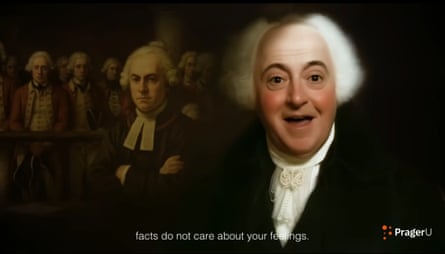
“I love the founders. I think they’re flawed human beings who nevertheless accomplished great things,” Lengel said. “But I think what [PragerU has] done is they’ve betrayed that whole concept, and they’ve made it into a joke.”
Lengel said he formally asked PragerU to remove his name from its website, but his requests were ignored. “The AI scandal shows they’re not dedicated to learning. They’re dedicated to pushing a political point of view,” he said.
The problem with Lengel’s objections is that few PragerU fans are likely to care. America’s polarized politics have moved into schools, and battle stations have already been taken.
On one side are Streit and her admirers, who seem to authentically believe that PragerU’s work can save the United States from the precipice of decline. “I think America’s parents feel, like me, that we just need to take matters into our own hands,” she said.
And then there are those who look on aghast, as an organization with early ties to oil billionaires, and with an occasionally casual relationship with accuracy, seeks to mold kids at their most impressionable age.
“It’s cradle-to-grave marketing,” Corso-Gonzales said. “They’re trying to constantly expand this propaganda machine.”