 2 months ago
65
2 months ago
65
Pauline Voss, the deputy editor of Nius, a fast-growing rightwing media outlet whose ambition is to be Germany’s Fox News, believes progressive civil society groups in Germany are engaged in a coordinated campaign to “act against their own population”.
That may be why, according to research this year by the progressive pressure group Campact, the far-right Alternative für Deutschland (AfD) filed 295 parliamentary queries targeting left-leaning NGOs last year – more than twice as many as in 2024.
Parliamentary queries in Germany are a legitimate form of democratic control. But campaigners say filing them in such numbers, and all insinuating the same thing – that NGOs’ protected status and public funding gives them unfair political clout – amounts to harassment, intimidation and “an attempt to impose a political narrative”.
Once upon a time, German civil society “served as a counterweight to the state and its institutions”, Voss said last September. “Today, it acts as an extension of the state.” This, she went on, was a threat to “free democratic discourse”. Civil society groups were, in effect, “fighting” the people.
The rule of law depends not only on an independent and effective justice system and a free and plural media, but on a robust system of civil society checks and balances, says the Civil Liberties Union for Europe (Liberties): “Independent institutions that hold governments to account; the ability to access information and to challenge decisions; and for civil society to organise.”
This was the area of most concern in Liberties’ 2026 rule of law report. In Hungary, where Viktor Orbán this month faces a battle to stay in power, those checks and balances have withered. NGOs with even the smallest levels of foreign funding are blacklisted; targeted tax audits, media smear campaigns and legal traps make much dissent prohibitive; LGBTQ+ marches have been effectively banned.
What is the misrule of law series about?
ShowThe rule of law is the set of standards and principles that ensures no one in society is above the law, and that everyone is treated equally, in accordance with the values of democracy and fundamental rights, and under the control of independent courts.
Defined more broadly, it should ensure that authorities use their powers and public resources for citizens’ good. That means, among other things, that people should be accurately and fairly informed by a free and plural media, and able to express their views through civil society organisations and by exercising their right to protest.
To make sure those standards are met, the rule of law requires governments to maintain independent, impartial institutions – including, most obviously, the judiciary.
On 12 April, Hungary will hold a general election in which Viktor Orbán risks defeat. For more than a decade, Orbán has shown how the rule of law can be degraded in a modern EU country.
He has packed the courts with judges loyal to him, and the media with editors happy to parrot his propaganda. He has tyrannised NGOs, and curbed LGBT and other human rights, creating what he has called an "illiberal democracy”.
He may be out next month, but the rule of law is increasingly under threat across Europe. In this series, Guardian correspondents look at the state of the rule of law in four major EU countries: what’s crumbling, and why it matters.
But similar tactics, driven often (though not exclusively) by far-right parties either in power or riding high in the polls, are now being deployed in many other EU countries, including some – such as Germany – with otherwise solid rule-of-law reputations.
The far-right AfD is not the only German party targeting groups opposed to its agenda. Just one day after Friedrich Merz’s centre-right CDU won the general election in 2025, it submitted a formal parliamentary inquiry of its own regarding NGOs.
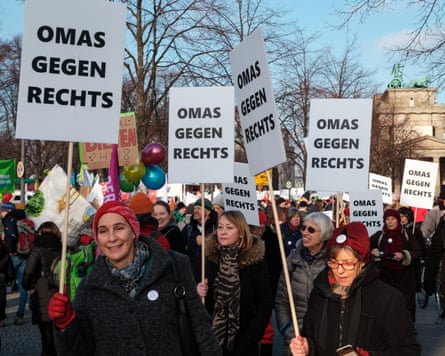
The inquiry contained more than 550 detailed questions about the financing of groups including Greenpeace and Omas gegen Rechts (Grannies against the Right) which had demonstrated during the election campaign against what they described as the CDU’s lurch to the right.
“We were speechless and angry,” Kerstin Neurohr, of Grannies against the Right, told German media at the time. “And each of us realised: our work will remain necessary for the foreseeable future; somehow, things are just getting worse.”
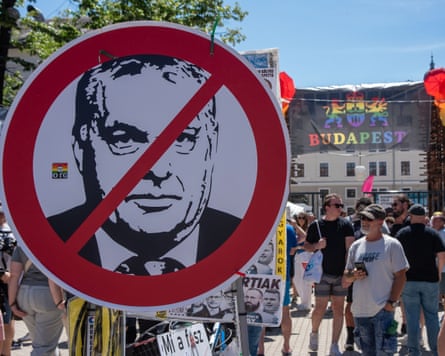
Critics said the inquiry echoed repressive moves against civil society in Hungary and Slovakia, both ruled by nationalist, authoritarian governments. The targeted NGOs spoke of a chilling effect, with fears they could lose their tax-exempt status if their work is deemed to be too political.
In parallel with growing political pressure on civil society organisations, and in common with other countries around Europe, Germany has also imposed what Liberties calls “massive restrictions on the freedom of expression and assembly”, affecting particularly climate and Palestine solidarity demonstrations.
Groups critical of the government’s support for Israel and its war in Gaza have called out what they call heavy-handed tactics in restricting protest rights, with clashes between police and demonstrators at pro-Palestinian rallies common in Berlin.
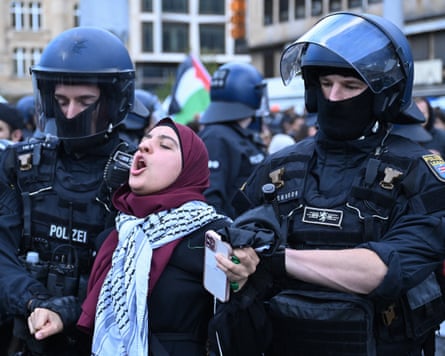
Authorities have accused activists of creating an “aggressive atmosphere” but participants and observers have repeatedly denounced what they say are excessive and unprovoked attacks against protesters by police using pepper spray, water cannon, batons and hand grips deliberately intended to cause pain.
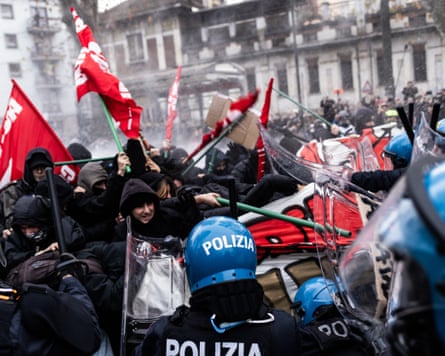
A similar picture emerges in Italy, where Giorgia Meloni’s ruling coalition has made restoring “law and order” a priority since taking office in October 2022. In April last year, it pushed through – by decree, so bypassing political and technical debate – a draconian new security bill introducing a range of new crimes affecting activists, minorities, and its opponents.
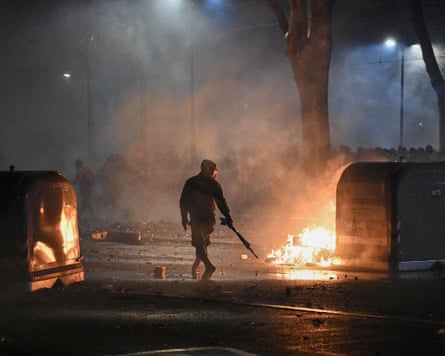
The bill’s provisions, applied for the first time two months later against steelworkers protesting in Bologna, further criminalise various forms of peaceful protest and passive resistance – including, for example, green campaigners blocking roads and demonstrators resisting police.
A second security bill, drafted after violent clashes in Turin over the eviction of a left-wing social centre and approved just in time for the Winter Olympics, allows police to detain people suspected of being potential agitators for up to 12 hours – before a protest has even begun.
Late last year the far-right Lega party of deputy prime minister Matteo Salvini tabled yet another security bill (the third), with 14 more provisions further criminalising protest and dissent. It included a proposal to demand a deposit from demonstration organisers to cover eventual damages.
Riccardo Magi, the president of the leftwing party Più Europa (More Europe), said the overall trend showed clear evidence of “a shift towards illiberalism”. Angelo Bonelli, an MP for the Green-Left Alliance (AVS), said it represented “a serious violation of the constitutional right to demonstrate”.
Meloni’s government, led by her Brothers of Italy party, which has neo-fascist roots, has also moved against civil society groups and NGOs – most notably those operating search and rescue ships in the Mediterranean.
A series of government decrees has led to the “administrative detention” of rescue vessels and support aircraft, plus stiff economic sanctions against the groups that operate them. In July last year, 32 search and rescue NGOs said this meant that since 2023, they had spent a total of “960 days in port, instead of rescuing lives at sea”.
Due to Rome’s headline measures, very few NGOs now operate in the Mediterranean. But while the policies have led to a decrease in the number of people arriving in Italy by boat, deaths at sea remain high.
Checks and balances have also weakened in France. In July, more than 30 leading NGOs including Greenpeace and Oxfam signed an open letter warning of a “worrying” trend, with civil society groups routinely subjected to “threats, surveillance and defamation” in a campaign of attempted intimidation.
“Administrative dissolutions”, a measure initially devised in the 1930s to combat fascist leagues, were used or threatened by the French government in 2025 against several citizen movements, including environmental activists and a pro-Palestine group.
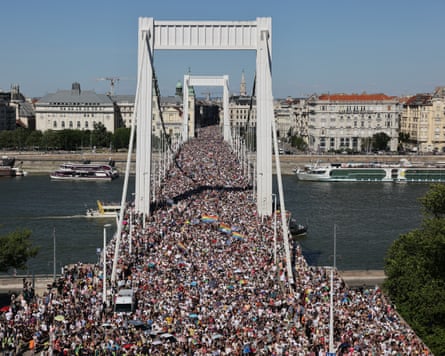
Route restrictions or outright bans on demonstrations, police violence – a longstanding problem in France – and the withdrawal of public subsidies or premises were all contributing to “a dangerous restriction of civic space”, the letter’s signatories wrote.
Poland, meanwhile, which experienced eight years of nationalist rule by the previous Law and Justice (PiS) government, serves as a reminder of how important a vibrant civil society can be.
Caught between the war in Ukraine, a rise in support for far-right parties and a hostile president with the power of veto, Donald Tusk’s administration has made some controversial decisions. But civil society organisations, in Liberties’ words, “uphold standards, and sound the alarm”.
As the French letter-writers put it, they are “the beating heart of our democracies. They raise awareness, protect, and defend the public interest.”
In the face of a Europe-wide trend towards “the normalisation of repression”, where “the defence of human rights is increasingly equated to extremism”, it is time, they said, “to raise our heads and resist, together”.