1 month ago
35
1 month ago
35
In the midst of Oscar season, it becomes evident just how much work it takes to win an Academy Award, both in on-screen work and off-screen campaigning. Consider, however, that multiple actors have won more than one Oscar. (Emma Stone, one of this year’s best actress nominees, won twice in the past decade.) Only a single cat, meanwhile, has twice won the Patsy – the Picture Animal Top Star of the Year. (The award, given by the American Humane Association, not to be confused with the Humane Society, was discontinued in 1986.) That cat is Orangey, the subject of a small retrospective at New York City’s Metrograph cinema. Plenty of rep houses will play a movie like Breakfast at Tiffany’s around Valentine’s Day; the Metrograph is going deeper into the Orangey catalogue for a wider variety of titles and genres.
Breakfast at Tiffany’s does offer Orangey his most famous role: the rather less colorfully named Cat, pet of Holly Golightly (Audrey Hepburn), who calls him a “poor slob without a name”. Orangey features heavily in the film’s climax, when Holly releases her pet into an alley as she prepares to leave town, only to have Paul (George Peppard) rush to retrieve him. It completes a running thread that Cat is a part of Holly’s wildness as well as her potential domestication. What better animal, of course, than one equally prone to draping himself over his makeshift mistress and making yowling leaps around her apartment?
The Audrey Hepburn classic won Orangey his second Patsy; his first was for a bigger role in Rhubarb, a comedy from a decade earlier about a cat that inherits ownership of an eccentric rich man’s estate, including a Brooklyn baseball team. This sounds like a proto-Air Bud – there’s nothing in the rulebook that says a cat can’t own a baseball team! – but Rhubarb appears to have been made with adults at least nominally in mind. It’s a 50s screwball comedy, which is to say it’s pokier than its classic-era counterparts from a decade earlier, and feels padded out (if still amusing) at 95 minutes. Still, Orangey steals plenty of scenes; even more than in Breakfast at Tiffany’s, this cat leaps heedlessly between furniture items, at one point parking himself atop a chandelier. He’s far more memorable than his agreeable two-legged co-stars.
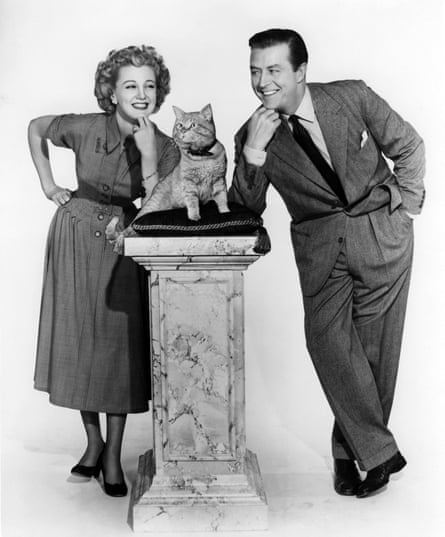
Human stars do maintain one advantage, though. There is only one Audrey Hepburn and there are, admittedly, somewhere between two and 40 Orangeys. At least two cats actually played Cat in Breakfast at Tiffany’s, and in general it’s difficult to draw any straight lines across Orangey’s biologically feasible but logistically questionable 16 years of credits. Deeper research into his career tends to lead to conflicting reports. Film-maker and critic Dan Sallitt wrote a bit about Orangey for Filmmaker Magazine, locating a passage from the book Amazing Animal Actors explaining that the making of Rhubarb actually involved recruiting a whopping 60 different-but-similar-looking cats – the movie is in black-and-white, so perhaps a precisely matching hue was not a great concern – and selecting 36 particularly trainable cats, each doing an assigned trick, to create a single composite performance. (This only defies belief in that, as much as Rhubarb the cat does in the movie, I’m not sure we see 36 distinct tricks.) A contemporaneous New York Times article puts the number of Rhubarbs at 10, though director Arthur Lubin does describe a “principal” cat who bit him, prompting the director to “retaliate with a shrewd kick” while the Humane Association representative wasn’t looking. This does seem compatible with the Rhubarb character, who is largely disagreeable at first.
Watching the cat performances both within the movies and across the different titles certainly lends credence to the idea that Orangey was more a cat type, provided by trainer Frank Inn, than a specific animal. Two films in the Metrograph retrospective showcase Orangey’s genre versatility: he supposedly has a small part in the western Stranger on Horseback, and more of a supporting role in the horror goof The Comedy of Terrors – both films directed by Jacques Tourneur, who also, appropriately enough, made the 1942 classic Cat People. (That was before your time, Orangey.) But despite the shared director, these two cats seemingly aren’t much alike in temperament or performance style. The animal in Horseback lounges around a lawman’s office like an unbothered and casually cuddly bodega cat; the one in Terrors (made when Orangey would have been at least 13) zips around with the vigor of a cat half his age. Maybe he was invigorated by the prospect of sharing scenes with an all-star cast of horror icons; with Vincent Price, Basil Rathbone, Boris Karloff and Peter Lorre on hand, this may be Orangey’s most stacked ensemble (due respect to Ms Hepburn).
It’s more fun, of course, to imagine Orangey embarking upon a singular 16-year career, rather than flitting in and out of random scenes from various films. In that sense, his spiritual successor is the orange-ish cat from Inside Llewyn Davis, also played by several felines, described by director Joel Coen as “a pain in the ass.” As Coen says, dogs often want to please people; cats have little such interest, which of course only winds up drawing our attention further. It’s like watching a baby in a movie; you’re struck by the cuteness and then, perhaps, by the uncanny sensation that for a moment you’re watching someone on screen who cannot actually be acting in the traditional sense. For the babies and the cats, the scenes are real, regardless of whether they involve absurd plots, murderous funeral directors or fake socialites (and also regardless of whether the cat in question cares at all). Even the most intense adult human actors are pretending. Orangey, in all of his indeterminate forms, actually lives the movies.