 3 months ago
74
3 months ago
74
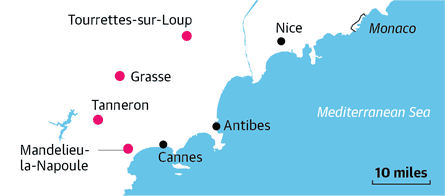
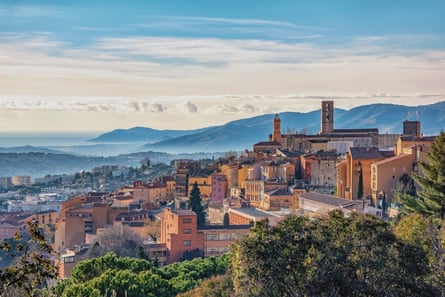
As I take my seat in Galimard’s Studio des Fragrances, in the Provençal town of Grasse, I limber up my nostrils for the task ahead: to create my own scent from the 126 bottles in front of me. Together they represent a world of exotic aromas, from amber and musk to ginger and saffron. But given that I have left the grey British winter behind to come here, I am more interested in capturing the sunny essence of the Côte d’Azur.
Here in the hills north of Cannes, the colours pop: hillsides are full of bright yellow mimosa flowers, violets are peeping out of flowerbeds and oranges hang heavy on branches over garden walls, even though it’s not yet spring. It is the perfect antidote to the gloom back home, and the chance to bottle these very scents is a joy.
Over the next two hours, with the help of perfumery expert Manon Zamoun, I blend my own perfume that I name “Mimosa trail”. The scents (natural essences or synthetic aromas), are set out on three shelves, the top shelf for the high notes, the bottom for base notes, with the heart notes in between. I sniff, blend and decant; it’s the most rewarding chemistry lesson of my life.
The bottles’ labels are turned away from me so my choices are led by my nose not my brain. I’m surprised to find I liked parma violets and patchouli, while rose d’orient and fleurs de lilas don’t make the cut.
Galimard is Grasse’s oldest perfume house, established in 1747. The trade grew out of the town’s leather tanning industry; with scents created to cover the pong, it became the “perfume capital of the world”. Its other two famous perfume houses, Molinard and Fragonard, opened in 1849 and 1926 respectively, later joined by big names such as Dior, Guérlain and Chanel.
But beyond perfume, Grasse is a delight to wander – a maze of yellow-hued streets, overlooked by towering palm trees and, today at least, a welcome blue sky, though there’s still a little chill in the air. I take comfort in the fact it’s 10 degrees warmer than it is back home because I’m here to fast-forward spring with a short road trip between the lesser-known villages and towns of the Côte d’Azur.
En route to Grasse, I’d stopped at Tourrettes-sur-Loup for another of the region’s flowers: violets. When seen from the south, the village is a jumble of terracotta-roofed houses clinging to a clifftop. It’s known for its tradition of growing the small, purple blooms, and has supplied the perfume industry since Queen Victoria visited in the late 19th century while wintering in Nice, 18 miles (30km) south west of here. The queen gave her name to the variety that was, in her day, cultivated by 40 families in Tourrettes and, thanks to its long stalk, was traditionally given in small posies between Christmas and Valentine’s Day.
At La Bastide aux Violettes, a small museum on the outskirts of the village, I discover more about the flower and its history, and inhale its sweet, delicate scent in the greenhouse, where they grow in vertical columns. There are now only three producers, including Jérôme Coche and his family, who turn the petals into products such as crystalised violet sweets. The village still celebrates the end of the season with La Fête des Violettes in late February/early March, which attracts about 12,000 people (some on coach trips from Italy) with carnival floats, dancing, music and a flower and produce market.
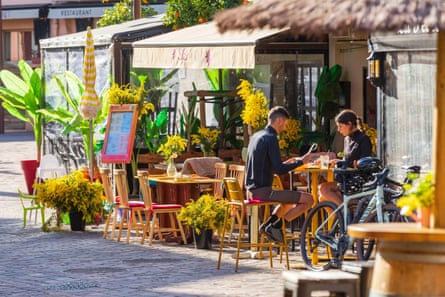
Out of season the village is quieter, awaiting the summer crowds. Wine bar-restaurant La Cave de Tourrettes is buzzing with life though, even on a wet Wednesday evening, and my two-course meal is a superb beef tartare with grana padano, caper berries and cornichons, followed by pork filet mignon and orange-scented sweet potato with braised leeks (mains from €25.50). The next morning, the sky is a blaze of blue and I eat breakfast on the balcony of my townhouse apartment, with a lovely view of the valley towards the Mediterranean.
The sun is also shining in Mandelieu-la-Napoule, on the coast, my last stop. Mimosas were just starting to come into bloom on the dramatic route between Tourrettes and the village of Gourdon, which winds through the Gorge du Loup, with its waterfalls, tunnels and steep cliffs – but down on the coast, spring has really sprung.
La Route du Mimosa is a trail through the most impressive blooms, covering 80 miles from Bormes-les-Mimosas to Grasse. Around the town of Mandelieu-la-Napoule – which hosts the Fête du Mimosa, a weekend of celebrations to mark the start of the season in February – there are group hikes into the hills organised by the tourist office, as well as farms to visit and shops where producers have turned its delicate flavour into jams and cordials, and its scent into candles and soaps.
For a thrilling ride and to gain some local knowledge I’ve booked a three-hour tour with La Grande Vadrouille (€160 for one or two). Local guide Daniel Saffioti welcomes me to ride in the side-car of his Chang Jiang Pekin Express motorbike. Daniel knows all the best routes from Mandelieu to Tanneron, a town farther inland where you find mimosas in abundance. After donning my helmet and sunglasses, we set off along the coast road, La Corniche d’Or.
This sinuous route southward to the Cap d’Esterel offers astonishing views of Cannes and its backdrop, the snow-capped Mercantour mountains of the Alpes-Maritimes. Along the road, mimosas burst between palm trees and over the garden walls of luxurious villasWe double back toward Mandelieu, and then motor on into the hills, stopping for a rest just outside Tanneron, where the landscape is a tapestry of olive groves, eucalyptus trees and lavender fields awaiting their summer blooms. A closer inspection of a mimosa tree allows me to breath in its delicate scent and see its fern-like leaves and tiny flowers up close – like little yellow pompoms electrified by the sunshine. Daniel tells me how they were introduced by the British, having been brought from Australia (they are a kind of acacia) and how council workers work hard to keep them from taking over the landscape and roadsides, such is their propensity to thrive in the Provençal climate.
Our tour finishes in Mandelieu and after bidding Daniel farewell, I sit on the terrace of the Biskota cafe for lunch and a mimosa-infused lemonade. In the evening is the opening of the Fête du Mimosa. Gingham-clothed tables and benches are laid out for locals to sit and drink wine and street performers, some on stilts, dance through the crowds. Tomorrow there will be floats adorned with flowers, but tonight a firework display shoots up over the crenellated walls of the waterside chateau. I breath in the sulphurous tang that hangs in the air; it may not be the floral scent of spring, but it doesn’t matter – I’ve got a bottle of that in my bag.
The trip was provided by Côte d’Azur Tourism and Mandelieu-La-Napoule Tourism. La Borgarda in Tourrettes-sur-Loup has a one-bedroom apartment from €195 a night and a three-bedroom townhouse from €330 a night. The Pullman hotel has doubles from £130. Perfume blending at Galimard’ Studio des Fragrances is €99pp
Carolyn Boyd is the author of Amuse Bouche: How to Eat Your Way Around France (Profile, £10.99). To support the Guardian, order your copy at guardianbookshop.com