2 hours ago
1
2 hours ago
1
The world is closer than thought to a “point of no return” after which runaway global heating cannot be stopped, scientists have said.
Continued global heating could trigger climate tipping points, leading to a cascade of further tipping points and feedback loops, they said. This would lock the world into a new and hellish “hothouse Earth” climate far worse than the 2-3C temperature rise the world is on track to reach. The climate would also be very different to the benign conditions of the past 11,000 years, during which the whole of human civilisation developed.
At just 1.3C of global heating in recent years, extreme weather is already taking lives and destroying livelihoods across the globe. At 3-4C, “the economy and society will cease to function as we know it”, scientists said last week, but a hothouse Earth would be even more fiery.
The public and politicians were largely unaware of the risk of passing the point of no return, the researchers said. The group said they were issuing their warning because while rapid and immediate cuts to fossil fuel burning were challenging, reversing course was likely to be impossible once on the path to a hothouse Earth, even if emissions were eventually slashed.
It was difficult to predict when climate tipping points would be triggered, making precaution vital, said Dr Christopher Wolf, a scientist at Terrestrial Ecosystems Research Associates in the US. Wolf is a member of a study team that includes Prof Johan Rockström at the Potsdam Institute for Climate Impact Research in Germany and Prof Hans Joachim Schellnhuber at the International Institute for Applied Systems Analysis in Austria.
“Crossing even some of the thresholds could commit the planet to a hothouse trajectory,” said Wolf. “Policymakers and the public remain largely unaware of the risks posed by what would effectively be a point-of-no-return transition.
“It’s likely that global temperatures are [already] as warm as, or warmer than, at any point in the last 125,000 years and that climate change is advancing faster than many scientists predicted.”
It is also likely that carbon dioxide levels are the highest they have been in at least 2m years.
Prof Tim Lenton, an expert on tipping points at the University of Exeter in the UK, said: “We know we are running profound risks on the current climate trajectory, which we can’t rule out could turn into a trajectory towards a much less habitable state of the climate for us. However, we don’t need to be heading towards a hothouse Earth for there to be profound risks to humanity and our societies – these will already be upon us if we continue to 3C global warming.”
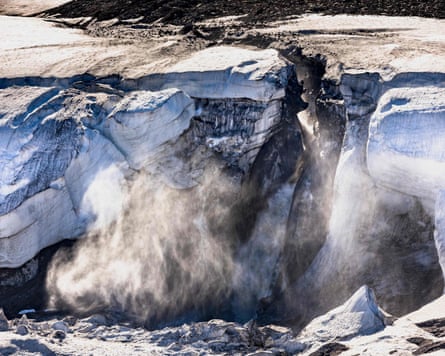
The assessment, which was published in the journal One Earth, synthesised recent scientific findings on climate feedback loops and 16 tipping elements. The tipping elements include the Greenland and Antarctic ice sheets, mountain glaciers, polar sea ice, sub-Arctic forests and permafrost, the Amazon rainforest and the Atlantic meridional overturning circulation (Amoc), a system of ocean currents that strongly influences the global climate.
Tipping may already be happening in Greenland and west Antarctica, with permafrost, mountain glaciers and the Amazon rainforest appearing to be on the verge, the scientists said.
“Research shows that several Earth system components may be closer to destabilising than once believed,” they concluded. “While the exact risk is uncertain, it is clear that current climate [action] commitments are insufficient.”
Prof William Ripple, at Oregon State University, US, who led the analysis, said: “The Amoc is already showing signs of weakening, and this could increase the risk of Amazon dieback. Carbon released by an Amazon dieback would further amplify global warming and interact with other feedback loops. We need to act quickly on our rapidly dwindling opportunities to prevent dangerous and unmanageable climate outcomes.”
Scientists warned in 2018 of the prospect of a hothouse Earth. In this scenario, global temperature stays significantly above the 4C rise of current worst-case climate scenarios for thousands of years, driving a huge rise in sea level that drowns coastal cities. The scientists said then that the “impacts of a hothouse Earth pathway on human societies would likely be massive, sometimes abrupt, and undoubtedly disruptive”.