 2 hours ago
1
2 hours ago
1
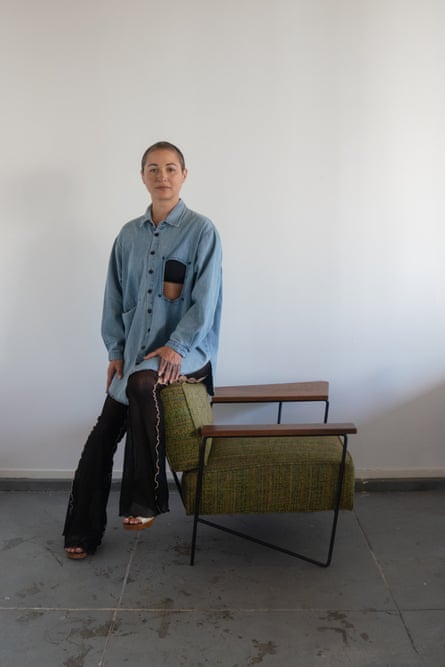
In 1945, during the Battle of Okinawa, the great-uncle of the Japanese-American, Los Angeles-based artist Jacqueline Kiyomi Gork was stationed on the island as a US solider, having volunteered for service probably in the hopes that his family might be spared from the Japanese internment camps back home. They weren’t, and so while his siblings and parents were incarcerated at Tule Lake in northern California, he was on the frontlines in what has been deemed one of the bloodiest conflicts in the Pacific during the second world war.
The caves of Okinawa were used “almost as bunkers to protect people”, Kiyomi Gork explains. “But they were also spaces of mass suicide because of Japanese propaganda.” Local Uchinanchu who took refuge there were instructed by Japanese soldiers to kill themselves, rather than face what they were told would be a violent fate at the hands of the US army. As one of the few American soldiers who spoke Japanese, Kiyomi Gork’s great-uncle worked to ensure their safe passage.
The parallel experiences of the Uchinanchu in the caves and Japanese-Americans interned at Tule Lake – that have been silenced by decades of repressed trauma and historical whitewashing – sit at the heart of Kiyomi Gork’s forthcoming exhibition, Gama 1213-B, at Canary Test, an experimental arts space in downtown Los Angeles. “The camps are something difficult to address because there’s been so much silence and shame around them,” she explains. “I grew up with an inherited shame around being Japanese, like not being able to speak or read the language or acting like a Japanese girl should. There are a lot of problematic western expectations around what being Japanese is. It was a topic that I never felt comfortable addressing in my home or in myself until I got older.”
It was only when Donald Trump started creating more immigrant detention centers in his first term that her family began to talk about the eerie similarity of these centers to the interment camps. Then, when the war broke out in Gaza “I just stopped,” Kiyomi Gork says. “I needed to make work about what was happening. And for me the way I could do that was through my family and their relationship to history.”
This prompted her to visit the caves of Okinawa. Sitting alone in a quiet, damp space, Kiyomi Gork found herself listening to a trickle of water at the bottom of the caves. “People generally like the sound of water,” she remarks, because “we need it to survive, so the sound of it is enhanced by that mortal need”. But in the caves, Kiyomi Gork recalls that the water sounded “menacing and unnerving”. This prompted her to consider how her perspective of the space – informed by all that she knew and didn’t know about the Battle of Okinawa, her great-uncle’s service, the lasting scar that the war left on her family and all Uchinanchu, and the island’s continued military occupation – changed her relationship to something that is, in most other contexts, innately comforting.
Working in sound, installation and sculpture for over 20 years, Kiyomi Gork routinely explores how sound affects movement and movement affects sound; blurring boundaries between performer, audience and architecture; and often, for example, creating feedback loops that enhance the sound of the viewers’ own movements in the space of the exhibition. Gama 1213-B represents a departure from this modality. “It’s less of a choreography in the space and more of letting the sound happen around you, less you creating the sound with your body,” she says. Titled after the Uchinaaguchi word for cave (gama) and the number of her grandfather’s barrack at Tule Lake (1213-B), the exhibition at Canary Test will feature a recent sculptural work and a newly created ambisonic sound piece – alongside a selection of books from Kiyomi Gork’s research and her grandparent’s collection – that honor the charged, intentional and yet uncontrollable silences of these sites.
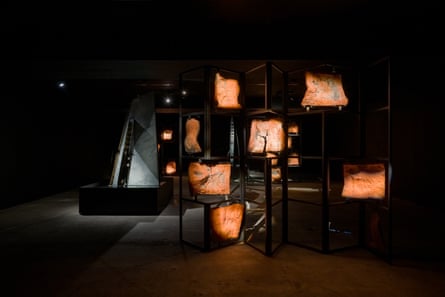
With clay sourced from the caves in Okinawa, Kiyomi Gork recreated sections of the cave walls as large ceramic tiles, using a mold based on 3D scans of its surface. Inset within a gridded, metal folding screen, these quasi-archeological fragments mimic the sonic effect of the cave’s multifaceted surface which possesses so many angles for sound to bounce off that echoes and reverberations are effectively deadened.
Kiyomi Gork’s ambisonic sound piece about Tule Lake recreates a different kind of silence. Visiting the site – which is now an airplane field that bears little acknowledgment of where the barracks previously stood, or the people they incarcerated – the artist recorded what remains: sounds of the wind and the open air. She processed this recording through a virtual barrack (working with a sound lab at a structural engineering company in Los Angeles) to simulate what it might have sounded like inside the structures.
“I’ve gone through a lot of video footage about the camps,” Kiyomi Gork says. “But no one really talks about how it felt or [the specifics of] how it sounded.” Both this piece, and her sculpture, consequently live in something of an liminal space, oscillating between the physical structures that have been documented and the experiences of them, which can only be imagined.
The line of inquiry into her Japanese-American and Uchinanchu roots exemplified by this exhibition, which Kiyomi Gork describes as an unfinished and potentially endless project, is “more about the unknown than anything”, she explains. “About being OK with not knowing. Or being OK with the fact that there is this huge silence, and honoring that.”
As much as Gama 1213-B is a sonic and sculptural memorial to individuals on both sides of the Pacific, how anyone connects with an unknown nevertheless remains unknown. “For me, at least, it’s through time,” Kiyomi Gork says. “This is a time-based work, so it’s through spending time with it, almost like a meditation, [that one can] sit with and acknowledge [what happened].”
-
Gama 1213-B is on show from 12 February to 20 March at Canary Test in Los Angeles