
 3 hours ago
4
3 hours ago
4
In the back of Black Seed Bagels in northern Brooklyn is a giant catering kitchen filled with industrial-size containers of condiments and freezers full of dough. A tall, silver electric oven named the Baconator stands in a far corner, cooking thousands of pounds of meat every week to accompany Black Seed’s hand-rolled, wood-fired bagels. The Baconator is connected to a battery the size of a carry-on suitcase, which is plugged into the wall.
While the morning rush is under way, the 2.8-kilowatt-hour battery can directly power the commercial oven to reduce the company’s reliance on the electric grid, Noah Bernamoff, Black Seed’s co-owner, explained recently at the company’s Bushwick shop. Two more batteries are paired with energy-intensive refrigerators in the front.
Businesses like Black Seed often pay hefty demand charges on their utility bills that reflect the maximum amount of power they use during a month – costs that can represent as much as half their total bill, on average. By shifting to battery power during key times, Black Seed aims to lower its peak grid needs and reduce monthly fees from the utility Con Edison in the process.

Black Seed is part of a battery pilot programme run by David Energy, a New York-based retail energy provider. The startup supplied the batteries for free last August and, using its software platform, controls exactly when the three appliances draw on backup power. Vivek Bhagwat, David Energy’s head of engineering, said he expected that tapping batteries for the refrigerators – which are always humming – would be especially helpful during the hottest months, when the shop’s air conditioners run around the clock.
“We’re pretty optimistic about our ability to curtail energy in the summer, when it really matters most, through this machine,” he said, standing beside a doorless fridge holding water, juice and soda.
For Black Seed, even modest benefits from batteries could make a difference if multiplied across the company’s 10 locations in New York City, Bernamoff said. By way of example, he noted that saving $80 at every shop every month could add up to almost $10,000 a year in avoided utility costs.
“We’re in the game of nickels and dimes,” he said of the bagel business. “So we’re always happy to save the money.”
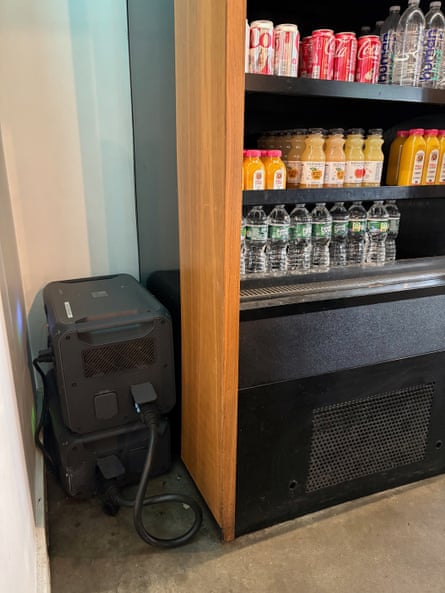
James McGinniss, David Energy’s CEO, thinks this “do-it-yourself battery” strategy has some serious potential to help small businesses combat rising electricity costs, both in New York and beyond. As well as in Black Seed’s Bushwick shop, his company has installed batteries at fast-food restaurants, a day spa and a dog grooming store, where the battery is cushioning the power draw of a fur-drying machine.
As of mid-January, David Energy has signed deals with customers to put plug-in batteries in about 50 locations, adding up to more than 500kWh of energy storage capacity.
The startup’s plug-in battery pilot is building on the growing interest in DIY energy technologies worldwide. McGinniss cited the example of balcony solar systems that can plug into standard household electrical outlets, which are big in Germany but aren’t yet allowed under most current electrical codes in the US – although state lawmakers in New York and elsewhere are pushing legislation to change that.
Backup batteries, however, are ready for market. Portable batteries are increasingly affordable and popular options for households that are looking for backup power during blackouts but cannot, or don’t want to, install fossil fuel-burning generators.

As a retail energy provider, David Energy competes with large utilities and other energy retailers to provide customers with cheaper electricity plans. It does so primarily by buying electricity from wholesale markets and then reselling it to businesses and households. But the battery pilot is part of the company’s broader long-term goal to “run the grid 24/7 on clean energy,” McGinniss said.
As solar and batteries have become “the cheapest electron we can create”, giving customers access to those technologies has become a business priority for David Energy as well – “because people like cheap energy,” he said.
But how can a retail energy provider recoup the cost of supplying batteries to customers for free? McGinniss did not disclose the current financials for David Energy’s no-cost battery programme. But he did say the devices offered money-saving opportunities for customers and money-making ones for his business that could expand over time.
For customers, the fundamental proposition is the opportunity to reduce a big, hard-to-manage portion of their monthly utility bills – the demand charges. Unlike the per-kWh “volumetric” charges that most households pay, these particular fees are assessed based on the maximum amount of power a business draws from the grid during any 15-minute period within a month. The structure is designed to incentivise customers to reduce peak electricity use, which drives much of the cost for utilities of building and maintaining grid infrastructure.
For New York City businesses, these demand charges can add up to between 15% and 50% of a typical commercial customer’s monthly bill, McGinniss said. Using stored battery power for big appliances that tend to need a lot of energy during those times could significantly reduce those peaks, he said.
The results can vary greatly from customer to customer, though McGinniss estimated that every kilowatt shaved from that peak could cut about $50 from a monthly bill. That’s a good way for David Energy to entice and retain customers, he said. But the startup can also use the same stored battery power to earn revenues for itself.
One option is participating in so-called demand-response programmes, which pay customers to reduce power use during, for instance, hot summer evenings when demand for electricity is putting power plants and grid infrastructure under stress.
Retail electricity providers such as David Energy can make (or lose) money depending on how cleverly they manage their ever-changing mix of purchases on wholesale energy markets against their commitments to provide their customers with retail power at competitive prices.

Bernamoff at Black Seed Bagels said he was excited by the longer-term possibility of installing not only more plug-in batteries but also large-scale storage systems at its Bushwick location – particularly as city and state policymakers in New York push to electrify buildings. Today, Black Seed primarily uses fossil gas appliances and heating systems in its stores. If the company is required to switch to electrified versions, adding batteries could help it manage its higher electricity bills and limit strain on the local grid, he said.
“The industrial battery side of it all could be really interesting,” Bernamoff said, sitting at a cafe table beneath a poster advertising the store’s scallion-kimchi cream cheese. “To the extent that we’d be able to reduce peak power at the service level, instead of piece by piece, now we’re really talking. Because then every outlet, every lightbulb, is being better managed and reduced.”
-
A version of this article was originally published in Canary Media and has been republished in the Guardian as part of our ClimateDesk partnership.