 3 hours ago
4
3 hours ago
4
‘If you want to paint, put your clothes back on!” That was how Carolee Schneemann summarised the critical response to her 1975 performance piece Interior Scroll, which she had performed nude standing on a gallery table. After making a series of life model poses, she removed a scroll from her vagina and began to read her manifesto. In doing so, Schneemann asked an important question: “What does it mean for a female artist to be both the artist and the life model?” Or as she put it: “Both image and image-maker?”
The female nude, as depicted and objectified by the male artist, has dominated western art for centuries. Despite decades of feminist efforts, that interaction between the great male genius and his female model – sometimes muse – remains a subject of perennial fascination. To enter a gallery, or to open a university textbook, is to be confronted with a parade of idealised naked females by male artists from Rubens, Titian and Botticelli to Picasso and De Kooning.
When Gwen John stood in her bedroom in 1909 sketching herself nude, her body reflected in a wardrobe mirror, what was she thinking? At the time, she was in the midst of a passionate, unhappy affair with Auguste Rodin, for whom she frequently posed. To pose for herself, though, was different, not to mention daring. John struggled to be her own muse, as opposed to Rodin’s, but this image shows her free from the male gaze.
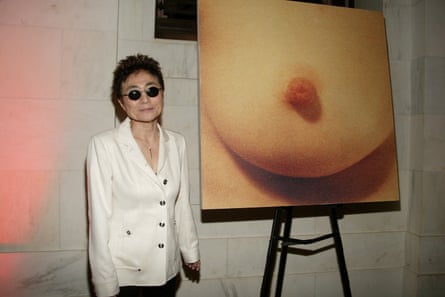
Like many women, the female body – and what it means to live in it – has preoccupied my thoughts throughout my life. Yoko Ono’s portraits for her series My Mommy Is Beautiful are shot from an angle at which we probably all encounter the female body as infants: looking up at our mothers from below. I was 13 or 14 when I read the poem Standing Female Nude by Carol Ann Duffy, told from the perspective of an artist’s model: “Belly nipple arse in the window light, / he drains the colour from me. / Further to the right, / Madame. And do try to be still.”
Its quietly devastating final line – “I say / Twelve francs and get my shawl. It does not look like me” – profoundly shifted my perspective, and is now one of the epigraphs to my novel, Female, Nude. The story follows Sophie, a painter commissioned to make a portrait of a female friend while they are on holiday in Greece, and at the same time embarks on an affair with that friend’s ex-lover. It is through Sophie’s engagement with other female artists, all of whom have made nude self-portraits, that the reader learns about her inner world. The novel is punctuated by vignettes that see Sophie standing in front of these works in different galleries, and at varying stages of her life, addressing each artist directly in imagined conversations about art and the female body.
The novel grew from the idea of female nudes created by women, particularly self-portraits. For much of western art history, women did not have access to nude models and, if they were brave enough, had to rely on their own bodies. The work they produced was often met with outrage, dismissal, mockery or indifference. To some, Schneemann’s Interior Scroll was a groundbreaking work reclaiming hundreds of years of historical baggage when it comes to the female nude. To others, it was tasteless pornography. Because when a female artist takes authority over depictions of her nudity, it can only be political. It is always a threat to the status quo. (Schneemann had already got in trouble at art college for painting male nudes, an act that was considered almost as disruptive.)
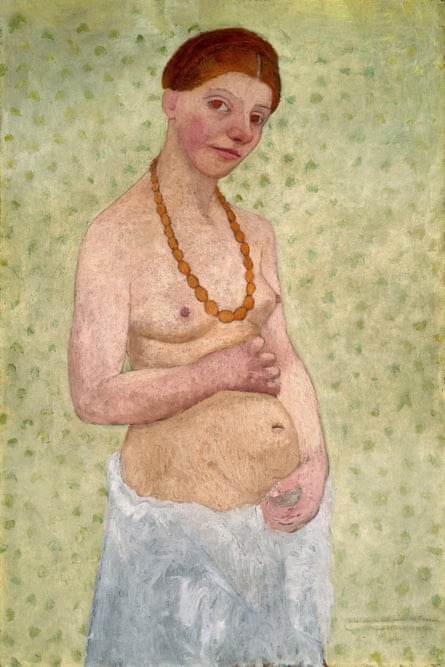
Like Schneemann, the Indian-Hungarian artist Amrita Sher-Gil would cause a furore at school for wanting to paint nudes. In the end, she was kicked out. Sher-Gil went on to paint herself topless in her 1934 work Self-Portrait As a Tahitian – a tribute to Gauguin, or an appraisal of his colonial male gaze, depending on your outlook. The ruthlessness of Gauguin’s gaze crops up again in the work of Emma Amos, who often used her groundbreaking art to critique the whiteness and maleness of the artistic canon. The Amos “nude” I chose to include in my novel is 1994’s Work Suit, in which she wears Lucian Freud’s naked body like a garment in a statement that is both scathing and satirical. She is asking: “Is this what it means to be a great artist?” Amos, who died in 2020, still hasn’t been given her due.
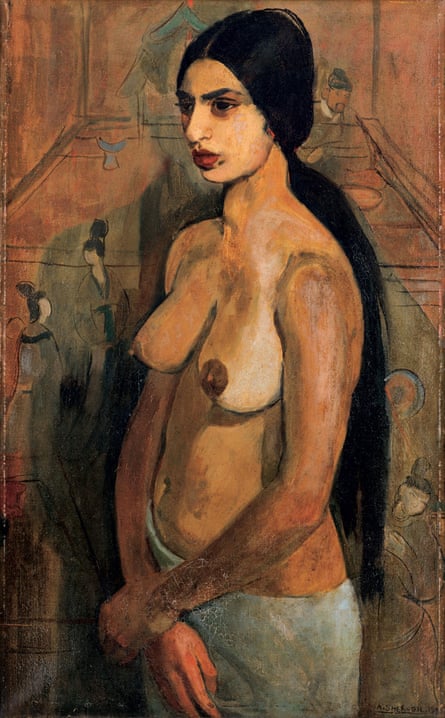
As far as I know, no history of the female nude self-portrait has been published, so I set about compiling my own. Officially, the first was made in 1906, by Paula Modersohn-Becker, and it is this painting that opens the novel. The joy of being a novelist, as opposed to an academic, is that you are able to take liberties. Not for me the debate as to whether Artemisia Gentileschi’s nudes count as self-portraits or not, despite the fact that so many of them quite clearly have her face. She’s in my canon which, as well as Amos, includes performance art, from Interior Scroll to Yoko Ono’s Cut Piece (in which members of the audience cut off pieces of Ono’s clothing). Ana Mendieta’s Silueta series of “earth-body” works also features and as does The Woman of Hohle Fels, a mammoth-ivory carving found in a cave, made 40,000 years ago or more.
I looked at photographers, too. Some, like Francesca Woodman, are well known for their depictions of their own bodies. I chose her because her nudes capture the inherent strangeness of living in a young woman’s body, an experience that can feel uncanny, gothic almost, but also erotic, powerful, fraught with irony. Others, such as Anne Brigman, who was making nude photographs of herself in the Californian desert as early as 1907, are still often overlooked. These I included in my canon alongside paintings that are more straightforwardly painterly works of self-portraiture by Alice Neel, Jenny Saville, Gwen John and Suzanne Valadon, as well as contemporary artists such as Lisa Brice.
At one stage in her life, Suzanne Valadon could have been the model in Duffy’s poem. She was, after all, “Renoir’s dancer”, and worked her way out of poverty by modelling for many other renowned artists, observing how they worked and learning from them. She is known for her frank, naturalistic approach to the female nude, and her own Self-Portrait With Naked Breasts, from 1931, is no different. Like Neel’s famous self-portrait, it shows a woman and an artist who has lived, given birth and aged, her face a bit of a scowl, her breasts a fact, not for ogling.
It is this refutation of the male gaze that unites many of these nudes, but at the same time each of these artists looks beyond it, engaging with what it means to be a woman who makes art in a body that is also the subject of it. Whether it’s ageing (Alice Neel), motherhood (Louise Bourgeois), disability (Frida Kahlo), race (Emma Amos), sexual desire (Tracey Emin), fluidity (Zanele Muholi) or misogyny (Yoko Ono), these artists have done more than expand the definition of the female nude: they have reinvented it in a way that only they could.
To quote Sophie, my protagonist, who is imagining a conversation with Artemisia Gentileschi while standing in front of her Susanna and the Elders, a powerful depiction of misogyny and harassment: “Here I am, you’re saying. Let me show you what a woman can do. Because only a woman could have made this.”