 6 hours ago
14
6 hours ago
14
Have we lost the ability to surrender to a story? Surely, if there’s any narrative that deserves our undivided attention, it’s that of a crown court judge fighting the legal system’s approach to sexual violence against women, when she discovers her own son has been accused of rape. But as Rosamund Pike discovered last weekend, even such a visceral and emotionally demanding drama wasn’t enough to keep everyone in the room absorbed.
Pike made headlines when she walked back on stage at London’s Wyndham’s theatre after the curtain call for Inter Alia – not for a solo bow, but to remonstrate with an audience member for texting during the climax of her performance. “Maybe it was very important, and maybe you’re a doctor, and you’re saving someone’s life, and I hope you are,” she said. “But we do see these, we do feel them. I feel like I’ve got to hold you all, so when I feel that and see it, it’s hard.”
What Pike was describing isn’t really about phone etiquette, however. It’s about our growing inability to be fully present with a piece of art, to sit with it and be absorbed by it, rather than merely skimming its surface.
Pike is not the first to call out poor audience behaviour in theatres. Earlier this year, Cynthia Erivo interrupted her West End performance of Dracula after spotting an audience member filming the show. In 2017, Andrew Scott halted the “to be or not to be” soliloquy in Hamlet when he saw a theatregoer had opened a laptop to send emails. More recently, Lesley Manville criticised audiences who film curtain calls rather than simply applaud. “Clap or don’t clap,” she said, “but don’t just stick up your phone in our faces.”
The same drift has been visible in cinemas for years. The pandemic, coupled with the rise of streaming, changed viewing habits to such an extent that streamers are now asking screenwriters to simplify scripts for viewers who use their phones while watching. I can’t remember the last time I watched a film in a multiplex without someone’s screen glowing in my eye line. Phones ring, people film the title card for their Instagrams. In one recent screening, the man in front of me scrolled through X for almost the entire film.
Even Martin Scorsese has said he no longer watches films in cinemas because of bad audience behaviour. What does it mean when one of the greatest living film-makers has given up on the shared experience his entire career has been built around?
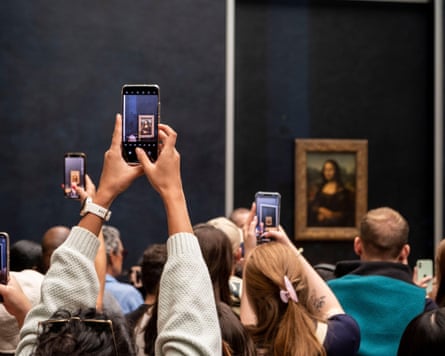
It’s not just dramatic media, too. On BookTok, content creators have revealed that they skip long descriptive passages in fiction and read only the dialogue, consuming the plot while leaving the texture of the writing behind. In museums, crowds gather in front of masterpieces to take selfies, while the painting is barely seen. Increasingly, culture is experienced as content to be documented for likes and shares.
This declining ability to sit with art is a direct consequence of the digital landscape. For years, the platforms through which we increasingly access public life have trained us in partial, interruptible consumption: the infinite scroll, the skip, the 30-second clip. It is, after all, the basis of their entire business model. But the result has been a culture that struggles to believe anything deserves our undivided attention.
Writing in the early 20th century, Virginia Woolf made sustained attention the very substance of her prose – the flicker of light on water, the texture of a London morning, a moth dying on a windowpane. For Woolf and the modernists, paying close attention was not simply a way of experiencing art, it was one of the essential conditions of being human.
Now we have festivals and artists such as Jack White banning smartphones, because the crowd were more glued to their phone screens than what was happening on stage. More theatres are considering Yondr pouches – especially after photos of James Norton nude on stage in A Little Life were leaked in 2023. The fact that we need enforcement measures to create the conditions for attention is itself a reflection of how far things have gone.
Yet attention cannot be restored by a pouch alone. More hopeful are the signs of a cultural backlash: young people posting less on social media, swapping smartphones for dumbphones, and seeking out experiences that resist interruption. It hints at a growing recognition that constant connection comes at a cost.
Great art has always demanded the temporary relinquishment of the self, a willingness to enter someone else’s world. If we lose that capacity, we lose more than the ability to sit through a play without checking our phones. We lose the ability to surrender to a story, and with it the possibility of being transformed by one.
-
Nadia Khomami is arts and culture correspondent at the Guardian