 2 months ago
103
2 months ago
103
Key events Show key events only Please turn on JavaScript to use this feature
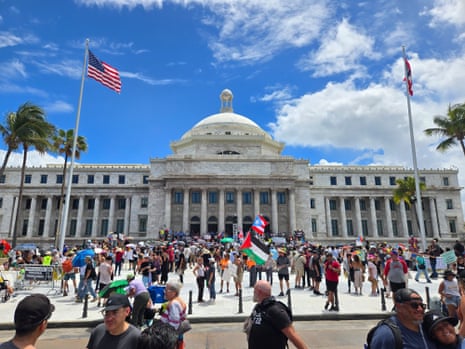
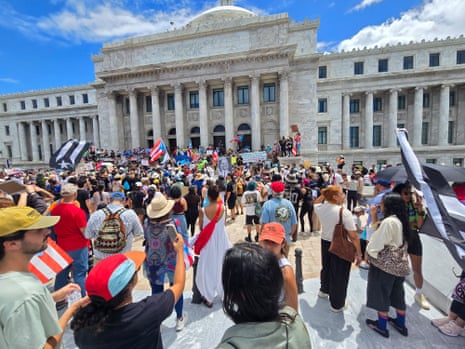
Thousands of demonstrators have gathered outside the Capitolio de Puerto Rico in San Juan where my colleage Joseph Gedeon is reporting.
Here’s a scene of the crowds:
In an op-ed published today, California congressman Ro Khanna said, “The Epstein class thinks it runs America. Today, No Kings protesters send their response.”
“As more Americans are sent to fight abroad and the survivors of abuse are silenced at home, people increasingly feel dispensable,” the California congressman wrote in MS NOW. Khanna co-sponsored the Epstein Files Transparency Act. “For too long, Americans have seen our leaders fight harder for the Epstein class than for the working class. They have watched our system shield elites instead of delivering fundamentals such as affordable health care, housing and education.”
In the year since Donald Trump retook office, the number of protests in the US outpaced those at the same point in his first administration, according to data from the Crowd Counting Consortium, an open-source project collaboration between Harvard University’s Kennedy School and the University of Connecticut, reported Lex McMenamin and Andrew Witherspoon.
There were more than 10,700 protests in 2025, a 133% increase from the 4,588 recorded in 2017, the first year of Trump’s first term. According to the data, an overwhelming majority of US counties – including 42% that voted for Trump – have had at least one protest since he was re-inaugurated last year.
“It is a very historic time, in the sense that people are mobilizing where they live in ways that I don’t think I have seen before in my lifetime,” said Erica Chenoweth, a political scientist at Harvard Kennedy School and co-director of the Crowd Counting Consortium.
Demonstrators are gathering at “No Kings” protests across the country – from the National Mall in Washington to the Twin Cities in Minnesota, where massive anti-ICE protests took place earlier this year after federal agents killed two residents.
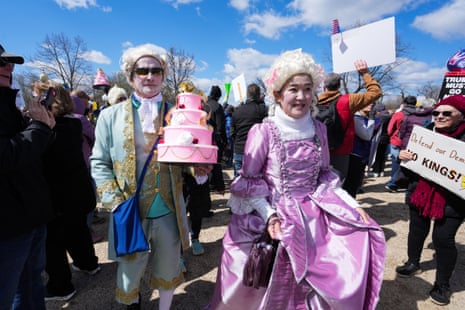
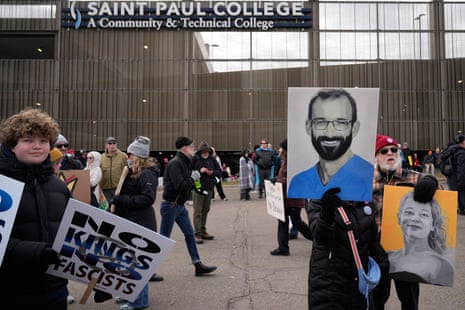
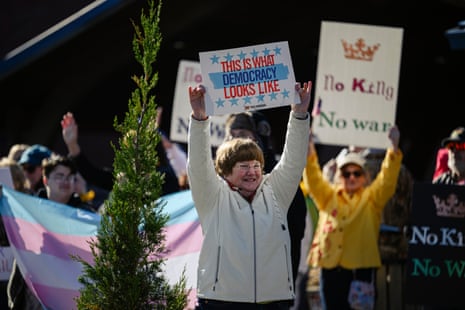
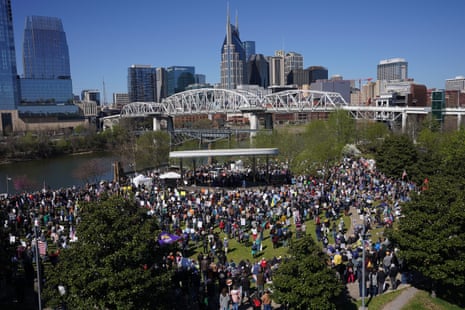
More than 3,000 events are expected to occur in cities and small towns across the country today. Here are some images from the protests occuring in Pennsylvania, Michigan, Kentucky and Tennessee:
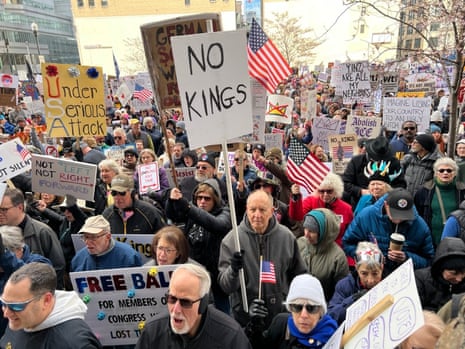
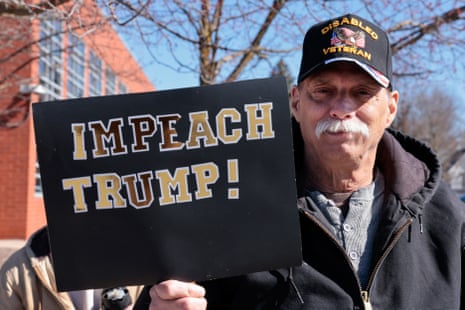
Second No Kings protests in October 2025
Americans across all 50 states marched in protests against the Trump administration in October, aligning behind a message that the country is sliding into authoritarianism and there should be no kings in the US, reported my colleagues Rachel Leingang and Edward Helmore.
Millions of people turned out for the No Kings protests, the second iteration of a coalition that marched in June in one of the largest days of protest in US history.
People in communities big and small came together nationwide with signs, marching bands, a huge banner with the US constitution’s preamble that people could sign, and inflatable costumes, particularly frogs, which have emerged as a sign of resistance beginning in Portland, Oregon.
Melody Schreiber
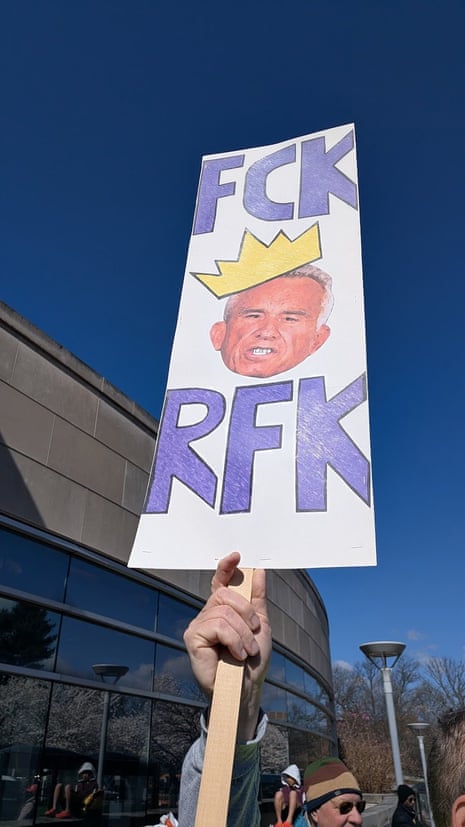
At the National Institutes of Health (NIH) in Bethesda, Maryland, about a thousand people gathered to protest the Trump administration’s cuts to scientific research and wide-ranging policies that have damaged health at home and abroad.
“If we don’t speak up, RFK Jr and Jay Bhattacharya will own the airwaves,” said Nina Friedman, a doctoral candidate at University of Maryland whose research has been supported by NIH.
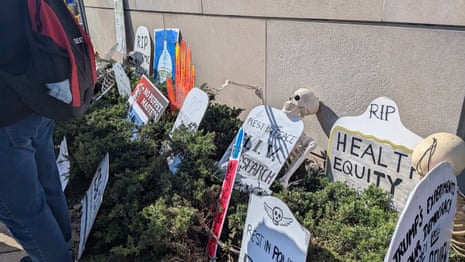
“What I see is one person trying to run science like a king,” said Michael Green, an early career researcher whose work on trust in doctors among Black patients was terminated in the sweeping cuts enacted over the past year. “I study trust for a living,” Green said. “Trust is not gained by going on a podcast,” he added, a reference to the frequent right-wing podcast appearances by Jay Bhattacharya, the head of NIH.

Alaina Demopoulos
The June 2025 No Kings protests were estimated to be among the biggest ever single-day protests in US history.
Working out exactly where the protest ranks compared with similar recent events has been a project of G Elliott Morris, a data journalist who runs the Substack Strength in Numbers, calculated turnout between 4 million and 6 million, which would be 1.2% – 1.8% of the US population. This could exceed the previous record in recent history, when between 3.3 million and 5.6 million people showed up at the 2017 Women’s March to rally against Trump’s misogynistic rhetoric.
Morris estimated the No Kings Day protest turnout in two steps. First, his team gathered data at events for as many locations as possible, defaulting to tallies published in local newspapers. Where that wasn’t available, they relied on estimates from organizers and attenders themselves.
To come up with a rough approximation of nationwide numbers, he then estimated the attendance in each unreported protest would be equal to the median of the attendance in places where data did exist. “That’s a tough approximation, but at least an empirical one,” Morris wrote in an email. “We use the median instead of the average to control for outliers, [such as the fact that] big cities pull the average up, but most events are not huge urban protests.”
Morris stressed that the Strength in Numbers tally remains unofficial, and he hopes that researchers will “build” on his data when they conduct more studies. But his estimation is similar to that made by Ezra Levin, the co-founder of Indivisible, the progressive non-profit that organized the event. He estimated that 5 million people across the globe took to the streets.
First No Kings protests in June 2025 as Trump held military parade in Washington DC
The first set of No Kings protests took place in June 2025, as my colleagues Rachel Leingang, Andrew Gumbel and Melissa Hellmann reported at the time. The events took place at the same time as Donald Trump held a military parade in Washington DC on the day of his 79th birthday.
As tanks and soldiers paraded through the streets of Washington on Saturday, several million people around the country turned out to protest against the excesses of Donald Trump’s administration.
The protests, dubbed “No Kings”, took place at about 2,100 sites nationwide, from big cities to small towns. A coalition of more than 100 groups joined together to plan the protests, which are committed to a principle of nonviolence.
This week, the president has deployed national guard and US marine troops to Los Angeles to crack down on protesters who have demonstrated against his ramped-up deportations, defying state and local authorities in a show of military force that hasn’t been seen in the US since the civil rights era. Interest in the Saturday protests rose as a result, organizers said, including at a site near Trump’s south Florida Mar-a-Lago estate.
Meanwhile, crowds have begun to gather in Washington DC:
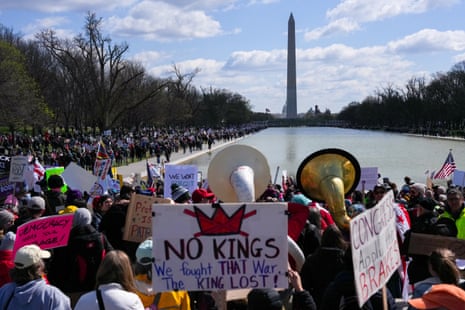
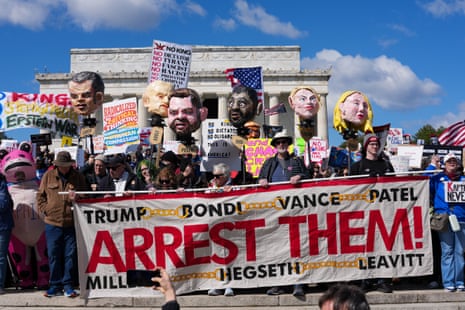
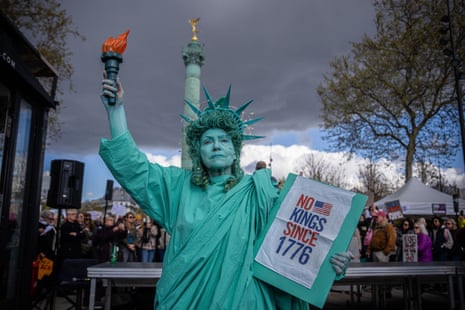
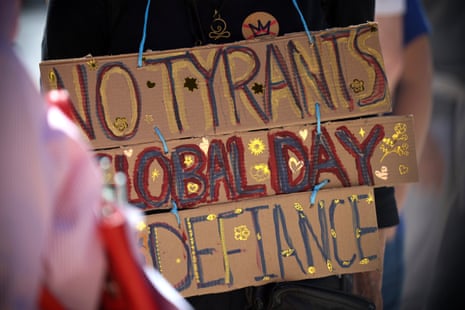
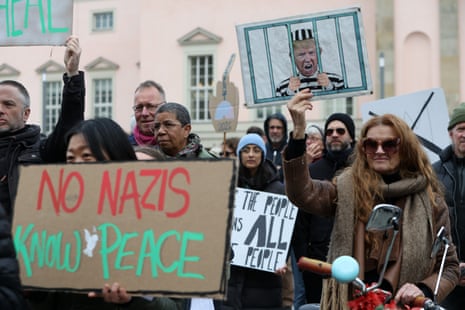
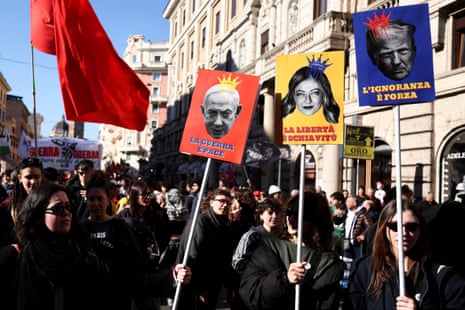
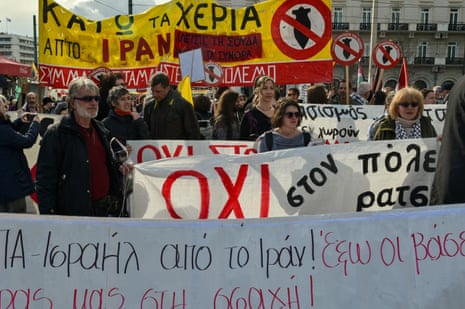
Although it’s still early in the day in the United States, Americans living abroad have already been out protesting for hours alongside their neighbors, including in France, Portugal, Germany, Italy and Greece.
Here’s a snapshot of the protests they organized:
What to know about the third No Kings protests
Lex McMenamin
This is the third set of protests to take place across the US since Donald Trump was re-elected as president. My colleague Lex McMenamin explains what to know about the latest protests:
Millions of people are expected to protest against the Trump administration at more than 3,000 No Kings events in cities and small towns across the country on Saturday. Ezra Levin, co-founder of Indivisible, one of the groups coordinating No Kings, said he expected it to be “the biggest protest in American history”.
This will be the third No Kings protest since Trump was re-elected. A flagship event will be held in Minnesota’s Twin Cities – Minneapolis and St Paul – after residents stood up to the surge of federal immigration agents the Trump administration sent into the region earlier this year. In January, agents killed two residents, Renee Good and Alex Pretti, who were observing Immigration and Customs Enforcement (ICE) activities.
Levin said in January that the third No Kings was a response to many Americans’ growing outrage over ICE and the Department of Homeland Security’s (DHS) “reign of terror” in communities across the country. Invisible co-founder Leah Greenberg recently told the Guardian that the Iran war was also motivating people to take to the streets.
“Every No Kings is going to be about the issues that are driving people most at that moment,” said Greenberg, “and it’s also going to be about the collective ways in which they begin to harm our democracy.”
Good morning. Today our US politics blog will cover the third No Kings march as millions of people are expected to protest against the Trump administration at more than 3,000 events across the US.
A flagship event will be held in Minnesota’s Twin Cities, where massive anti-ICE demonstrations broke out earlier this year after federal agents killed two residents.
Our reporters will share updates from that and other events across the country, at what event organizers hope will be “the biggest protest in American history”.