 2 months ago
67
2 months ago
67
The Navajo Nation, home to the Navajo tribe, also known as the Diné, meaning “the people”, is the largest Native American reservation in the US, encompassing 27,000 sq miles across New Mexico, Arizona and Utah. The Navajo people exemplify resilience amid a rapidly changing cultural landscape and various threats to their heritage.
Despite challenges such as inadequate housing, unreliable infrastructure and limited access to technology, elders and youth are striving to preserve their rich cultural heritage and identity.
-
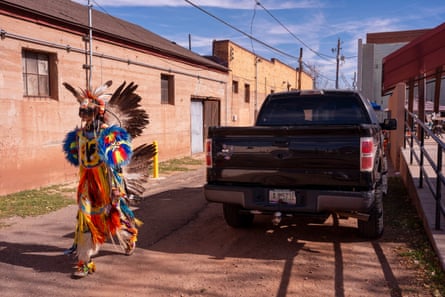
A Native American dancer, dressed in his traditional regalia, makes his way to a performance in Winslow, Arizona. During November there are many public performances and events celebrating Native American culture.
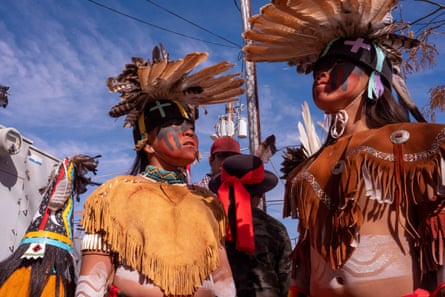
The legacy of colonialism has profoundly affected the Navajo culture. The forced assimilation of children into boarding schools led to significant cultural suppression.
Virginia Brown, a 69-year-old elder, recalls her traumatic experience: “I was forced into a boarding school when I was six years old. They cut off all our long hair and washed our mouths out with soap if they caught us speaking Navajo.”
This resulted in a generational gap in traditional knowledge and language that the Navajo are desperately trying to reclaim.
-
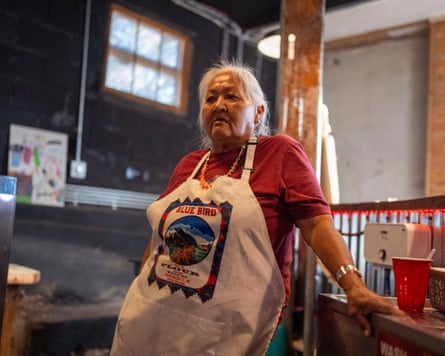
Virginia Brown cooking traditional fry bread.
Despite Navajo being one of the most widely spoken Native American languages, the fluency of Navajo speakers has declined. Unesco now considers it a “vulnerable” language, after a 3.4% decrease in speakers in recent years.
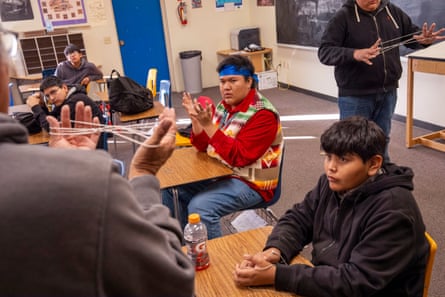
In response, many schools, such as the nearby Holbrook high school, have begun teaching the language and culture to help keep their heritage alive.
Many of the younger generation certainly believe the rhetoric that their culture seems to be declining. At a local skate park in Tuba City, young kids ride the ramps and gather around their phones.
“I think our culture is decreasing,” says Victoria, 14. “Kids my age are being consumed by social media and aren’t interested in our own culture. It makes me pretty angry.”
Some say the influx of large-scale media exposure has shifted focus away from traditional values and practices, with many young natives choosing dominant cultural narratives over ancestral ways.
Yet, there are many who actively uphold their heritage – practising and maintaining the traditional crafts that elders taught them.
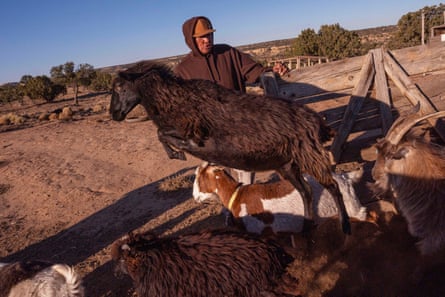
-
Drake Mace, a shepherd and weaver, tends to his sheep at his home in Whitehorse, New Mexico in November 2025.
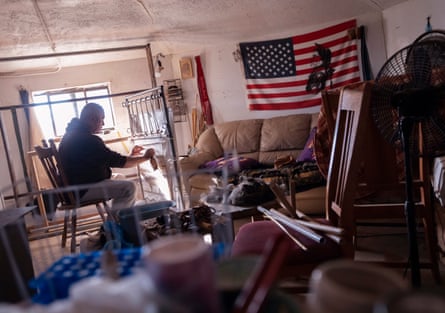
-
Drake Mace weaves a rug at his home using a vertical loom.
“I feel I am closest to my grandmother when I am with my sheep,” says Drake Mace, 40. He herds Navajo-Churro sheep and uses their wool to weave intricate rugs on a traditional vertical loom, using the traditional weaving skills his grandmother taught him.
Approximately 30% of Navajo households lack running water, forcing residents to spend hours hauling water from public spigots. As a result, some families are relocating to towns, leaving behind ancestral homesteads that have been in their family for generations.
Others, such as Tara Seaton, 48, manage to live on the reservation while also working from home. She combines her traditional way of life with modern technology, working for Texas State University and paying $140 a month for Starlink internet.
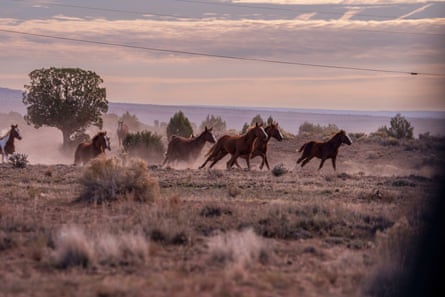
-
Feral horses running through the Navajo Nation. While the horses carry huge importance to the cultural heritage of Native Americans, they also bring troubles to the land, water, traditional foods and wildlife.
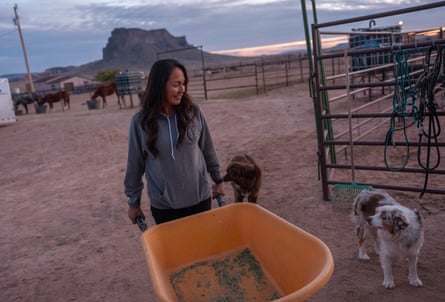
-
‘The best of both worlds’: Tara Seaton, 48, at home in Dilkon, Arizona. She lives on the reservation, miles from any town.
“I’m more of a traditional Navajo,” she says. “I ride my horses and try to stay true to my culture. I wouldn’t be able to have what I have without my culture. But being able to work from home allows me the best of both worlds and plus I get to stay here.”
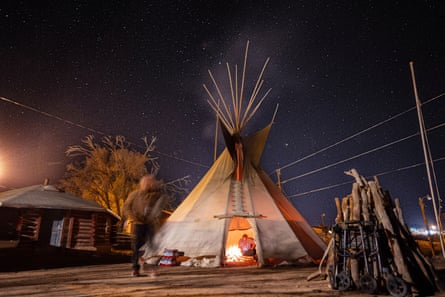
Sacred ceremonies in the Navajo culture are integral to restoring universal balance – known as the Hózhó. They are often held in a hogan (earth-covered dwelling) or a tipi.
-
A tipi is set up in preparation for a peyote ceremony at a home in Window Rock, Arizona.
-
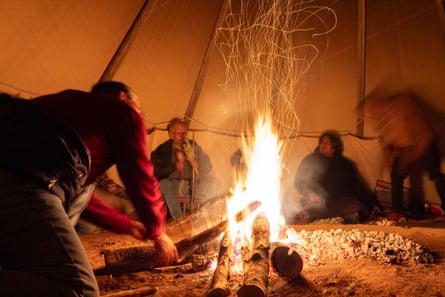
A man tending the fire during a peyote ceremony in a tipi in Window Rock, the Navajo Nation capital.
-
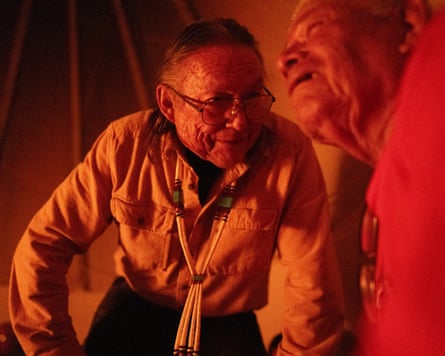
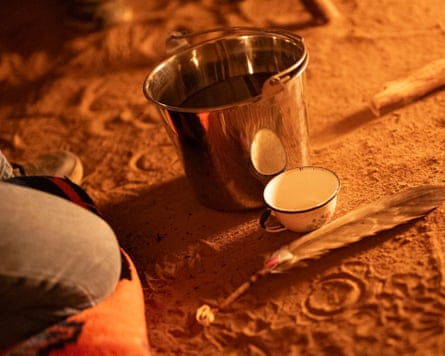
Jonus Yazzie, left, speaks with another man during a peyote ceremony. A bucket of peyote tea on the floor during the ceremony.
Jonus Yazzie, 70, has prepared his tipi at his home in Window Rock, the capital of the Navajo Nation.
The ceremony is a peyote meeting, a sacred all-night spiritual and healing ritual using the extremely hallucinogenic peyote cactus as a holy sacrament to communicate with the Great Spirit.
Jonus was asked by one of his nephews to hold the meeting to help him, as he was going through a difficult time in his life.
Another of Jonus’s nephews, Tom, 53, points at the local oak wood fire, which burns gently in the centre.
-
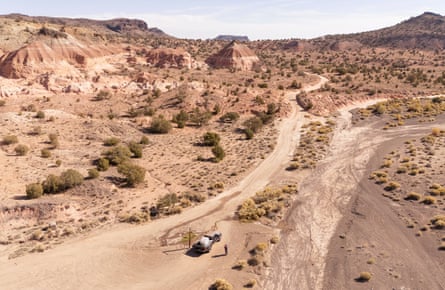
Emmet collects water from his local community well. Approximately 30-40% of Navajo Nation residents lack running water, requiring them to haul water from public taps, community wells, chapter houses or nearby border towns.
“This is our way of life and what we were taught,” says Tom. When asked if he feels the culture is slipping in today’s world, he replies: “Long ago people lived differently. Our traditional values have evolved. We are constantly changing and morphing. But we are still here.”
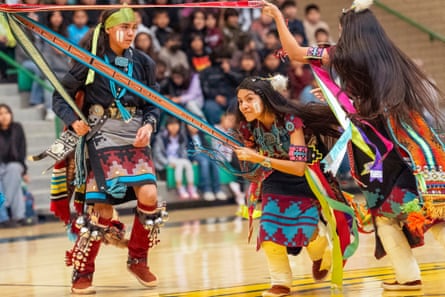
Native American dance groups such as the Diné Tah Navajo dance troupe strive to keep cultural practices alive, showcasing vibrant performances to schools and at public events.
Shawn Rice, leader of the troupe, emphasises the healing aspect of their dancing, which reconnects younger generations with their heritage.
-
Performers from the Diné Tah dance troupe dance in front of students at Newcomb high school, Navajo Nation.
-
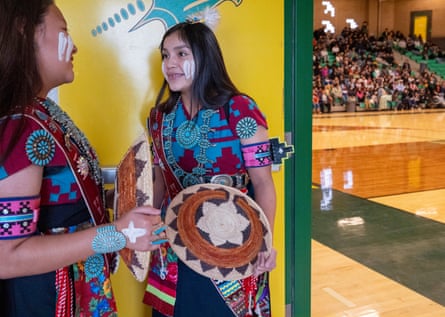
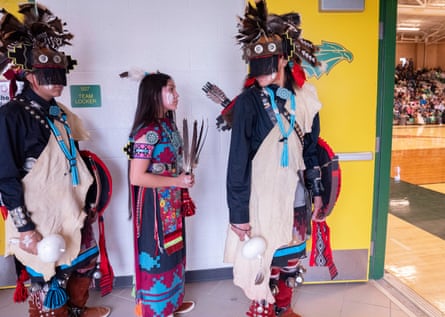
Performers from the Diné Tah dance troupe preparing to dance in front of students.
Shawn explains: “When we dance, we are healing the wounds of what my father’s generation went through. When the elders see our dances, they cry because they haven’t seen them in so long. What we have left we are going to cherish.”
The fight is real. And while some of the population now live in urban areas and border towns off the reservation, this does not mean their culture is being curtailed.
-
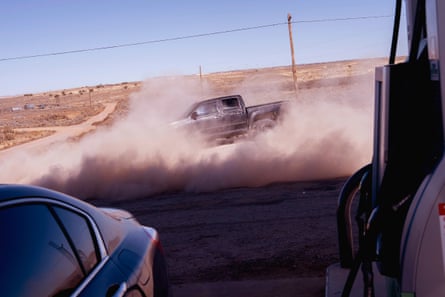
Navajo teenagers doing donuts in their truck at a petrol station.
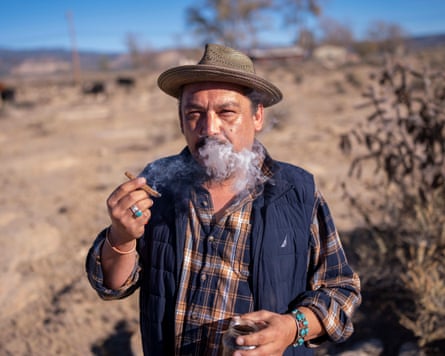
Ira, Virginia’s son, clearly shows his passion for his culture, and is committed to spreading indigenous ways of life. As his mother cooks Navajo fry bread, he says his children are fluent in Navajo, and he has helped revive the wool and textile market.
“We integrated hemp to help clean the land and atmosphere, and then started weaving with that,” he says.
-
Ira at his home just off the reservation.
“We are on the frontlines of mentorship programmes. We created the indigenous farmers’ cooperative to open up the indigenous trade routes going north. We are raising our children with our language and culture in the ancient ceremonies that are still relevant today.”
-
Students being taught traditional Native American games in the Native American culture class at Holbrook high school.
As Ira carries the torch of Navajo culture and helps spread the Hózhó – the maintenance of beauty, harmony and balance – there are many others on the outskirts of the reservation doing the same.
The Navajo culture is no longer tied strictly to one geographic location. Practices such as weaving and silversmithing, as well as speaking the Navajo language, are increasingly being preserved by those living in “border towns”, creating a diaspora that keeps the culture alive in new environments.
-
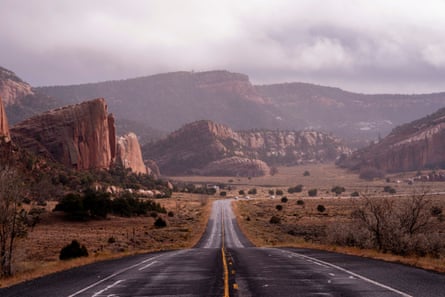
A road through the dramatic landscape of the Navajo Nation.
Ira finishes by saying: “Our elders used to say they were surviving. But now we get to say we are thriving.”
The Joan Wakelin bursary 2026 is open for submissions.