1 month ago
61
1 month ago
61
They are two small sketches by the Renaissance master Hans Holbein: one has long been considered to be a portrait of Henry VIII’s doomed second wife, Anne Boleyn, and the other is of an unknown woman whose name was lost to time.
Now researchers using AI have discovered that the unnamed woman might be the tragic queen after all, while the other figure could in fact be Boleyn’s mother.
The works, which belong to the Royal Collection and are known as the Windsor sketch and the Unidentified Woman, respectively, were analysed by a team at the University of Bradford, who found that they might have been incorrectly inscribed in the 1700s, leading to a misunderstanding that has lasted centuries.
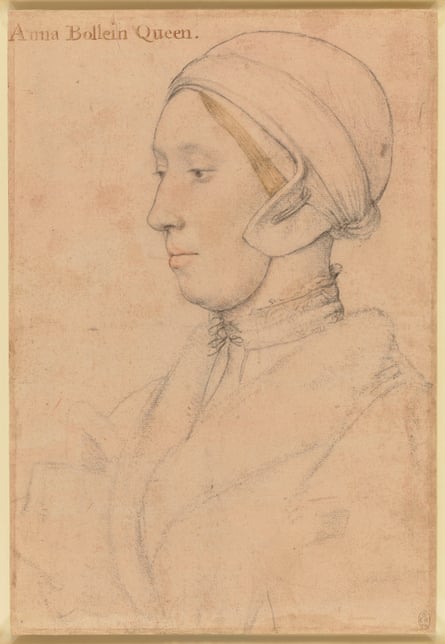
The independent scholar Karen Davies was studying the Holbein corpus of images, which number more than 80, and had her suspicions about the Windsor sketch, which shows the sitter in side profile. She was light-skinned, with red hair, while Boleyn was often described as being of a darker complexion.
The corpus was also known for its inconsistent labelling, with an image of Boleyn’s cousin Henry Howard actually being of his father. In a study published in March, Davies estimates that fewer than 15% of the works in the corpus possess contemporary documentary verification.
Davies teamed up with Prof Hassan Ugail, the director of the centre of visual computing at Bradford University, who has developed an AI model to recognise paintings by old masters and previously attributed to Raphael a painting that had puzzled art historians for decades.
“We looked at the entire collection and compared one image against another to create a huge matrix,” he said of the Holbein corpus. “It clustered paintings that were close to each other.”
The unidentified woman sat in the Boleyn-Howard cluster, while the Windsor sketch, seemed to be closer to images of Elizabeth Howard, Boleyn’s mother.
Davies said she hoped the analysis would open up debate on the images, and the rest of the Holbein corpus. She said: “I think now we’ve opened up the question. It’s not like we’re making a claim and that’s the thing settled. I hope that there’s a debate about reassessment more widely.”
A Royal Collection Trust spokesperson said the identity of the unnamed sitter had long been the subject of debate. “In sharing the Royal Collection and opening it up for research, we welcome further discussion, debate and new information,” they said.
Hans Holbein’s portraits of the Tudor court are among the finest Renaissance-era artworks.
Born in Augsburg in Germany, Holbein worked in Basel before moving to England where he specialised in portraits and sketches.
He had moved to escape the chaos of the Reformation in Europe but ended up among the suspicion and paranoia of the court of Henry VIII. The monarch wanted to divorce his wife, Catherine of Aragon, and marry Boleyn; the pope’s refusal to help led to the English Reformation.
Holbein painted portraits of Thomas More, who was executed in 1535, and Boleyn, who was beheaded the year after.
Earlier this year the most well-known Boleyn image, the Hever “Rose” portrait, was analysed, with historians suggesting the Elizabethan artist responsible for the painting sought to create a “visual rebuttal” to claims she was a witch with a sixth finger on her right hand.