 3 months ago
73
3 months ago
73
There is a paradox at the heart of sibling relationships and it is this: that children raised in the same family are for ever bound by shared experiences, yet have different childhoods. The paradox is partly (and most commonly) explained by the topic of birth order theory – the idea that your position in the family shapes your personality and potential. Oldest children, for example, are born into an adult world, full of grown-up language and behaviour. Governed by anxious, inexperienced but still fresh parents, they bask in the glow of undivided attention. Their infancy will be markedly different to that of their little brother or sister who will be born into a family. These second-born children have a toddler as their role model/ally/nemesis, no new clothes, and they also have to share their parents’ attention. These parents are a little less fresh and little more savvy. By the time any subsequent children come along, parents are at their most relaxed and most exhausted. Youngest children get away with a lot (spoken as a true middle sibling).
But neat as birth order theory may be, our place in the family roll call cannot fully account for the ways in which we grow up “together apart” as siblings. To do that, we must examine – and in some cases untangle – all of the knottiness underpinning our accepted roles as “responsible firstborns”, “problematic middles” or “spoilt babies”. We need to look at the home environment, the state of the parents’ relationship, their careers, the pressures placed on each child on account of gender or aptitude, the expectations in families where a child has additional needs – or indeed, in the worst-case scenario, where a child may not have survived – before we can begin to comprehend our brother’s or sister’s version of events. Difficulties typically arise because of the slipperiness of memory, often shot through with profound emotions – making it hard to pull together a coherent and agreed-upon story of our pasts.
Since starting to interrogate my own history, I have found that bringing all the versions of one event together tends to be painful. It’s usually because the stories we cling to most Gollum-like are the ones where we were either innocent or victimised: I was the most hurt, the least understood, the most unkindly treated. I think there is that tendency in us all (although I also know I’m particularly guilty of this). So to then hear another person’s version of events provokes a strange kind of recalibration. You might just start to see the whole of the moon. Or at the very least consider a good hard edit on your own starring role in history. In our family, this process was really complicated.
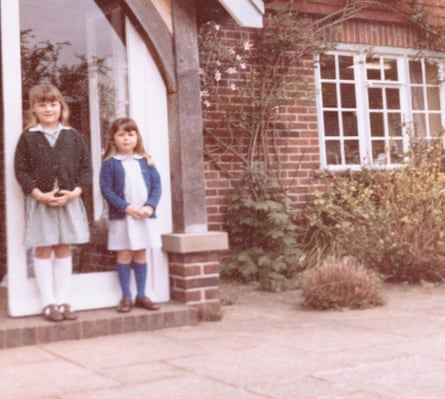
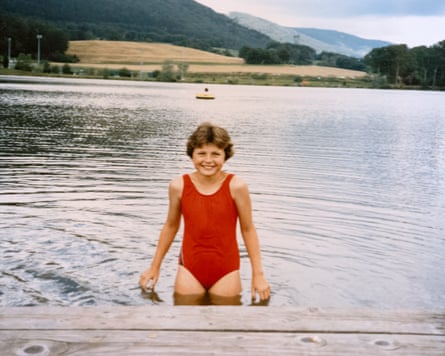
I am the middle of three girls, 22 months younger than my older sister Bex and a whopping six years older than the baby, CJ. Growing up, we definitely did not swim in the same waters. In 1984, when I was six, our family moved to the Netherlands. CJ (“Squidget”) was just a few months old. For six or so years, we lived together near the sea in Scheveningen. Bex and I (and eventually CJ) went to the nearby British school. But when I was 11, my mum moved out, going to live in a nearby town with a man she had fallen in love with. She took CJ with her. Bex and I stayed with my dad in our family home for another year before moving back to the UK with him. Some of those years are blurry in my memory, the chronology still shaky today. But I know my mum remarried quickly, and my dad, too, subsequently. Both step-parents already had two children of their own, so we ended up as a separated trio of sisters, with stepsiblings in two countries: seven kids in the mix.
I am not for a minute suggesting that our childhood was the strangest or hardest set-up. But I am sure that the complications in the way we were brought up forced me to think more than most people about siblinghood. Having the same parents but living apart meant that we became a very small uncontrolled nature/nurture experiment. It also meant that in an instant our unit of three was for ever changed. My older sister and I became a pair and the baby became a de facto only child: the hierarchies realigned. On top of that, because we lived apart, we had to make the effort to keep our relationship alive. As children in the 1990s, we didn’t do that very well: there was no internet, no email or Zoom, no WhatsApp. Photos still had to be developed on the high street and then stuffed into envelopes and posted, so keeping up with each other’s lives wasn’t easy. And childhood moves quickly.
My sisters and I were together for six years before our parents separated. It’s true that we often reunited for Christmas or summer holidays, but we missed out on the mundane glue of arguing over the TV remote, or who finished the nice cereal. We skipped the chance to nurture the true sibling familiarity that comes from spending lots of unremarkable Sunday afternoons mooching around the house. More than that, there was just such a vast space between our realities. At one end of the scale, the cupboards in each other’s houses were full of biscuit brands that we did not recognise, and the washing powder smelled wrong. At the other end of the scale, we only had one parent each and lived in different countries. We couldn’t easily chat about our teachers, friends or schools when we were visiting our other parent and other sister. They didn’t know what we were talking about. And that meant so many missed stitches in what it usually takes to knit siblings together in their shared memories.
Many of us may find our brothers or sisters maddening. Much of this has to do with growing up on top of one another under the same roof, vying for parental approval. When you gather with your siblings and settle back into the familiar patterns of your shared childhood, these identities can provide a rich sense of belonging and intimacy. While it may be annoying to be teased for always being the person with the messiest bedroom, or accused of attention-seeking when you’re not even speaking, there is comfort even in the irritation. You can reminisce and poke fun. The stories may be tired, but they feature you all. The jokes may be well worn, but they get funnier over time because everyone is in on them – there’s a tenderness to anticipating the punchline. For children who don’t have that reservoir to go fishing in together, it can feel like a void.
Now in our 40s, we have done a lot of work, taking time to sketch out our pasts for the other – to make sure we understand each other as fully as possible. But I still find there are things that are impossible to express. In 2020, my friend from school died in a terrible accident. It was someone CJ had never met. All she understands is my sadness about it – she doesn’t know how he fitted in with my other friends, my school, the neighbourhood, the town we were teenagers in, so she will only appreciate the fact of the loss, without being able to travel back there with me.
Even in families without significant upset or separation, the process of sharing memories with your siblings can be fraught. On the one hand, there’s the fact that we are separate and alone, experiencing our childhood from our unique vantage point: as the baby, the middle or the oldest of five. Who else could understand exactly what that looks and feels like? And, on the other hand, we are, at the same time, together as members of the same family – even in those families that don’t fit into a neat mould, where steps and halves may enrich and complicate the picture, for example. As sibling therapist Erin Runt explained, “No one else has that really intimate knowledge of those early years of your life, nobody else understands the nuance of it. They’re the only person who can go back and be like, ‘Was Dad always cranky?’ ‘Were you always the golden child?’ … And even if they had an alternate interpretation, they were still there. So if you’re trying to figure out the truth, in so far as there is such a thing, there are so few people in this world who can help you do that.”
Yet, our siblings can only ever do it imperfectly. Their perspective is not your perspective. It’s as if they were filming the scene from another part of the room, picking up certain audio and visual cues but missing some of the bits you may have zoomed in on. The result is a distortion of what you have long replayed in your own mind as a faithful record of events. You may long for people to understand, for example, why you are terrified of the ocean, remembering the horror of a wild and wavy day at the beach. Your siblings were there; they would back you up, surely? And yet – let’s say – you were three years old, and the waves that threatened to sweep you off your feet barely lapped at your older brother’s shins. On the same beach, on that same sunny day, you were panicking and afraid, and he was happily paddling in the shallows. Both can be true at the same time.
Being physically apart from your brothers and sisters is (obviously) a stark example of the “non-shared environment” theory, used to explain how it can be that two siblings who share genetics and a home end up being so different. It is the idea that while siblings may live together, many other things about their specific experience are unalike: they had parents interacting with them differently, and they had a distinct set of teachers and friends. I like to think of it like this: families are formed along rivers. When we are born, we are placed – Moses-like – on to the rolling stream and away we float. If we have a twin, they are likely bobbing along beside us (give or take a few minutes) and the water surrounding us is largely the same. It is just as cool and fast-flowing, unsettled and muddy, or tranquil and warm. However, if we are not twins, the conditions we arrive in will have changed, like the weather, and the water has moved along. With time, parents get older, richer, poorer, more tired, sick, separated, remarried. The family may have relocated and the environment is kinder or crueller. There’s a new dog, a grandparent falls ill, a sibling leaves home. And the river flows.
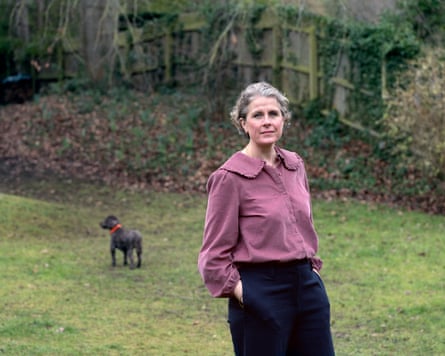
A version of this theory comes up when a family suffers trauma. I recently chatted to a woman who walks her dog in the same park as me. She told me about a friend of hers who had died suddenly over Christmas. The friend was young, her children only 19 and 17. The lightning bolt of their mother’s death has struck them at different ages and stages, and so they will cope with the tragedy independently. They will be united in their grief in many ways, of course, but when their mum died, one was in their first year at university, the other was at home with his dad, managing his school exams. Over time, this difference in experience will be part of the story they tell about the most awful Christmas ever – and part of the way they come to accommodate the enormous sadness of their loss.
Despite the separation we endured as sisters, and all the ways we absorbed the fallout from the breakup of our family, the unique set of ingredients that went into the events of those years are ours alone. It is only recently that we have started slowly telling each other about the years spent apart from our different points of view, and it’s a strange experience to hear one of your childhood memories retold by a sister who (naturally) casts herself as the main character.
When I was 11, my mum left me, and that has been a defining episode in my life. At exactly the same time, six-year-old CJ lost her sisters, her home and her father. We have talked at length about the way the breakup affected us. There is comfort in the shared damage – and at the same time a huge amount of loneliness in the bits that hit us uniquely hard. Even at the time, the ways in which we felt permitted to grieve the situation were dictated by our birth order. The baby was to be protected as she was so young. But really, 11 is not so old. It just happens to be older than six. And 13 was tough for Bex for a host of reasons. Everything is relative.
Recollecting these events with them has warped the pictures in my mind, threatening my sense of self. I have felt dizzy with the realisation that these parallel histories exist just as vividly in my sisters’ minds. We find ourselves saying to one another, “I had no idea. I’m so sorry. I never knew.”
If you think about your own childhood, there may not be any examples of such tumult, but there will be episodes that can provide a kind of emotional glue, laid down somewhere as shared memories. It may be something like the death of a grandparent, moving house, or the loss of a parent’s job and the attendant stresses. It is valuable to revisit these challenges as adults, with a more mature perspective. You may be surprised how revealing the surrounding narratives turn out to be.
There is a vertical hierarchy in the home as children, most commonly determined by age. But really hearing one another out as adults can tilt things so the relationship becomes more horizontal. It is a process that may help nudge you towards something more even-handed, a friendship, perhaps. And by middle age, with some distance from our younger selves, we may even sit and talk about our memories in a slightly less possessive and slightly more clearsighted manner. Perhaps some of the emotions around them hang a little looser. We may feel able to embark on a little light collaborative pruning or editing, without creating more upset. We could finally accept that the most harmonious option might be to work on a collaborative version of events which allows everyone’s “truth” to be honoured, so that we can begin to move forward.
Of course, we do not choose our siblings in the same way we chose our friends, and yet at my age, I find my relationships with my sisters provide precisely the kind of consolation I need in a world that seems to be increasingly confused. Even as imperfect keepers of each other’s histories, I treasure them. And, should we all make it to old age (83 is the average life expectancy for a woman in the UK) I could eventually boast of knowing and loving them for 83 and 77 years respectively. It’s a hell of a long time.
Last summer, we got together to celebrate my older sister’s 50th birthday. The whole family was there: both my parents, their spouses, all of our partners, step-siblings, everyone’s children and a few of the dogs. So many years have passed now, and everyone has changed. New chapters are being added to our story all the time. And yet, some moments during that sunny afternoon party glittered with memories of every other happy time we have been together as a trio. I hope that never changes.
The hierarchical bonds that form in childhood have flexed as our circumstances have changed. The initial vertical relationships – with some “bigger” or “smaller” than the other, ahead or behind – have slowly shifted into something more horizontal and peer-like, because we can talk about the past and what we want the future to look like. It has been a difficult yet hugely rewarding task. It has helped us forge meaningful rapports as adult sisters, sturdy enough to weather the twin challenges of ageing parents and the grief that will sadly follow, things that can easily deepen painful cracks in sibling relationships built on shallower foundations.
I have learned that the aim is to “catch up”, to transition from playmates on a rug, to teens, to fully formed adults, independent from our parents and their (not altogether accurate) views of who we are. There are moments, of course, when the hierarchy may reassert itself, to plan a special party, make a financial decision or coordinate care. But my hope is that the strength of our bonds will hold fast enough to allow us to navigate all the challenges that the next chapters might bring – together.