1 month ago
55
1 month ago
55
Continuation of status quo 'intolerable' for US, says Iran's top negotiator
The Iranian parliament speaker, Mohammad Bagher Ghalibaf, said in a post on X this morning that a “new equation of the strait of Hormuz is in the process of being solidified” and warned that the continuation of the “status quo” was an “intolerable” position for the US to maintain.
Ghalibaf, Iran’s chief negotiator, added:
The security of shipping and energy transit has been jeopardised by the United States and its allies through the violation of the ceasefire and the imposition of a blockade; of course, their evil will diminish.
We know full well that the continuation of the status quo is intolerable for America; while we have not even begun yet.
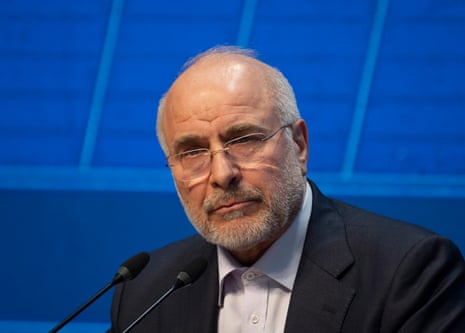
Iran imposed a blockade on foreign shipping using the strait of Hormuz soon after the war began with a US-Israeli attack on 28 February which killed the country’s former supreme leader. The US president, Donald Trump, imposed a counter-blockade of ships using Iranian ports on 13 April.
Trump’s so-called “Project Freedom”, which began yesterday, says its aim is to use the US military to guide stranded cargo ships out of the strategic waterway. But in doing so it makes the resumption of war much more likely as Iran’s military central command warned that it would strike any US naval vessel approaching the strait.
Key events Show key events only Please turn on JavaScript to use this feature
Iran had “no pre-planned programme” to attack oil facilities in the UAE, Iranian state TV quoted a military official as saying, after the UAE blamed Iran for a drone strike at an energy installation in Fujairah (see post at 09.20 for more details).
“What happened was the product of the US military’s adventurism to create a passage for ships to illegally pass through” the strait of Hormuz, the official said. “The US military must be held accountable for it.”
US secretary of state Marco Rubio’s meeting with Pope Leo on Thursday will include a “frank conversation” about the Trump administration’s policies, the US ambassador to the Holy See, Brian Burch, has said.
“Nations have disagreements, and I think one of the ways that you work through those is ... through fraternity and authentic dialogue,” Burch said.
“I think the secretary is coming here in that spirit,” he added. “To have a frank conversation about US policy, to engage in dialogue.”
Rubio’s trip, which coincides with the first anniversary of Leo’s papacy, comes weeks after Trump lashed out at the Chicago-born pontiff over his condemnation of the unprovoked US-Israeli war on Iran, widely seen to have been launched illegally. Trump called him weak and said he was not doing a very good job as pontiff.
Leo stirred the ire of Trump after he suggested a “delusion of omnipotence” was fuelling the war and called the president’s threat to annihilate Iranian civilisation if Iran did not agree to US demands to end the war and open the strait of Hormuz as “truly unacceptable”.
Pakistan prime minister condemns attacks on UAE
Pakistan’s prime minister, Shehbaz Sharif, has condemned the attacks on the US-allied UAE after the Gulf nation was struck by a barrage of missiles and drones yesterday.
The UAE came under repeated attacks from Iran for the first time since a ceasefire took hold in early April. One sparked a fire at a key oil facility in Fujairah and injured three Indian nationals, authorities said.
In a post to X this morning, Sharif expressed his full solidarity with UAE president Sheikh Mohamed bin Zayed Al Nahyan.
“Pakistan strongly condemns the missile and drone attacks on civilian infrastructure in the United Arab Emirates last night,” he wrote.
“Pakistan stands firmly with our Emirati brothers and sisters as well as with the government of the United Arab Emirates at this difficult time. It is absolutely essential that the ceasefire be upheld and respected, to allow necessary diplomatic space for dialogue leading to enduring peace and stability in the region.”
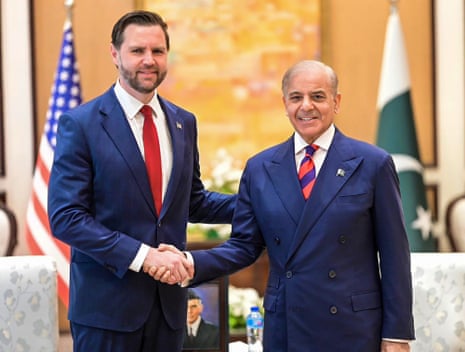
Pakistan is playing a crucial mediating role between Iran and the US, having hosted a first round of peace talks in Islamabad in April. It continues to relay messages between the two sides even if an agreement looks increasingly elusive.
The internet blackout in Iran has entered its 67th day, according to internet monitoring group NetBlocks, as the regime continues one of the longest-running national internet shutdowns ever recorded. NetBlocks said in a social media post:
The internet blackout in Iran is now entering its 67th day after passing incident hour 1584. The digital censorship measure casts a veil of silence around the growing number of reported executions, denying victims visibility, accountability, and the basic right to be heard.
Senior government officials are awarded “white” SIM cards granting them access to the global internet while the vast majority of the population remains completely cut off.
Under pressure to alleviate the economic harm the shutdown is causing, the government is now allowing less-restricted internet access to a small number of professions, businesses and friendly media.
There was an earlier internet shutdown in January during nationwide protests, which helped obscure extreme violence against Iran’s population.

Graeme Wearden
The oil price has dipped slightly this morning, after a jump on Monday.
Brent crude is down almost 1% at $113.41 a barrel, a day after jumping by 5.8% after the US launched an operation to reopen the strait of Hormuz.
You can track the latest business news here:
Continuation of status quo 'intolerable' for US, says Iran's top negotiator
The Iranian parliament speaker, Mohammad Bagher Ghalibaf, said in a post on X this morning that a “new equation of the strait of Hormuz is in the process of being solidified” and warned that the continuation of the “status quo” was an “intolerable” position for the US to maintain.
Ghalibaf, Iran’s chief negotiator, added:
The security of shipping and energy transit has been jeopardised by the United States and its allies through the violation of the ceasefire and the imposition of a blockade; of course, their evil will diminish.
We know full well that the continuation of the status quo is intolerable for America; while we have not even begun yet.
Iran imposed a blockade on foreign shipping using the strait of Hormuz soon after the war began with a US-Israeli attack on 28 February which killed the country’s former supreme leader. The US president, Donald Trump, imposed a counter-blockade of ships using Iranian ports on 13 April.
Trump’s so-called “Project Freedom”, which began yesterday, says its aim is to use the US military to guide stranded cargo ships out of the strategic waterway. But in doing so it makes the resumption of war much more likely as Iran’s military central command warned that it would strike any US naval vessel approaching the strait.
The Israeli military has issued more forced displacement orders for people in southern Lebanon – this time for those in the towns of Jabsheet and Sarafand.
In a statement on social media, the military’s Arabic-language spokesperson Avichay Adraee said these residents should evacuate their homes “immediately and move away from the villages and towns for a distance of at least 1000 metres to open areas”.
Signalling upcoming airstrikes, Adraee claimed the IDF are “compelled to act forcefully against” Hezbollah, which he said had violated the US-brokered ceasefire agreement between Israel and Lebanon that came into effect in mid April.
Hezbollah, which has been striking Israeli troops in Lebanon, says it will not cease its attacks on Israeli troops inside Lebanon and on towns in northern Israel as long as Israel continued its ceasefire violations.
Israel has been accused of violating the ceasefire agreement many times, with strikes killing civilians and homes continuing to be demolished despite the military saying it is only targeting Hezbollah sites.
Under the agreement’s terms, Israel was effectively given permission to continue its assault on Lebanon as it retained a “right to take all necessary measures in self-defence, at any time, against planned, imminent, or ongoing attacks”.
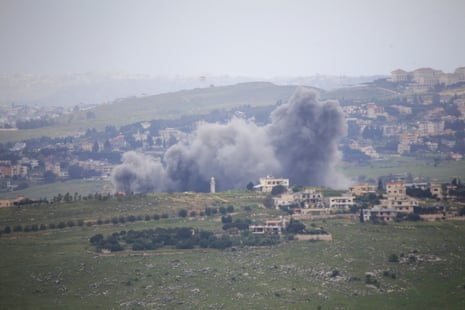
India’s ministry of external affairs said the attack on Fujairah in the UAE – which injured three Indian nationals – was “unacceptable” and called for an immediate end to the “targeting of civilian infrastructure and innocent civilians”.
Officials in Fujairah said yesterday that a fire broke out at the Fujairah Oil Industry Zone following what they described as a drone attack originating from Iran. Civil defence teams were deployed immediately to contain the blaze, Fujairah Media office said in a statement.
Opening summary: US targets Iranian boats amid tense push for control of strait of Hormuz
We are restarting our live coverage of the US-Israeli war on Iran. The US and Iran launched new attacks in the Gulf on Monday as they wrestled for control over the strait of Hormuz amid dual maritime blockades, taking the region back to the brink of full-scale war.
The fresh volleys of missiles and drones came after Donald Trump launched a new effort to get stranded tankers and other ships through the vital energy and trade route that has been virtually shut since the US-Israeli war against Iran began in late February.
On Monday, several merchant ships in the Gulf reported explosions or fires, the US said it had destroyed six small Iranian military boats – a claim Tehran denied – and Iran attacked the UAE with drones and missiles, setting the oil port of Fujairah on fire.
The US military’s Central Command (Centcom) said two US-flagged merchant vessels crossed through the strait of Hormuz on Monday as US navy destroyers operated in the Gulf. Shipping company Maersk later said one of its US-flagged commercial vessels had successfully exited the strait under US military escort.
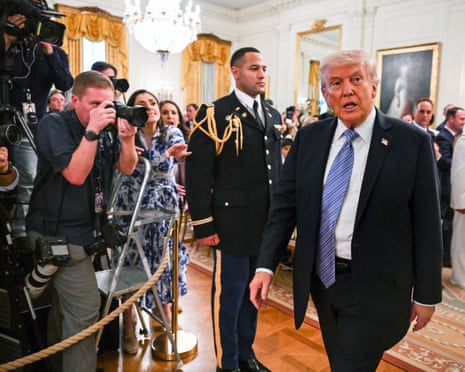
In other key developments:
-
Trump warned that Iran’s forces would be “blown off the face of the earth” if they attacked US vessels trying to reopen a route through the strait. The president announced the US operation – called Project Freedom – on Monday to help hundreds of ships trapped in the Gulf.
-
Centcom chief Adm Brad Cooper declined to say whether he thought the ceasefire with Tehran that begun on 8 April remained in effect amid Iranian attacks in the region but acknowledged Iran’s Revolutionary Guards tried to “interfere” with Trump’s operation.
-
Iranian foreign minister Abbas Araqchi said Monday’s events showed there was no military solution to the crisis. He said peace talks were progressing with Pakistan’s mediation and warned the US and the UAE against being drawn into a “quagmire by ill-wishers”.
-
Iran’s Revolutionary Guards said on Monday that no commercial vessels had crossed the strait in the past few hours, and that US claims to the contrary were false. Iranian state media also denied reports the US had sunk Iranian vessels.
-
The UK and Saudi Arabia both called for de-escalation after Iran’s attacks on the UAE – the first on the US ally since Washington’s ceasefire with Tehran took effect about a month ago.
-
In Oman, two people were injured by an attack on a residential building in Bukha, on the Hormuz strait’s coastline, an Omani state news agency reported.
-
A fire on a South Korean-operated vessel that had an explosion in the Hormuz strait has been extinguished, ship operator HMM said. South Korea’s foreign ministry said all 24 crew on the HMM Namu – including six South Koreans – were unharmed. Trump blamed an Iranian attack.
-
International Monetary Fund chief Kristalina Georgieva warned that inflation was already picking up and the global economy could face a “much worse outcome” if the war dragged into 2027 and oil prices hit about $125 a barrel.