2 months ago
71
2 months ago
71
Israel to ‘intensify’ strikes on Iran to stop missile fire, warns defence minister
Israel are to step up strikes against Iran as a result of its continued missile fire, says Israel Katz, warning the Islamic republic would pay a “heavy price”.
“Despite the warnings, the firing continues – consequently, IDF strikes in Iran will intensify and expand to other targets in sectors that help the regime develop and use military means against Israeli civilians. They will pay a heavy price, an increasingly heavy one, for this war crime,” Katz said in a video released by his office.
According to Reuters, more than 1,900 people have been killed and at least 20,000 injured in Iran since the start of U.S. and Israeli attacks, said Maria Martinez of the International Federation of Red Cross and Red Crescent Societies (IFRC) on Friday, citing figures provided by the Iranian Red Crescent.
Martinez said the Iranian Red Crescent continues to serve as the only nationwide humanitarian organization operating across the country amidst the escalating conflict.
Israeli opposition leader Yair Lapid warned last night his country’s government for the first time that the war was taking too high a toll.
“The IDF is stretched to the limit and beyond. The government is leaving the army wounded out on the battlefield,” Lapid said, echoing a warning delivered a day earlier by military chief Lieutenant General Eyal Zamir.
“The government is sending the army into a multi-front war without a strategy, without the necessary means, and with far too few soldiers,” Lapid said.
Key events Show key events only Please turn on JavaScript to use this feature
Japan to boost coal-fired power as war causes energy turmoil
Japan’s government plans to temporarily lift restrictions on coal-fired power plants as it seeks to ease an energy crunch caused by the Middle East war, AFP reports.
Officials presented the plan at a meeting of a panel of experts, who approved the proposal, the industry ministry said on its website.
“Given the current situation in the Middle East affecting fuel prices, we believe that uncertainty regarding future LNG procurement is increasing,” an industry ministry official said at the meeting, which was broadcast online.
“We think it will be necessary, by increasing the operation of coal-fired power plants, to... ensure the reliability of stable supply,” he said.
Power suppliers have previously been required to keep the operating rate of coal-fired thermal power stations that emit large amounts of carbon dioxide at or below 50 percent.
But the government now intends to allow the full operation of older, less efficient coal-fired plants, for a year from the new fiscal year starting April, according to the plan presented at the meeting.
It comes after Vietnam’s (4.16) trade ministry said this morning it had temporarily waived an environmental tax on fuel to cut soaring prices by more than a quarter.


William Christou
Rania Jaber told her husband that if God blessed them with a daughter, she would be named Narjis, Arabic for daffodil. After having twin boys, Jaber wanted a little girl she could dress up.
Jaber got her girl and made good on her promise: Narjis was born in 2020. Her mother was delighted to find that just like her namesake flower, her daughter’s hair was light. Narjis seemed “wise beyond her years”, Jaber said, recalling how her daughter would comfort her whenever she would cry.
As Jaber rushed to pack her daughter and two sons into the car on 2 March as she fled Israeli bombs, Narjis comforted her once again. “Mama, you’re my life. Don’t cry, I love you so much,” Narjis told her mother as stress began to overwhelm her.
It was one of the last things Jaber remembers her daughter saying. A few hours later, Israel dropped a bomb on their family home in Maifadoun, south Lebanon, killing six-year-old Narjis and her aunt.
“I keep replaying it. How our lives were torn apart. She was like a blossom. This girl … Oh my heart is breaking. I still can’t believe my daughter is gone,” Jaber said through sobs. The 34-year-old mother and her two 10-year-old sons, Abbas and Ali, were trapped under the rubble after the airstrike but survived with mild injuries.
Jaber has no shortage of pictures of her daughter: Narjis always has a wide smile, wearing the many dresses her parents bought for her, posing in her classroom with a papier-mache apple bearing a capital “A” held proudly in her hands. “She wanted to be a doctor,” Jaber said.
Iran guards say strait of Hormuz 'closed' to hostile shipping
Iran’s Revolutionary Guards said that they had turned back three ships trying to transit the strait of Hormuz, adding the route was closed to vessels travelling to and from ports linked to its “enemies”.
“This morning, following the lies of the corrupt US president claiming that the strait of Hormuz was open, three container ships of different nationalities... were turned back after a warning from the IRGC Navy,” the Guards said on their Sepah News website.
“The movement of any vessel ‘to and from’ ports of origin belonging to allies and supporters of the Zionist-American enemies, to any destination and through any corridor, is prohibited,” it added.
German foreign minister Johann Wadephul on Friday accused Russia of helping Iran identify potential strike targets, saying president Vladimir Putin was hoping to use the Iran war as a distraction from his attack on Ukraine.
Speaking to reporters at a G7 meeting in France, Wadephul also said he had spoken to US secretary of state Marcio Rubio to outline Germany’s position, that it was willing to help play a role in the strait of Hormuz after hostilities end.
“Putin cynically hopes that the escalation in the Middle East will divert our attention from his crimes in Ukraine,” Wadephul said. “This calculation must not succeed. We see very clearly how closely the two conflicts are intertwined. Russia is evidently supporting Iran with information about potential targets.”

Patrick Wintour
A war of regression: how Trump bombed the US into a worse position with Iran
Four weeks into a war that was going to take four days, and that has so far cost the US about $30-40bn and Israel $300m (£225m) a day, America is further away from a diplomatic agreement with Iran than it was in May 2025.
Not only has the war failed to persuade Iran to agree to dismantle its nuclear programme in the comprehensive and irreversible way America demanded in a 15-point paper that it tabled on 23 May last year, the US is now having to negotiate to reopen the strait of Hormuz, a strategic waterway that has been open ever since the invention of the dhow (with a short exception of a tanker war in the 1980s between Iran and Iraq).
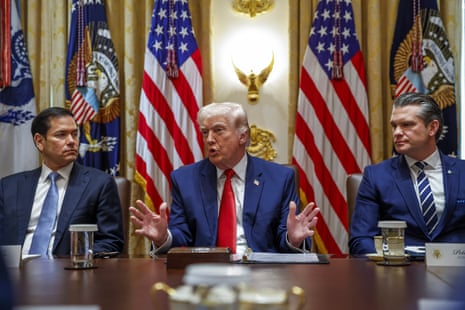
Read Patrick Wintour’s analysis here:
Patrick Wintour is diplomatic editor for the Guardian
Israel to ‘intensify’ strikes on Iran to stop missile fire, warns defence minister
Israel are to step up strikes against Iran as a result of its continued missile fire, says Israel Katz, warning the Islamic republic would pay a “heavy price”.
“Despite the warnings, the firing continues – consequently, IDF strikes in Iran will intensify and expand to other targets in sectors that help the regime develop and use military means against Israeli civilians. They will pay a heavy price, an increasingly heavy one, for this war crime,” Katz said in a video released by his office.
According to Reuters, more than 1,900 people have been killed and at least 20,000 injured in Iran since the start of U.S. and Israeli attacks, said Maria Martinez of the International Federation of Red Cross and Red Crescent Societies (IFRC) on Friday, citing figures provided by the Iranian Red Crescent.
Martinez said the Iranian Red Crescent continues to serve as the only nationwide humanitarian organization operating across the country amidst the escalating conflict.
Israeli opposition leader Yair Lapid warned last night his country’s government for the first time that the war was taking too high a toll.
“The IDF is stretched to the limit and beyond. The government is leaving the army wounded out on the battlefield,” Lapid said, echoing a warning delivered a day earlier by military chief Lieutenant General Eyal Zamir.
“The government is sending the army into a multi-front war without a strategy, without the necessary means, and with far too few soldiers,” Lapid said.
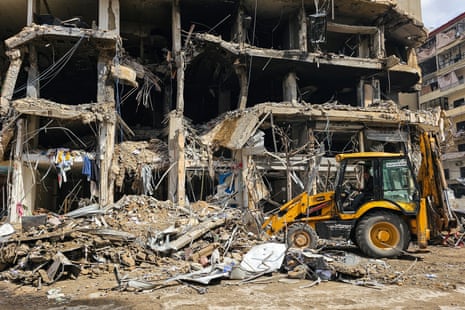
More than over 370,000 children displaced in Lebanon and 121 killed, UNICEF says
More than 370,000 children have been forced from their homes in Lebanon amid Israel’s offensive against Hezbollah, according to Reuters, with at least 121 children killed and 399 injured, UNICEF’s representative in Lebanon, Marcoluigi Corsi, said on Friday.
Israel’s defence minister, Israel Katz, has said his country intends to create a “security zone” up to the Litani River, which meets the sea about 30 km (19 miles) north of the border with Israel. He has said hundreds of thousands of Shi’ites will not return south of the Litani until security is ensured for northern Israel.
A UNHCR official estimates that about 150,000 people are isolated in Lebanon after the destruction of bridges.
An official told Reuters: “We have seen increasingly worrying rhetoric concerning activities in southern Lebanon by the Israeli army and authorities.
“What we really need is for Lebanon’s territorial integrity and sovereignty to be fully respected.”
UN report calls on Syria to investigate abuses during deadly clashes with Druze last year
A UN inquiry says Syria shows no sign it has investigated alleged abuses by its forces during deadly sectarian clashes in Sweida province. The U.N. commission says at least 1,700 people died, mostly from the Druze minority, while about 200,000 were displaced.
UN investigators interviewed more than 400 survivors, officials, and alleged perpetrators. The report described looting, arson, killings, and abductions during a government-led advance, according to AP.
The report says tribal fighters targeted homes across dozens of villages. It also documents retaliatory attacks on Bedouin civilians. Hospitals overflowed as bodies piled up.
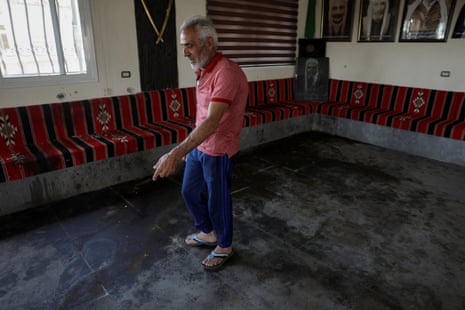
Hostilities are eroding the foundations of civilian life, ICRC says
A devastating pattern of warfare is eroding the foundations of civilian life in the Middle East, the International Committee of the Red Cross have said.
One month of hostilities has upended the lives of millions and sent shockwaves far beyond the region at a scale and speed that threatens to overwhelm the humanitarian response.
In just four weeks, thousands have lost their lives, including first responders and humanitarian workers. Hundreds of thousands have been uprooted. Essential infrastructure critical for the supply of energy, water and health care has been damaged or destroyed. The use of heavy explosive weapons with wide area impact in urban settings has caused suffering and fear on a dramatic scale.
The way hostilities have been waged has exacerbated the detrimental impact. Without respect for the rules of war, civilians will continue to suffer profound consequences that could outlast the current conflict.”
Patrick Wintour
Diary of Iranian president’s son reflects hopes and fears of ordinary citizens
An Iranian keeping a diary expressing his doubts about the war’s outcome, even shedding a tear over its impact on his grandmother, might not seem extraordinary but for the fact the diarist is the son of the president.
Apart from fierce loyalty to his father, Masoud Pezeshkian, the former heart surgeon elected to the presidency in 2024 who he says he has not seen since the war started, Yousef Pezeshkian’s daily reflections on social media chart how the war effort is going, its impact on ordinary Iranians and how he believes the fight could be made more effective.
The 45-year-old assistant professor in physics reveals no official state secrets, says he has none, and questions the value of knowing some information 48 hours before others. He instead hears what is happening from television or social media.
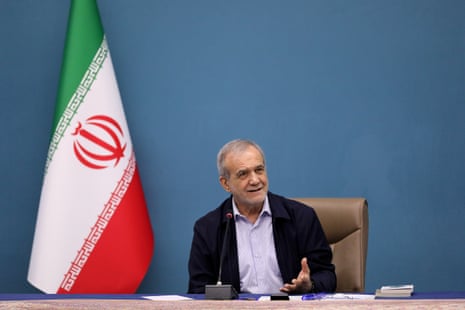
Read Patrick Wintour’s piece here.
Patrick Wintour is diplomatic editor for the Guardian
Europeans to press Rubio over Russian support for Iran at G7 meeting
Back to G7 now, and Reuters is reporting that the UK are “deeply concerned” about Russia-Iran links.
European powers accused Russia of helping Iran target U.S. forces in the Middle East war and said they would raise the issue in today’s meeting in France.
The ministers are also expected to discuss the strait of Hormuz, the critical Gulf waterway for the transport of oil and gas which Iran has effectively blocked, spiking energy prices and roiling financial markets.
Two western security sources and a regional official close to Tehran told Reuters that Moscow has been providing satellite imagery to Tehran and also helped Iran upgrade its drones to emulate the equivalent versions used by Russia against Ukraine.
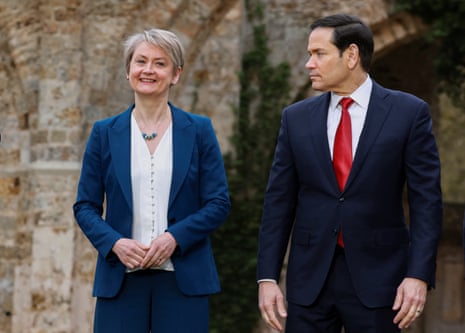
“We’re deeply concerned about the links between Russia and Iran that have been longstanding in terms of shared capabilities - for example, drones provided to Russia by Iran that have been involved in the conflict in Ukraine,” British foreign minister Yvette Cooper said.
“We have also seen support from Russia provided to Iran in the Middle East conflict,” Cooper told reporters at the meeting in Vaux-de-Cernay abbey near Paris. “As G7 countries, we have a shared interest in coming together to discuss these issues.”
Shipping to and from ports of US-Israeli allies still prohibited, says IRGC
Iran’s Islamic Revolutionary Guard Corps said on Friday that shipping “to and from ports of allies and supporters of the Israeli-American enemies” is prohibited through any corridor or to any destination, Iranian state media reported.
The IRGC added that the Strait of Hormuz is closed and any transit through the waterway will face “harsh measures”, according to Reuters.
Three container ships of various nationalities were turned back from the Strait of Hormuz after warnings from the IRGC revolutionary guards’ navy, media also reported.
US-Israeli strikes damage more than 100 museums and historic buildings, says Iran
Israeli strikes have caused damage to 120 museums and historic buildings, says Iran
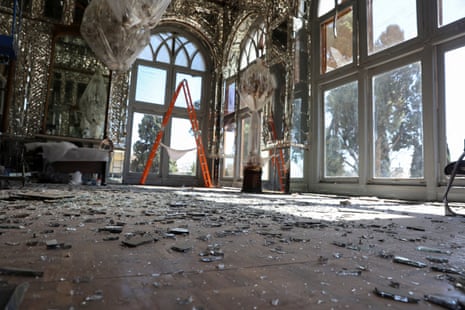
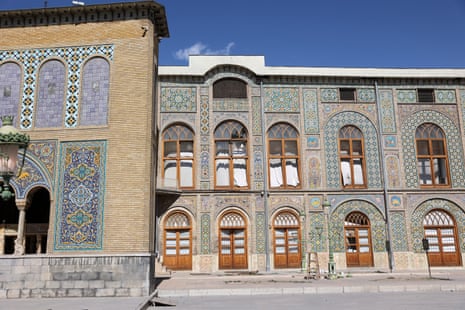
US and Israeli strikes on Iran have damaged at least 120 museums and cultural and historic sites across the country since the start of the war, the head of Tehran city council’s cultural heritage committee said in a report from AFP.
“At least 120 museums, historical buildings and cultural sites across various provinces were directly targeted and sustained serious structural damage,” said Ahmad Alavi.
He was quoted by state TV as naming UNESCO-listed Golestan Palace along with other sites damaged in the war, including Saadabad Palace, the Marble Palace and Teymourtash house, also known as the War Museum.