 2 months ago
74
2 months ago
74
Key events Show key events only Please turn on JavaScript to use this feature
IDF says it has hit Iranian command centres and weapons sites
The Israel Defense Forces (IDF) says it has temporary Iranian command centres and weapons production and storage sites in Terhan in a fresh wave of strikes.
In a post on X, the IDF said the sites targeted included “ballistic missile production and storage facilities, aerial defense systems, and observation posts of the Iranian regime”.
According to the IDF, Iran had moved some command centres to temporary sites. “Several temporary command centers were dismantled, including commanders who were operating within the HQ’s,” the IDF said in the post.
Iran Guards say strikes on Bahrain and UAE aluminium plants are retaliation for US-Israeli attacks
Iran’s Revolutionary Guards says it launched missile and drone strikes on aluminium plants in Bahrain and the UAE over the weekend in retaliation for a US-Israeli attack on Iranian industrial infrastructure launched from bases in Gulf states.
The IRGC said the strikes were targeting what they described as industries linked to the US military.
Since the Middle East war erupted at the end of February, Bahrain and other Gulf countries have regularly been targeted by Iranian missile and drone strikes in retaliation for the US-Israeli campaign.
In a statement carried by Iranian state broadcaster IRIB, the Guards said they hit an aluminium facility in the UAE and Aluminium Bahrain’s main plant, calling both sites “industries affiliated with and connected to the US military and aerospace sectors in the region”.
Aluminium Bahrain, one of the world’s largest aluminium producers, said two employees were wounded in an Iranian strike targeting its facility on Saturday.
The company, also known as Alba, said the workers suffered minor injuries.
Shipping helplines ring with alerts from seafarers trapped amid war
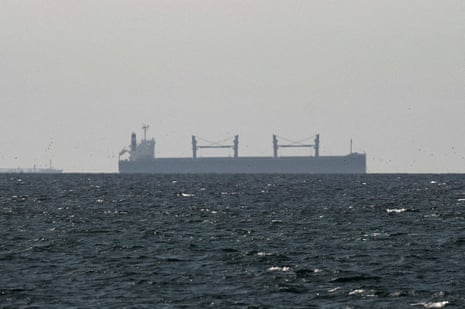
Seafarers’ helplines say they are overwhelmed with messages from crews stuck in the Gulf by the Middle East war, desperately seeking repatriation, compensation and onboard supplies.
“Writing to urgently inform you that our vessel is currently facing a critical situation regarding provisions and one crew health conditions,” read an email from one seafarer on 24 March to the International Transport Workers’ Federation (ITF)’s Seafarer Support team.
“Immediate supply of food, drinking water, basic necessities is required to sustain the crew,” said the message to the team’s helpline.
The ITF said it had received more than 1,000 emails and messages from seafarers stuck around the strait of Hormuz and the wider region since the war erupted with US-Israeli strikes on Iran on 28 February.
Opening summary
Hello and welcome to our live coverage of events in the Middle East as the war enters its second month.
The war only continues to escalate as Yemen’s Iran-backed Houthis confirmed a second wave of attacks on Israel since joining the conflict on Saturday. They have vowed to continue strikes in the coming days, posing a threat not just to worsening regional security but also global trade.
In Iran, two powerful explosions shook northern Tehran early on Sunday, an AFP journalist reported. The blasts occurred in the Iranian capital about 7.20am as air defences operated, but it was not yet clear what was targeted.
Meanwhile, the US is reportedly preparing plans for ground operations in Iran. The Trump administration has already deployed US Marines to the Middle East.
Here’s a quick recap of the latest:
-
In a televised speech, Houthi military spokesperson, Yahya Saree, said the Iran-backed group had launched a “barrage of cruise missiles and drones” in a second attack on Israel, targeting key military sites. He vowed the Houthis would continue military operations in the coming days until Israel “ceases its attacks and aggression”.
-
The entry of the Houthis, poses a direct threat to the Bab al-Mandab strait at the southern end of the Red Sea, a second major choke point in the supply chain of energy supplies and other trade in and out of the Middle East. With Iran’s near total closure of the strait of Hormuz, a shutdown of the Bab al-Mandab, located between Yemen and the Horn of Africa, would amplify the already grave impact of the war on the global economy, and could also reignite a Saudi-Yemen conflict.
-
The Pentagon is preparing plans for weeks of ground operations in Iran – potentially including raids on Kharg Island and coastal sites near the strait of Hormuz – though President Donald Trump has not yet approved any deployment, the Washington Post is reporting. Any ground operation would stop short of a full-scale invasion, instead involving raids by special operations forces and conventional infantry troops, the Post said, citing unnamed officials.
-
Exiled Iranian Crown Prince Reza Pahlavi has told one of the US’s biggest annual gatherings of conservatives that he is ready to lead a new Iranian government and would call on the country’s citizens to rise up when the “right moment arrives”, AP reports. Pahlavi is the son of the shah, a monarch deposed in 1979 when the Islamic theocracy came to power.
-
Iran’s Revolutionary Guard threatened to target US universities in the Middle East after saying US-Israeli strikes had deliberately targeted two Iranian universities. “If the US government wants its universities in the region to be free from retaliation... it must condemn the bombing of the universities in an official statement by 12 noon on Monday, March 30, Tehran time,” said the statement published by Iranian media.
-
Pakistan has said it would host a meeting of Middle Eastern powers on Monday in an effort to find a regional approach to ending the conflict. But the talks, which bring together the foreign ministers of Saudi Arabia, Turkey and Egypt, did not appear to include any of the warring parties, casting further doubt on persistent US claims of diplomatic progress.
-
Israeli attacks killed three journalists in a targeted strike on their car in southern Lebanon, which the Lebanese president condemned as a “blatant war crime”. The strike killed Ali Shoeib, from Hezbollah-owned al-Manar TV, Fatima Ftouni and her brother and cameraman Mohammed Ftouni from pro-Hezbollah outlet al-Mayadeen.
-
Tedros Adhanom Ghebreyesus, the director general of the World Health Organisation, called for an end to attacks on medical staff after nine paramedics were killed in southern Lebanon on Saturday.
-
The Israeli military bombarded Tehran with a “wide-scale wave of strikes”, damaging residential areas, civilian infrastructure, and research and educational buildings. The IDF also said it had hit Iran’s headquarters for naval weaponry.
-
Iran has allowed 20 oil tankers from Pakistan to pass through the strait of Hormuz. Ishaq Dar, Pakistan’s deputy prime minister, said two ships would cross per day. The country has been playing a key mediatory role in the conflict.