 2 hours ago
10
2 hours ago
10
The panicked crew of a cargo ship broadcast a distress signal late on Monday night from their location in the strait of Hormuz. About 20 nautical miles north of the coast of Oman, the Minoan Pioneer bulk carrier was hit by an unknown projectile, causing a blackout in the engine room and a fire in the accommodation area.
The crew scrambled to put out the blaze and called for help from nearby vessels. When they managed to disembark from the Greek-owned, Liberian-flagged ship on Tuesday morning, they realised the third engineer was missing. Days later, he is yet to be found.
The United Kingdom Maritime Trade Operations centre is investigating but has not yet officially confirmed the origin of the projectile, although analysts at the maritime intelligence company Windward noted: “Prior kinetic attacks at this exact location have been Iranian in origin, though Iran denies involvement.”
In the preceding 24 hours two other vessels in the region, a large- and a medium-sized oil tanker, had reported near-misses.
The flurry of incidents casts a spotlight on the danger facing the thousands of seafarers who remain trapped in the Gulf as the US-led war on Iran extends into its sixth month. What should have been a normal journey when they passed through the strait and entered the Gulf back in February has turned into a long and stressful waiting game.
Iran has in effect blockaded the waterway, trapping 20,000 seafarers for weeks on end and inflicting a huge psychological toll. One seafarer stuck in the Gulf told the Guardian in the early weeks of the conflict of the “impossible” situation they and their crew were in, which had contributed to another sailor having a breakdown.
As the war has dragged on, sailors have become casualties: 17 seafarers have died since hostilities began, the majority following Iranian strikes.
The crews stuck in the strait have had their hopes of departure raised several times, before being dashed. April’s ceasefire and the peace deal signed in June by Washington and Tehran both broke down shortly after being announced.
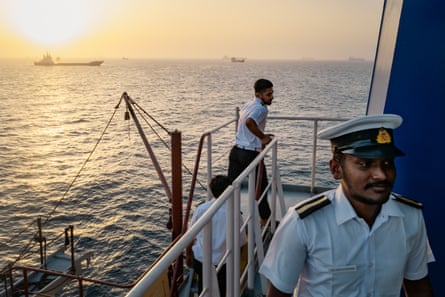
Several dozen oil and gas tankers seized the brief window offered by the memorandum of understanding (MOU), the ceasefire deal signed by both sides, to exit through the channel, but not all made it through in time. There are still 6,000 seafarers on 500 vessels, encompassing all types of ships, trapped in the Gulf, according to the UN’s International Maritime Organization.
“We need to remember that these are innocent people who are trained to do the work, that they are not trained for combat, and the vessels are not prepared to defend themselves against missiles and drones,” said the IMO’s secretary-general, Arsenio Dominguez.
For the crews stuck waiting to exit it is like being in “prison”, the head of one of India’s maritime trade unions said. “For the guys who are on board, the question that arises is, when is this going to end? The uncertainty of the ongoing geopolitical tension is causing them stress,” said Savio Ramos, general secretary of the Maritime Union of India, which represents merchant navy officers.
“It is like putting somebody in prison and not giving them freedom to move,” added Ramos, a tanker captain with more than two decades of experience moving large oil carriers around the globe. “You don’t know where you’re going, you don’t what you’re doing. It gets to you after some time.”
Most vessels – at least those with responsible owners – are receiving regular supplies of fresh water, food and other goods ferried by small boats from shore, yet most crews have no way of getting out of a perilous situation.
Ramos said some of the union’s members who wanted to return home had been able to do so, provided other senior officers were willing to enter the region and replace them.
Talks have been taking place, mediated by Oman, which along with Iran borders the waterway. However, the two countries’ proposed deal suggested Tehran would have control over the flow of traffic entering the Gulf. This would not be popular with shipowners or the wider industry and would be a significant deviation from the freedom of navigation for vessels before the conflict.
after newsletter promotion
Traffic is still passing through the strait, albeit at extremely low levels, since hostilities and attacks on ships resumed following the collapse of the MOU peace deal.
Only 52 non-Iranian linked vessels transited the strait in the week from 27 July to 2 August, according to analysts at the shipping publication Lloyd’s List, of which 60% exited the channel and 40% entered.
A further 32 Iranian-linked ships passed through the strait during the week. In total, these 84 vessels represent just over 10% of the average 700 ship movements each week before the conflict broke out.
This means 70 large oil and gas tankers, owned by mainstream companies that are not subject to sanctions, have been stranded in the Gulf since February, according to Lloyd’s List analysis. A further 65 tankers entered the region following the announcement of the MOU, only to find themselves unable to leave.
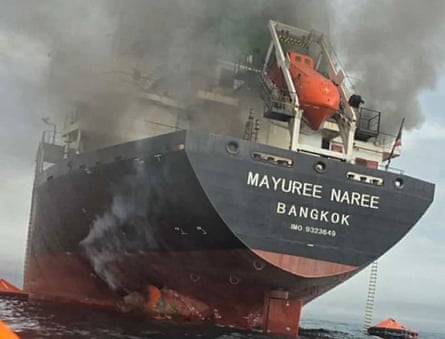
It is not clear how the stranded seafarers break down by nationality, but the biggest cohorts are likely to be Indians and Filipinos. India is the second largest global supplier of seafarers, with 312,000 working in the industry, after the 460,000 from the Philippines, according to the latest global seafarer report from the shipping associations the Baltic and International Maritime Council and the International Chamber of Shipping.
Since the war on Iran began, hostilities have spread to other regions including the Red Sea and Iraq. In addition, Russia and Ukraine have been attacking each other’s vessels in the Black Sea in an escalation of a maritime conflict in which 24 seafarers have been killed since the start of July.
This prompted analysts from Lloyd’s to call July “one of the deadliest months ever for commercial seafarers”.
Many in shipping are concerned that the longer the Iran conflict drags on and crews are stuck on vessels in a dangerous region, the fewer seafarers will be willing to travel to dangerous regions – or go to sea at all.
The IMO chief, Dominguez, pointed out that without seafarers the “90% of goods that are transported by ships will not be able to reach their final destinations and all of us are going to be impacted”.