 4 hours ago
15
4 hours ago
15
On a research vessel 15 years ago, a group of Japanese scientists documented something that had only previously been described by startled sailors to disbelieving listeners. They saw a formation of squid flying through the air.
The shoal of about 100 squid rose unexpectedly from a patch of the Pacific Ocean around 370 miles from Tokyo and glided near the boat for about 30 metres. The astonished researchers were the first to capture photographs of such a thing, which looked like the early stages of an alien invasion.
They were probably neon flying squid (Ommastrephes bartramii), the subsequent study states, a species that is part of a 20-strong flying squid family that was known to leap from the water but, until then, was only rumoured to also be able to glide above it.
The neon flying squid was able to gain such elevation by using the hyponome, a funnel-like muscular organ also present in other cephalopods, such as octopuses. The organ is able to force water out in a jet, propelling the body along both in and out of the sea. Photographs of the gliding squid show them with their arms (they have 10 limbs in all) splayed outwards.
Neon flying squid are about the length of a rolling pin and tend to gather near the surface to feed upon fish and crustaceans. It’s unclear exactly why they would fly in unison in this way, with one possible explanation being that they were evading a predator, such as a shark.
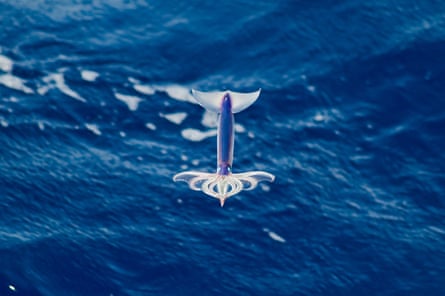
Flying squid are found around the world and their penchant for emerging from the water sometimes results in them landing on boats. But seeing such behaviour is unusual, even for those committed to studying the species.
“You have to be lucky,” said William Gilly, a Stanford University biologist who has spent several decades in squid research. “I’ve seen a small humboldt squid leap out of the water to get away from a mahi mahi fish, and the fish leaped out of the water too and caught the squid mid-air. But I’ve never seen them glide in a group.”
There is little doubt about the squid’s ability to move quickly in the water, however. Gilly has tagged a humboldt, the largest of the flying squid, and tracked it swimming at 10 metres per second (36km/h) in order to escape some sea lions.
Neon flying squid live across the Pacific, Atlantic and Indian Oceans and are highly migratory. They have an interesting golden or silver-coloured stripe down the middle of their undersides, perhaps as a form of camouflage.
In our popular imagination, the squid is often overshadowed by the octopus. But squid have their own sort of intelligence, they can change colour and they can swim more dexterously through the water than their more celebrated neighbours.
They are also more friendly. “One squid alone is an unhappy creature, it’s jittery and nervous,” said Gilly. “An octopus is a loner. It will kill another octopus if you put them in a tank together. Squid are far more social.”
-
It’s invertebrate of the year again! From 3-12 August, every day we will profile one of the thousands of amazing invertebrates that our readers have nominated. And then, when you’ve heard about all of them, we’ll open the voting so you can choose your favourites. Don’t hesitate to get in touch with thoughts and ideas: email us at [email protected] with Invertebrate in the subject line.