 4 hours ago
18
4 hours ago
18
The anticipation is palpable onboard the Boaventura II as the yacht sets off from Rio de Janeiro at sunrise. Once beyond the Cagarras Islands, rocky outcrops just three miles off Ipanema beach, the group gathers at the bow and starts scanning the horizon.
They do not have to wait long. “Eleven o’clock!” someone calls out, as a pod of bottlenose dolphins appears, playfully diving in and out of the water. Then, two spouts of vapour hanging in the air signal the reason for the outing: a pair of humpback whales. The majestic mammals surface to breathe with an unhurried chuff, before revealing the underside of their fluke as they dive back underwater.
This is a bucket-list moment for many on the boat, heightened by the spectacular backdrop of Rio’s jungle-cloaked mountains. But such a sight has become increasingly common, as Brazil’s humpback whales return to the shores of the Cidade Maravilhosa (Marvellous City) during the southern hemisphere winter after making a remarkable comeback from near-extinction.
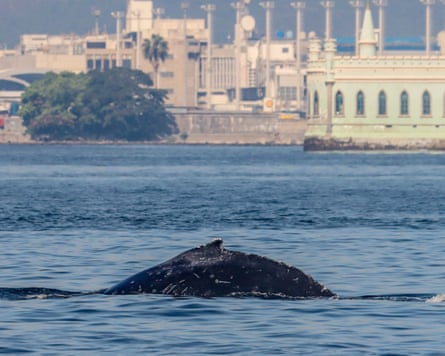
This year, one whale has even been repeatedly spotted within Rio’s Guanabara Bay. The sightings – at least 18 – are a first and have sparked speculation that humpbacks are returning to areas they once occupied centuries ago.
“You can’t put a price on this show. It’s pure magic,” says the yacht’s skipper, Theo Andrade, co-founder of the tour agency ROC Sail. After working on whale-watching expeditions around breeding grounds farther north, Andrade started running his own outings in Rio this year.
Luciane dos Santos, a 53-year-old passenger, is fascinated by the gentle giants and took a day out of her busy life running a drinks wholesaler in the hopes of catching a glimpse of them. “I’m amazed at how a 50-tonne animal can perform such a beautiful leap that leaves everyone spellbound,” she says.
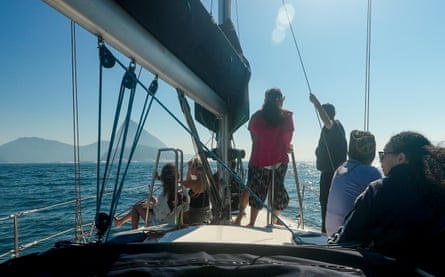
She was not disappointed. “I feel a sense of fullness – it’s truly a gift from nature,” says Dos Santos, after a morning spent admiring six humpbacks performing their aquatic ballet.
Humpbacks have always travelled along the Brazilian coast between June and November as they migrate from feeding grounds around South Georgia and the Sandwich Islands in the South Atlantic to the warmer, shallower waters of the Abrolhos Bank, off Brazil’s north-east coast, to breed.
As elsewhere, indiscriminate hunting – recorded as early as about 1780 in Rio by the artist Leandro Joaquim, who painted scenes of whales being chased and harpooned in Guanabara Bay – had decimated the population by the time a global ban on commercial whaling took effect in 1986.
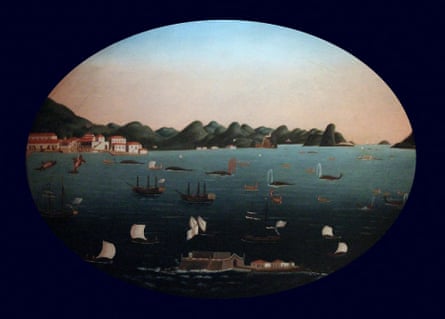
“At the end of the 1980s, fewer than 1,000 individuals were counted in this Brazilian group. Today, there are nearly 30,000,” says Thiago Ferrari, director of the Amigos da Jubarte (Friends of the Humpback) conservation project. Other estimates put the number closer to 35,000.
Brazilian waters are home to several whale species, including the once-endangered southern right whale – believed to be the species depicted in Joaquim’s painting – and Bryde’s whale. The 15-metre-long humpback is, however, “the star of the show” due to its acrobatic performances, says Ferrari.
Liliane Lodi, a marine biologist who works for the Ilhas do Rio (Islands of Rio) research project, which first registered a humpback whale in the city’s waters in 2014. The number of sightings has soared since then and, with them, observation of new and different behaviours.
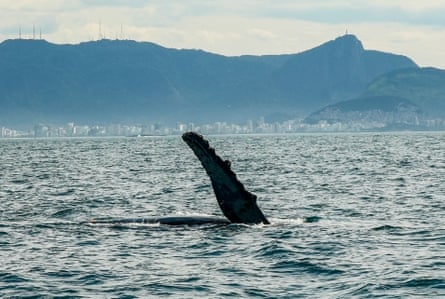
“Rio de Janeiro is an area of passage; it’s a migration route,” she says of humpbacks. “However, we have already registered behaviour that is typical of breeding grounds, rather than passage areas.”
That includes spotting newborn calves, displays of competitive behaviour between males and recordings of haunting whale songs.
This year, Lodi has been investigating the Guanabara Bay appearances. She concluded that they are of the same whale – a juvenile that has been living in the bay’s sheltered waters since mid-June, delighting early-morning canoeists. “It’s very sociable when it wants to be,” says Lodi, who enlisted the help of citizen scientists to study the animal.
Such collaboration between science and leisure is one of the reasons advocates believe Rio’s budding whalewatching industry can be a tool for conservation, as well as a new source of tourism revenue during the winter.
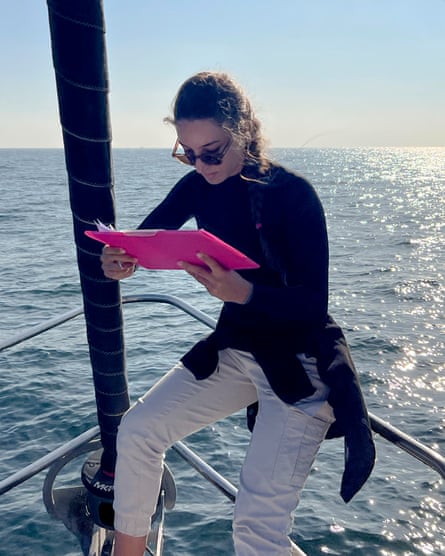
Mariana Bueno is an environmental sciences student employed by ROC Sail to accompany each whalewatching outing on the Boaventura II. “When you combine tourism and research,” she says, “you have infinitely better data collection than if you weren’t working together.”
Having a researcher onboard, says Ferrari, is “fundamental for healthy, sustainable and orderly whale-watching tourism”. With its team of biologists, the Amigos da Jubarte non-profit environmental organisation offers free training courses in partnership with local authorities, through which they have already certified about 20 agencies for cetacean watching in Rio, including ROC Sail.
Clipboard in hand, Bueno answers tourists’ questions, advises the skipper to ensure that he follows best practice – such as keeping at least 100 metres from the whales and never spending more than 30 minutes near the same individuals – and writes down details of every sighting. All of the information is passed on to Amigos da Jubarte to help research.
“Surveying the number of individuals allows us to track population growth … and individual behaviour,” says Bueno. “How they’re interacting with a vessel or how curious they are about humans. These behavioural surveys then serve as the basis for formulating laws and rules.”
But while Lodi recognises tourism’s contribution to research, she worries about its impact on conservation, as the trend for whale watching in Rio means more boats are clustering around the whale migration corridor just beyond the Cagarras Islands.
“This population increase is a source of great happiness to us researchers. But with an increase in numbers comes an increase in [human-whale] conflicts,” she says.
“Fishing, tourism, large ships, chemical pollution and noise pollution, these are all challenges [and] threats,” she adds.
Although Brazil has relatively robust laws protecting whales – swimming with them is prohibited, for example – the legislation needs updating and requires better monitoring to guarantee enforcement, she argues.
“For a whale, it doesn’t make much difference that one operator follows best practice if the others aren’t doing so,” says Lodi. “We’re dealing with highly intelligent animals. If they’re being intensely bothered, there could be cumulative effects in the long run.”