 2 months ago
75
2 months ago
75
An Italian council has bought a villa where Benito Mussolini spent his summer holidays, partly to avoid the property falling into the hands of “fascist nostalgics”.
Daniela Angelini, the leftwing mayor of Riccione, a town close to Rimini along Italy’s Adriatic coast, said the acquisition of Villa Mussolini through an auction was “an act of love and vision” and that bringing it back into public hands was a victory for the entire town.
Riccione’s council had fended off competition from a private buyer who was a former member of the Italian Social Movement, the neofascist party founded in 1946 by Mussolini’s lingering supporters.
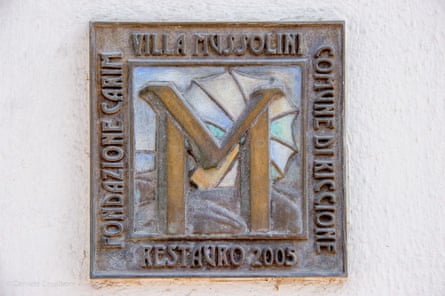
The villa has a long and, unsurprisingly, controversial history. Built steps away from the sea in 1893, it was bought by Mussolini’s second wife, Rachele, in 1934. The fascist dictator, who was born in Predappio, another town in the Emilia-Romagna region, would arrive by seaplane and often used the villa for government business during his stays. The Mussolini family expanded the property to include a third floor, 20 rooms and a tennis court.
After the second world war and fall of the fascist regime in Italy, the property came under public ownership. During Riccione’s economic boom in the 1950s and 60s, it was used for various commercial purposes, including a veterinary clinic for dogs and a restaurant. A communist mayor of Riccione tried to have it bulldozed in the late 1970s.
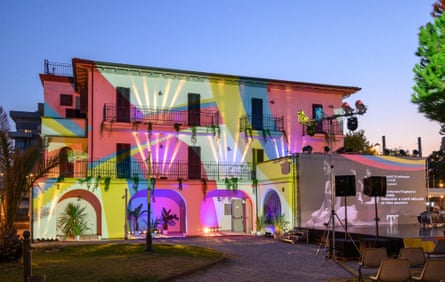
The villa was abandoned for years before being bought in the late 1990s by Rimini’s Cassa di Risparmio savings bank which restored and opened it in 2005 as a place for art exhibitions and other public events, including civil weddings.
The presence of the villa and its Mussolini associations have long divided Riccione, with debate resurfacing last year when the Cassa di Risparmio foundation decided to auction it. Councillors from Brothers of Italy, the far-right party of the prime minister, Giorgia Meloni, argued that whoever bought the property must not change its name from Villa Mussolini.
Angelini said the name would be maintained, despite pressure from some of her allies to change it.
She said history needed to be cultivated and not “cancelled” and that changing the name might have had the “dangerous effect” of turning the villa into a place for “fascist nostalgics … Something this administration will never accept”.
Angelini said the plan was to continue using Villa Mussolini as a community space, including for exhibitions recounting the “good, the bad and the ugly” of 20th-century history, and for other social and cultural events. “Yes, the name evokes an ugly story, and that we will tell. You can’t erase it, you must tell it in the right way, making sure our democratic values emerge.”
Since the second world war, Riccione, like the wider Emilia Romagna region, has been predominantly leftwing. But it was only in 2025 that the town council formally revoked Mussolini’s honorary citizenship, which almost all Italian towns and cities were forced to bestow during the fascist regime. “This is a man who was stained with crimes, who did not deserve that honour,” said Angelini. “But the villa is another story – it will be used as an expression of the values of our community and our democracy.”