 6 hours ago
8
6 hours ago
8
Almost 200,000 Ecuadorians and Ecuadorian Americans live in New York City, and last week quite a lot of them were in a Brooklyn restaurant called El Encebollado de Victor to watch their football team take on Germany – a traditional World Cup powerhouse.
It made for quite a sight: a sea of yellow shirts under the restaurant’s blue roof, which had been adorned with red, blue and yellow balloons for the occasion. Among the most patriotically dressed was Luis Aguilar, 45, who was born in the US to parents who had emigrated from Ecuador.
Aguilar was wearing an Ecuador jersey, an Ecuador scarf, and a straw hat with the Ecuador colors and Ecuador written on the front. He had an Ecuador flag tied around his neck, and was with a dog called Jax who was also wearing a flag.
As the match, held in New Jersey, began, it was clear there was a good turnout of Ecuadorians in the stadium too: yellow shirts were everywhere, and the country’s national anthem, ¡Salve, Oh Patria! was belted out in the stadium and in the restaurant.
“It’s very fascinating. I have not seen this many Ecuadorians in one place [the stadium] probably ever,” Aguilar said.
“To see all the yellow jerseys – it’s incredibly heart-warming and mesmerizing.”
New York City is home to more than 3 million people who were born outside the US, from more than 150 countries. It’s a mix that makes for rich culture and an array of food and experiences and, during the World Cup, patriotic hubs forming around bars, restaurants and cafes, as New Yorkers seek a taste of home.
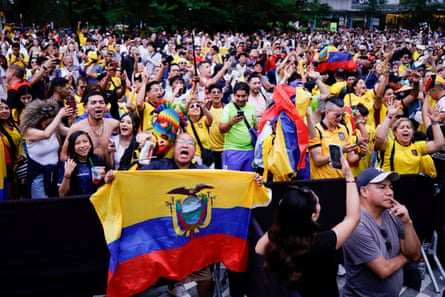
As the anthems were sung at El Encebollado de Victor, Karen Lasluisa, 12, was glued to a TV screen. She’s a big football fan – she plays in defence, and sometimes in goal – and was there with her two sisters and her mother, Elvia Tubon. Karen had a prediction for the game.
“I think she will cry if Ecuador loses,” Karen said, pointing at her mum.
It certainly didn’t start well. Germany scored after two minutes; Ecuador had to win to stay in the tournament. Luckily, they struck back and the game was 1-1 at half-time – when Daniel Gutierrez, 30, was confident they would win. Born in Quito, Gutierrez has lived in the US for four years, and has watched other games at the restaurant: “It’s kind of like being close to home,” he said. He was embracing that, eating encebollado – a fish stew made with yuca, onions and cilantro.
Away from football, Ecuadorians are experiencing a tough time. The country has become a transit hub for cocaine produced in Colombia and Peru; the government’s aggressive response has seen a surge in reports of human rights abuses, and at least 51 people, including children, are alleged to have been forcibly disappeared by law enforcement agencies.
“There’s lots of things going on in the country, and with all those bad things, this feels like an escape for people to enjoy themselves a little bit. To enjoy being together, to maybe hope for better things,” Gutierrez said.
“The political situation, it’s always been difficult for us. That’s why there’s lots of Ecuadorians in the US right now, because of immigration: we all have to come here and search for a better future.
“So we are like locals here, which is nice, but at the same time a little sad, because it should not be like that, you know. We should be all in Ecuador, supporting from our country.”
The restaurant served as the next best thing, and when Ecuador scored to take the lead, then closed out 2-1 winners, it was hard to imagine that the atmosphere was any more raucous back home. Chairs were sent flying as people leapt to their feet, a roar cascading out on to the quiet street. Karen Lasluisa didn’t get to see her mum cry after all – not tears of sadness, anyway.
The stadium was packed with Ecuadorians that day, but that has been less true for Senegal during the African nation’s journey through the World Cup. In March the Trump administration introduced a new policy which required people from countries including Senegal, whose team is nicknamed “The Lions of Teranga”, to make a one-time bond payment of up to $15,000 to enter the US.
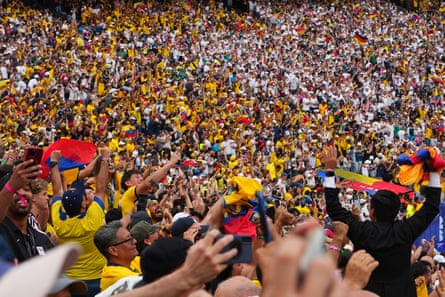
It meant few of the Douzième Gaindé, the Senegal national team supporters group, were able to attend. The supporters are colorful and loud, and are renowned for the impact they have on their team – Douzième Gaindé translates to 12th lion. Without them, Senegal struggled in their first few games.
People already in the US, however, have rallied behind the team. That was evident in New York’s “Petit Sénégal” neighborhood last week, a stretch of Harlem which is home to restaurants, cafes and stores. Senegal football shirts were visible everywhere, including in Pâtisserie Les Ambassades, a cafe which serves traditional Senegalese food.
Charlotte Gueye, 31, was in the back of the small, but airy space with a friend. Originally from Dakar, she has lived in New York for years.
“I think the visas thing did have an effect for the Norway game [Senegal lost 3-2], for example,” Gueye said.
“The Norwegians’ cheers were really loud, and I feel like there’s a psychological aspect for players from that: if you can’t see or hear your fans, I feel like that can affect you on the pitch.
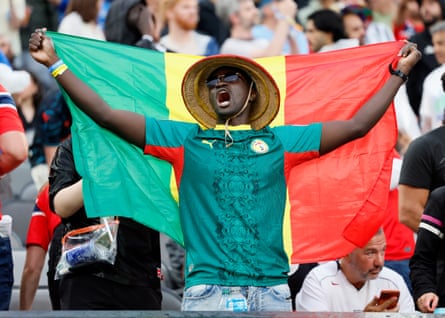
“I think it’s really sad that it came to that, not just for Senegal, but also for other countries where they were not able to get visas to come. That’s not what the World Cup is about.”
Gueye had ordered thiebou dieune, a fish and rice dish seen as the national dish of Senegal, and lamb mafé, a fragrant peanut and tomato stew: next to her Rokhaya Ndiaye, 25, and her husband Momodou Sey were also here for the traditional fare.
“Just to sit down and eat Senegalese food while watching our game, just showing full-on patriotic support, having our jersey on and everything, it’s the only way to watch the game,” Ndiaye said.
She was wearing Senegal’s green away shirt, Sey was wearing the white – they had bought them from a shop round the corner – and said the US was missing out on not having more fans from Senegal in town.
“Senegalese people are about warmth, kindness. They’re definitely super welcoming. Hilarious. Yeah, Senegal is just a place where, if you just want to put your mind at ease, it’s the place to go.”
Another nation with a strong claim to warmth is Brazil, who have won the World Cup a record five times. A Brazilian diaspora is spread across the borough of Queens, and people were shoulder-to-shoulder in Beija Flor, a restaurant in the Astoria neighborhood. Inside the owner, Lucia Cruz, has overseen an extensive program of football decoration, with yellow and green streamers dangling from the ceiling and A Seleção – the nickname for the team – cloths on the tables.
People were arriving at the bar at 11.30am on Monday, for a game which started at 1pm. Fans took up spots in front of a big screen and ordered coxinha, pastel and caipirinhas as they waited for the game to start.
“It’s a different energy,” said Ana Paula Fortkamp, 33, who moved to New York from Paraná, in south Brazil, three years ago.
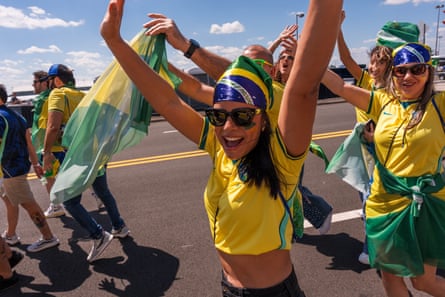
“It’s Brazilian energy. The whole world knows that we’re excited, and that we dance: you cannot find that in an American sports bar, you know, it’s very, very different.”
There was little to dance about in the first half, as Brazil went down 1-0 to Japan, who few had expected to win the game. With samba music blasting during half-time, however, the mood was upbeat as the second 45 minutes began. More people turned up for the second half, and Beija Flor set up two TVs on the street outside, where about 50 people crowded together, straining to watch the action.
“I think our culture as Brazilians, we’re a very embracing culture,” said Monique Prado, 29. She lives in Connecticut with her husband, and the pair had driven an hour and a half to watch the game.
“Even if you don’t know who you’re standing next to, they become like family at the time of a game. Brazilians – we embrace soccer so much, so when you’re watching the game with other people, we’re just your people so it’s a lot of fun, and it’s a great energy.”
As the game went on Brazil scored to equalize then, in the last minute of the game, they scored again to beat Japan and advance to the next round. Fans jumped in the air and embraced, cheers rebounding off the outside of the restaurant. People hugged each other, and extra drinks were ordered.
It might not have been the same as watching back in Paraná, or Rio de Janeiro, or São Paulo. But for these Brazil fans, like their Ecuadorian and Senegalese peers, watching with their compatriots offers a taste of home, an opportunity to come together, and, hopefully, to see your team win.