4 hours ago
21
4 hours ago
21
My Chemical Romance take the stage to the strains of the Carpenters’ Yesterday Once More, its syrupy but heart-rending tones offering a reminder that MCR’s current tour is essentially about nostalgia: it celebrates the 20th anniversary of the release of the emo figureheads’ third album The Black Parade. An hour-long concept piece about a dying cancer patient, it was a band throwing everything they could think of at an album, apparently gripped by fear that the multi-platinum success of its predecessor, 2004’s Three Cheers for Sweet Revenge, would prove fleeting. It variously sounded like pop punk, Queen, Britpop, glam, heavy metal, Pink Floyd circa The Wall and Kurt Weill, so wilfully overblown that when Liza Minnelli made a guest appearance on vocals, the listener scarcely raised an eyebrow.
The end result succeeded in catapulting the band to even greater fame and its reputation has only increased in subsequent years – in some quarters, it’s openly described as the Sgt Pepper of emo. A 2019 feature in the New York Times detected its influence not merely in the work of a host of subsequent emo bands, but in the oeuvres of pop and rap names such as Juice WRLD, Lil Uzi Vert, 100 Gecs, Billie Eilish, Melanie Martinez and Post Malone.
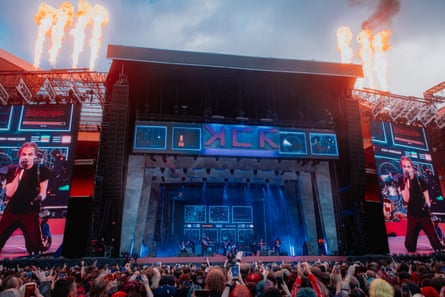
Happily, My Chemical Romance seem to have decided that the best way to celebrate the album’s anniversary is not merely to perform the album in full, but to amp things up a bit, as if they’d come to the conclusion that the original was maybe a little too understated for its own good. It now arrives with an entirely new concept attached: a storyline about a dystopian dictatorship called Draag, which comes not merely with its own language, but its own alphabet, designed by frontman Gerard Way. Stern-faced government officials and soldiers stalk the stage while the band perform; an actor playing the country’s leader sits on a throne, impassive in shades; Way sings Welcome to the Black Parade from a lectern.
It isn’t clear whether all this is intended as a comment on America’s slide into authoritarianism – though there’s definitely something of the ghastly obsequiousness that surrounds Donald Trump about Way’s description of the dictator as “the most handsome man alive” – but it isn’t entirely clear what’s supposed to be going on full stop. At one juncture, a mock execution by firing squad takes place in the centre of the crowd, followed by a burst of Boots Randolph’s Yakety Sax, better known as the theme from the Benny Hill Show. During Mama, a man with his back on fire runs across the stage. By the time the band reach Famous Last Words, most of the set is consumed by flames. Stuff about a nuclear war flashes across the big screens, which potentially explains the flames, but doesn’t explain why, midway through The End, Way is stabbed by a man dressed as a pierrot: he concludes the song prone on the stage, covered in blood, before the pierrot guy detonates a suicide vest.
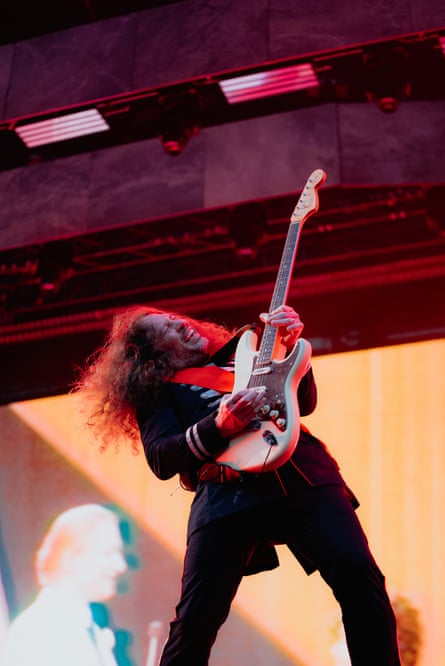
It’s completely baffling, but, equally, it would take a monumental effort on the part of the viewer not to be entertained by the relentless bombardment of visual effects and hammy acting, and indeed the sense that My Chemical Romance themselves are abundantly aware of how preposterous it all is: Way sings the angsty ballad Cancer to a ventriloquist’s puppet. Moreover, the music on The Black Parade is more than strong enough to withstand whatever imagery the band throw at it: no matter what’s going on onstage, the actual songs cut through, whether it’s the T Rex-y glam of Teenagers, or I Don’t Love You, which is essentially Coldplay’s Yellow with dyed hair, piercings and copious kohl around the eyes.
A second set, flitting through the rest of their back catalogue, demonstrates all the more that classic songwriting is what underpins their grand concepts, and their ability to alchemise teen angst into the stuff of high drama. Performed without costumes, actors or special effects on a stage in the centre of the stadium, the songs are no less varied or melodically striking than those in the main event: the bratty glam of Vampire Money, Helena’s angsty arena rock, Na Na Na’s bold combination of thunderous punk rock and rococo Brian May-influenced soloing. For all the retrospection implicit in the event itself, it also sounds weirdly current, something underlined by the fact that a substantial proportion of the audience are visibly too young to remember this stuff being released. Should the reconstituted My Chemical Romance choose to forge ahead rather than simply looking back, one suspects they’d be overjoyed.