 1 month ago
44
1 month ago
44
With the 2026 Winter Olympics off to a spectacular start with the opening ceremonies in Milan, Cortina, Livigno and Predazzo, the coming weeks promise medals, memories and iconic moments.
While history awaits this year’s athletes, we asked readers about their most memorable moments of past Games and the performances that still give them chills.
Adam Greener, 60, Oxfordshire
I was living and working in Tignes, France, during the 1992 Albertville Winter Olympics. The very first Olympic moguls competition took place on a long, steep slope on the verge of Val Claret, the highest of Tignes’ villages. I was drawn to the fun, irreverent, fast and loose attitude of the bumps skiers and the amazingly acrobatic and dangerous runs they put down.
One skier in particular, Edgar Grospiron, a young Frenchman, had captured mine and pretty much everyone else’s attention. He was known for his rapid fire runs, super fast turns, and massive airs (jumps). He was also seen as an upstart and challenge to some of the more traditional freestyle skiers, with their more finely carved, but fast turns.
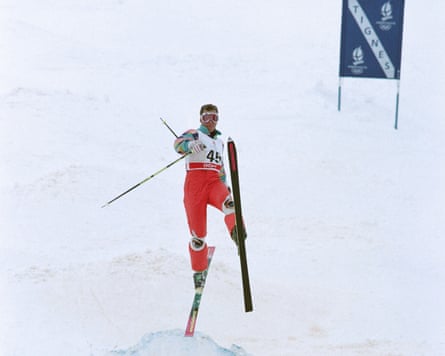
On the day of the men’s moguls finals it was packed. A massive crowd braved the cold and snow to cheer on some of the world’s most rad skiers. I got there early, I was right at the front of the pen with an amazing view up the slope. Music was banging, people were busting some pretty athletic moves (to keep warm) and there were drinks aplenty. When you go watch the moguls you go to party.
Grospiron finished top in the qualifying round and then advanced to the final. Up against his countryman Olivier Allamand and the American star Nelson Carmichael, his last run was insane. In just 31 seconds he covered almost 250 metres and pulled two massive jumps over moguls that were the size of small cars. It was pure adrenaline on planks – we all went crazy.
A French guy had won the inaugural Olympics moguls and it wasn’t just any French guy, it was the pioneer of “head down the fall line at breakneck speed and grace”, Edgar. He was already a legend to those of us who followed the bumps. The antithesis of the traditional ski racer, the purveyor of a competitive freestyle movement we see today everywhere. I’ll never forget that day, that crowd, that moment and that Winter Olympics.
John Runions, 64, Tring
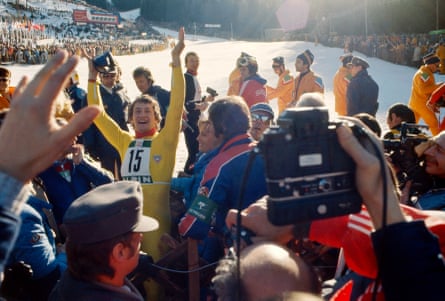
When I think of the Olympics, I think of lots significant moments but Franz Klammer winning the men’s downhill run in Innsbruck in 1976 is indelibly stamped in my memory. As a hardcore teenage skier watching in Ottowa, Canada, I was hyperventilating during his “edge-of-disaster” run.
I was 16 years old at the time, watching it live on the TV in my parents’ house. When I think back to that moment, I smile from ear to ear. As Klammer flew down the slopes, his arms were waving and his legs were sticking out, yet somehow he managed to get all the way down the hill without falling and still won the Olympic gold. His lack of style was impressive and something we hadn’t seen at that time. Normally, racers are coached to hold tight form in order to shave off tenths of seconds. But somehow it worked for Klammer.
For the next couple years afterwards, when me and my friends would go skiing on the weekend, we would try to find big bumps we could fly over with our arms and legs kicking out everywhere like Klammer. He inspired the mid-70s generation of us skiers to try emulating him on the ski hills. The ski patrol weren’t particularly pleased, as I recall, and to this day I have no form when skiing fast.
Ros Williams, 85, Somerset
Watching Jayne Torvill and Christopher Dean win gold with a perfect 6.0 at the 1984 Sarajevo Winter Olympics was something absolutely special.
I was in my 40s and worked as a secretary at the time. My husband, Ian, and I were both ice skaters for fun. I wasn’t a particularly good one at all, he was much better than me. He used to know Torvill and Dean, he was from the same place as them and they would sometimes skate at the same ice rink in Nottingham.
We watched the performance live on TV at home. One of the most striking aspectswas the music they chose to skate to. Maurice Ravel’s Boléro is one of my favourite pieces of music from one of my favourite composers. My favourite part was when they performed a jive at the end of their performance – that was marvellous.
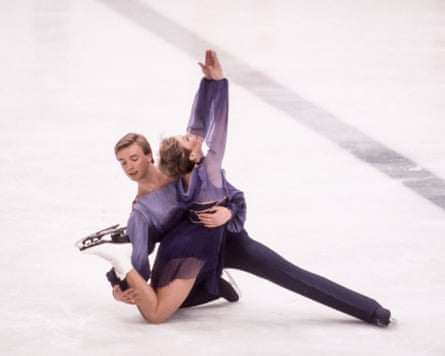
I remember we were staring at the TV and just gawked at them. I couldn’t believe what I was watching, it was amazing. I’d never seen anything like it, and even now, I still haven’t. There’s lots of wonderful skaters about nowadays but that was something truly unique. The moment inspired me and my husband to continue skating, I was on the rink way into my 60s, and my husband – who is in his 80s – is still skating now.
Tim Burrows, 60, Norfolk
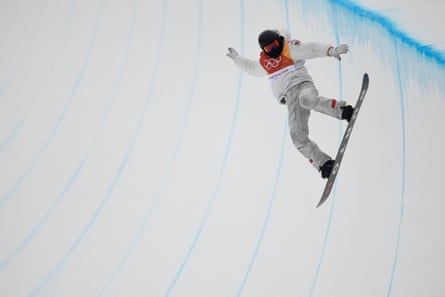
My favourite Winter Olympics moment was the American snowboarder Shaun White winning his third Olympic Gold in the halfpipe event at the 2018 Games in South Korea. He was in second place with the last run of the day and had to execute a perfect and technically very difficult run to win gold.
He had been practising what’s known as back-to-back 1440s (mid-air spins) that summer in New Zealand and almost ruined his Olympic chances when he hit the lip of the halfpipe with his face and needed 60 odd stitches. But he survived that and pulled off those tricks in his last run in South Korea to win the gold.
The run was what we snowboarders call “stoke” – a rush of euphoria. It made me cry. It meant a lot to me as someone who switched from skiing to snowboarding in my 30s, and despite some injuries to my wrists and elbows along the way, I stuck at it because of the great feeling that snowboarding brings. I intend to keep snowboarding well into my 60s and beyond if my nerve holds, although I’m absolutely terrified of the half pipe and I will never be Shaun White. I salute Shaun for what he did for my sport.