 6 hours ago
13
6 hours ago
13
When Tom Pidcock talks about how it feels to chase down the greatest cyclist of his generation, his language is so vivid you can almost taste the salt-baked sweat on Tadej Pogacar’s jersey.
But as we discuss the pair’s epic duel at the Milan–San Remo classic in March, and what it was like when a bloodied Pogacar went nuclear on the final climb, Pidcock can’t help but smile.
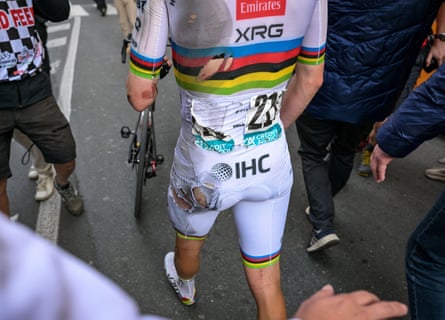
“Up the Poggio, when I was following his attack, it was like racing a zombie,” he says. “He was white, white skinsuit, white shorts cut up, blood. He’s a demon. It was incredible.”
What made Pogacar’s performance even more staggering was that he had crashed 30km from the finish. Yet as everyone else slipped back, Pidcock refused to back down. He kept pressing, through the descent and on to the Via Roma, where both men’s elbows and wheels swayed manically from side to side.
But then came heartbreak as Pidcock lost a race that spanned 297km by just four centimetres. “He crashed, and he still dropped everyone in the race apart from me,” he says, with a mixture of awe and bewilderment. “And we came to the line sprinting for the win. Obviously I was very frustrated with how close it was.
“Honestly, I have so much respect for him after that. He could have easily thrown in a towel. He got up. And he still won the race. That was a really incredible thing.”
But what do you say to cycling fans who believe that Pogacar’s dominance makes the sport boring? Should they just embrace and accept his brilliance? “Well, you have to embrace and accept it,” Pidcock replies. “But they’re not wrong are they?”
It is a reply that sums up Pidcock. In a world of soundbites and media training, the 26-year-old is a welcome throwback: a daredevil on the road, an unvarnished free spirit off it.
At one point, I tell Pidcock that Liz Truss also went to his alma mater, Roundhay School in Leeds, and was quite critical of it.
“Liz Truss, what was she again?” he responds.
“She was the prime minister.”
“Oh yeah, the one that lasted three weeks?”
“A bit longer than that, but still less than a lettuce.”
“Well, she has to blame her poor career on something, doesn’t she? I liked the school.”
On another occasion I ask Pidcock whether google.ai is right to suggest that he is a passionate Arsenal supporter. “An Arsenal fan? I don’t know anything about football,” comes the blunt reply.
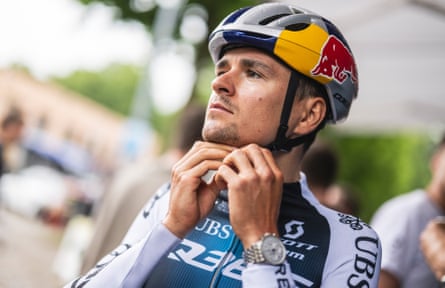
But with a month to go before the Tour de France it is clear that Pidcock is in a good place – something you couldn’t say after he fell into a ravine at the Volta a Catalunya at the end of March.
Somehow he managed to claw his way out before making it up the 16kmclimb to the finish, despite a stress fracture of the tibia, damaging several knee ligaments and sustaining heavy bruising. But why carry on?
“So it’s funny … well, it wasn’t funny. But at the time, once I’d got out of the ditch, I could get on the bike and I could kind of pedal. My shoulder, my elbow and my hand initially hurt the most. I was like, ‘Yeah, I’ve definitely broken something here but maybe I haven’t. I’m going to finish the stage.’
“But by the time I got to hospital, my knee was massive and I couldn’t walk. I was just super lucky I didn’t just explode it given the amount of bruising on both sides of it.”
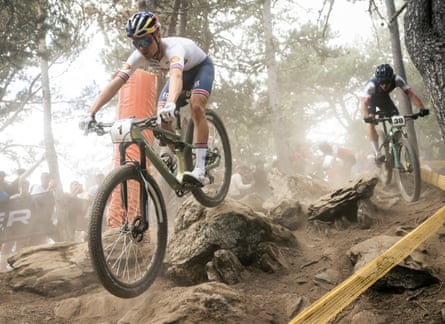
Yet a month later he was back racing at the Tour of the Alps, where he won a stage, and followed it up recently with his fifth victory in the Nové Mesto mountain bike race.
“I had quite a long time off – basically nine days doing completely nothing – which actually I never do even in an off season,” he says. “But I actually felt all right on the bike. I was like: ‘OK, let’s go race. Why not?’ And to be honest that’s quite brave, because I’m in the spotlight. I’m showing myself up a little bit if I’m not good. People expect me to perform.”
Does he thrive off adversity? He nods. “At the Tokyo Olympics, I broke my collarbone six weeks before. I think when something happens to me, I’m so on it and I’m so focused that I get the most out of myself.”
Now all eyes are on the Tour de France where Pidcock, then 22, became the youngest man to win on Alpe d’Huez in 2022. It is a day of which he retains fond memories, after chasing down Chris Froome and then breaking clear with 10km to go.
“The Alpe d’Huez was just cool,” he says. “Being the first person and passing all the crowds, it was one of those days where it all was just too good to be true.”
So what went through his mind as he went up those famous 21 hairpins? “To embrace the suffering. That’s something I’m still trying to get better at. You can always do a sprint when you’re going up a climb at threshold. You think: ‘Oh fuck, another minute. It’s so long.’ But actually you just have to take it minute by minute, corner by corner. Obviously it helps, when you have got thousands of people screaming in your ear from four centimetres away.”
He remembers something else about his first Tour, too. “After the time trial on stage 20 we stopped in this little town and Luke Rowe bought a massive crate of beers and I bought some biscuits and some Magnums, because I don’t really drink,” he says, smiling. “So it was just nice. And then we obviously had to race around Paris the next day. And it’s the hardest circuit in the world. You think you are all finished, but it’s hard and bumpy.”
Does he ever worry about crashes at the Tour? “No, it’s part of what we do. Mistakes happen. In general, with anticipation, you can tell when something’s going to go wrong. Also it’s about where you’re positioned in the peloton. If you’re strong enough to be at the front, generally you’re going to be safer. Or at the back, you’re safe. In the middle, in the death zone, then you’re asking for it. If there’s a crash, there’s no way out.
“It’s the same with driving. People who are good drivers will anticipate that something’s going to happen.”
So how often are you in the death zone? “Not very often. It’s just better to be at the back and get to the front in one go, and spend as little time there as possible. But some people like fighting just to stay in 50th position, which is the worst place to be.”
Pidcock is a fine descender and appears to have little fear. He has even taken part in several stunts for his sponsor Red Bull, including being filmed going 71mph behind a motorbike, but he rejects the notion that you have to be a little crazy to be a top road cyclist.
“I’d say that downhill racers are nutters. They can have pretty bad crashes, but that’s the type of person that they are. They don’t worry about crashes. But on the roads, there’s 150 other blokes that actually could do something which you cannot control, which means you get hurt.”
There is something else Pidcock believes people get wrong about professional cycling. “The amount of commitment, sacrifice, and hard work it takes to actually be at the top. Everything you do that’s not training or resting is basically impacting on your performance. You think ‘let’s go out for dinner’ but that’s full of fat and salt and it’s shit. So it’s really not a normal life.”
Pidcock says his fiancée, Bethany, cooks for him most of the time, but when he makes dinner he cooks rice in one pan, vegetables in another, and protein in a third. “And some soy sauce, salt and pepper, and that’s it,” he says.
When he is not cycling, Pidcock says he enjoys Formula One, watching mountain bike racing – which he prefers to road running – and in the winter he goes running.
In fact, he is such a good athlete that during lockdown Strava flagged that he had run a 5km in a lightning fast 13min 25sec, a time that would have been quick enough to qualify for the Olympic final. And while it later transpired that the Strava measurement had not been accurate, Pidcock says he wouldn’t mind another crack at running fast.
“I did want to attempt it again. But I never did. I run a bit, but I’ve done a lot less mainly because I can’t find any good running shoes. There are fast ones, but then I get shin splints. And then there’s big clockety ones, but then you just run slow because it’s like wearing walking boots.”
Still Pidcock agrees that he is in a much better place since joining the Swiss Pinarello-Q36.5 team after leaving Ineos at the end of 2024. “I’m a lot happier. It’s no secret that it was not going well at Ineos. It’s brilliant and I also think you see in my results. But we left on good terms.”
So did he not take extra pleasure in beating Ineos’s Egan Bernal in the Tour of the Alps recently? “No comment.”
It is a rare moment where Pidcock shuts up shop, but he is back being thoughtful and interesting when he discusses why he is not that desperate to add a Grand Tour to his two Olympic mountain bike gold medals.
“The Grand Tour thing doesn’t really excite me so much, but it’s an achievement. If I manage to win a grand tour it will be the biggest achievement in my career, because for me to concentrate for three weeks is difficult.
“But I want to win the road worlds. Then I will have won all three disciplines. And the gravel worlds, actually, but if that never happens I’m not not so bothered. I want a monument. And for sure, I’m going for three Olympic medals. My goal is to finish my career after five Olympics, so after the 2036 Olympic Games I’ll retire.”
That gives him theoretically another decade at the top. And having come third in the Vuelta a Espana last year, Pidcock knows that more eyes will be on him when the Tour de France starts in Barcelona in July. But he believes he can do himself justice against riders such as Pogacar, Jonas Vingegaard and the young French sensation Paul Seixas – and go on to win a Grand Tour in the future, too.
“Everything I’ve ever achieved in my career, I’ve always imagined doing it first before I’ve done it. I’ve never done anything out of the blue, like magic. So having that stepping stone, I know I can be on the podium again.
“I’m not saying that I have the ability right now to beat Tadej and Seixas and Vingegaard. But in the right situation, I can see it happening. And with the right situation, I can win a Grand Tour.”