 3 months ago
67
3 months ago
67
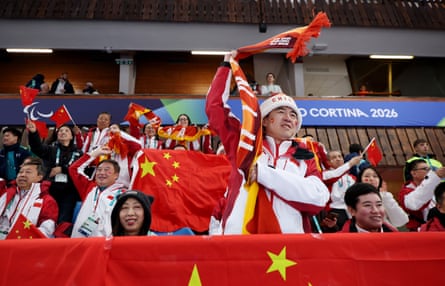
With two days of competition left at the Winter Paralympics there is no doubt who will finish top of the medal table. At close of play on Friday, China had a total of 33 medals, the same as their nearest rivals the USA and Italy combined. They have won gold in four of the Games’ six sports – cross-country skiing, curling, snowboarding and biathlon – and are in line for a medal in para-ice hockey too. This sporting dominance is all the more striking because, only eight years ago, China was nowhere.
At the Pyeongchang Games, the Chinese won a solitary medal, gold in the mixed team curling. Three of that team are competing here at Milano Cortina and a fourth, Wang Meng, already has a gold medal around her neck after winning the inaugural mixed doubles alongside her partner Yang Jinqiao. “I’m very, very proud, very, very honoured, and also very grateful,” she said after beating the Korean pair 9-6 following a tie-break end. “I’m so grateful to so many people who have helped us along the way, and [to be] finally standing on this podium”.
Meng’s reference to the support she has received will be directed in part to the staff of the National Ice Sports Arena for People with Impairments in Beijing. Covering more than 13,000 sq meters, the centre was opened in 2020 and is a hub not only for the development of elite athletes in curling and other winter sports, but for ordinary people with disabilities who wish to try out and learn about para-sport. A striking building that resembles a pair of wings, it was a central venue at the Beijing games four years ago. It was also just one part of a network of 40 similar venues that had been built across the country.
One Paralympic executive talks of their shock at seeing China “come from nowhere” to finish top of the medal table in Beijing. Again, it wasn’t close, as the hosts won 61 medals, more than a quarter of the entire total. But while the Chinese success was stunning, it was not necessarily a surprise. A similar transformation had taken place in the summer Paralympics some 16 years previously, when the Chinese stepped to the top of the table at the Athens games; a place they have remained ever since.
The approach that built and sustained athletic success in the summer had been effectively transferred to winter too. The process involves building infrastructure of the kind described above, but also outreach, with the China Disabled People’s Federation launching a grassroots ‘winter sports season’ in 2016. By the time of the Beijing Games this season was reaching people in 31 different regions of the country and, by Chinese official estimates, a total of 300 million people. That meant the Chinese National Paralympic Committee was able to select from a pool of more than 1000 para-athletes in 2021, up from only 50 when the programme began.
This all costs money, of course, and by all accounts it has been no object as China sought to level up its winter programme. Alongside all the structural development, there was also a recruiting spree ahead of the Beijing games, with leading winter parasport coaches from around the world brought into the country. One European coach recalled being taken to a mountain, presented with 200 young people and told to teach them to ski. But while there had been no programme previously, there was now the budget to create a world-leading one.
Anyone who has had experience of the Chinese parasport system raves about its sophistication and depth. But the country also has one natural advantage over its global competition: the size of its population. The Paralympic movement uses the statistic that 15% of people across the world have some form of disability. If you apply that calculation to China’s 1.4 billion people, the total is more than 200m. One experienced parasport official says 65m is more like the number that could possibly have parasport ability, and even a hundredth of that would still be a huge base from which to develop talent. As the Chinese sport expert Mark Dreyer puts it: “China’s population means it can field many elite athletes, and that only the most competitive Chinese athletes get selected. If there’s a Chinese athlete in your race, there’s a good chance they will finish on the podium.”
Perhaps the best illustration of China’s winter parasport progress this year has come in the shape of Wang Meng’s partner, Yang Jinqiao. The 24-year-old was by some distance the youngest curler in the mixed doubles competition, and was arguably its best by a similar measure. His cool draws in clutch moments, knocking two stones from the gate in late ends, proved decisive against both Great Britain in the round robin stage and Korea in the final. He started his curling career at a regional level in 2018, the same year Meng won her first medal.
“When I saw China won the gold of wheelchair curling in Pyeongchang, I was so excited and proud of them,” Yang said after the pair’s success.
“So you were inspired by me? You took me as a role model?” joked Wang in response.
Yang smiled, nodded and said: “Yes. For sure.”