3 months ago
94
3 months ago
94
'We will not allow ourselves to be divided,' German FM says backing Spain after Trump's trade threats
On that note, Germany has offered its solidarity with Spain in a marked change of tone, after chancellor Friedrich Merz's previous refusal to defend the European partner in front of Donald Trump sparked some tensions between Madrid and Berlin.
German foreign minister Johann Wadephul said that Spain can rely on solidarity from the European Union, and from Germany, when it comes to the threat of new US trade barriers, Reuters reported.
“We will not allow ourselves to be divided; we stand firmly together,” he said at a press conference with his Moldovan counterpart, Mihai Popsoi.
Key events 24m ago European Commission steps in to help with repatriation flights 1h ago France, Italy and Greece to coordinate military assets near Cyprus, eastern Mediterranean 2h ago EU must strongly push back against Trump's economic threats to Spain, senior academic says 2h ago UK defence secretary visits British base on Cyprus amid calls for action to protect island 2h ago Germany to monitor fuel price gouging attempts, minister says 2h ago First government-organised German repatriation flight from Middle East lands in Frankfurt 3h ago 'We will not allow ourselves to be divided,' German FM says backing Spain after Trump's trade threats 3h ago Nato's Rutte praises Spain's role across Nato territory amid US-Spain spat 3h ago Rutte welcomes French nuclear deterrence debate, but says US remains ultimate guarantor 3h ago Nato's Rutte confirms Turkey's ballistic missile interception was 'serious' 3h ago Italy will send naval assets to protect Cyprus, support Middle Eastern allies after requests for assistance, defence minister says 4h ago France authorises US aircraft to use some of its Middle East bases, military says 4h ago Spain sending frigate to help protect Cyprus, defence ministry confirms 4h ago Italy, Spain, France, Netherlands to send naval assets to protect Cyprus, Italian minister says 4h ago EU hopes to see US respect its trade agreement with applies to all countries, Kallas says on tensions with Spain 4h ago Iran trying to 'export war, expand it to as many countries as they can,' EU's Kallas says 4h ago Sweden advises citizens to keep 'warchest' in cash 4h ago Ukraine ready to share expertise on fighting against Shaheds with Middle East partners, Zelenskyy says 5h ago 'They know it's not true,' Spanish defence minister rejects US suggestions of U-turn on Iran 5h ago Morning opening: Spain dismisses suggestions it changed position on Iran Show key events only Please turn on JavaScript to use this feature
European Commission steps in to help with repatriation flights
The European Commission’s Emergency Response Coordination Centre has worked with member states on organising six repatriation flights to Austria, Bulgaria, Italy and Slovakia.
Ten member states have activated the EU Civil Protection Mechanism: Austria, Belgium, Bulgaria, Cyprus, Czechia, France, Italy, Luxemburg, Romania, Slovakia.
The commission’s ERCC helps logistically and works with EU delegation and member states’s consular authorities in the region, the commission said.
“In addition to the coordination efforts, the European Commission can pay part of the financial costs of the repatriation flights,” the statement stressed.
More flights are expected in the coming days.
France, Italy and Greece to coordinate military assets near Cyprus, eastern Mediterranean
Meanwhile, France, Italy and Greece will “coordinate the dispatch of military assets” to Cyprus and the eastern Mediterranean after the outbreak of the Middle East war, a member of president Emmanuel Macron’s team said, AFP reported.
Macron had called the prime ministers of Italy and Greece, Giorgia Meloni and Kyriakos Mitsotakis, the source said.
“They agreed to coordinate the dispatch of military assets to Cyprus and the eastern Mediterranean and to work together to guarantee freedom of navigation in the Red Sea.”
EU must strongly push back against Trump's economic threats to Spain, senior academic says

Lisa O’Carroll
European leaders must push back against Donald Trump’s attempts to punish states with economic sanctions unless they align to his military goals, a senior academic has said in a new paper.
He said the bloc should also consider triggering the Anti-Coercion Instrument if Trump tries to halt trade with Spain or impose country specific tariffs in retaliation against its refusal to be part of his war on Iran.
“European leaders must see this coercion for what it is and respond collectively” to defend the sovereignty of its member states including Spain which was threatened by the US president, he said.
“Various European leaders including France’s Emmanuel Macron, European Council president António Costa and European Commission president Ursula von der Leyen have expressed their support for Spain. But a joint European statement would send a stronger signal of solidarity,” said José Ignacio Torreblanca, a fellow at the European Council of Foreign Relations and former op-ed editor of El País.
Torreblanca says the European Commission should also make clear that if the US attempts to coerce Spain and halt trade or impose country-specific tariffs, it will trigger the Anti-Coercion Instrument, billed as the “bazooka” of EU economic tools.
“A unified European response has discouraged escalation from Trump before when he advanced the idea of acquiring Greenland,” says Torreblanca.
EU internal market commissioner Stéphane Séjourné said yesterday that “any threat against member state is by definition threat against the EU.”
UK defence secretary visits British base on Cyprus amid calls for action to protect island

Helena Smith
in Akrotiri, Cyprus
Over in Cyprus, where so many allies intend to send their reinforcements, the UK’s visiting defence minister John Healey has just wrapped up talks with his Cypriot counterpart.
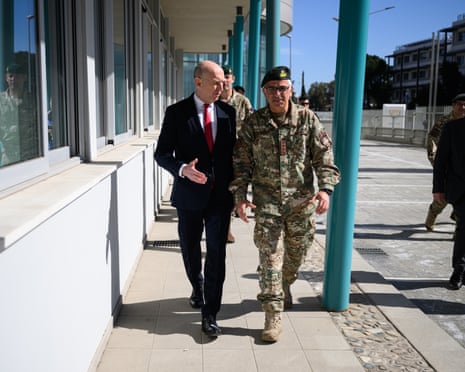
Emphasizing the two countries’ longstanding friendship, Healey said talks had focused on “how the UK is further reinforcing our air defences to support our shared security,” following Sunday’s drone attack on RAF Akrotiri.
The presence of UK sovereign base areas – a legacy of British colonial rule – has long been a bone of contention among both Greek and Turkish Cypriots. The drone strike, which caused marginal damage to the military installation’s landing strip, has brought that disgruntlement out into the open at an official level as never before.
For the first time the island’s political and diplomatic elite has expressed consternation over the dangers posed by the facilities, saying Britain has not done enough to protect the installations and surrounding areas where locals live.
The UK, unlike Europe, is perceived to have dragged its feet in deciding to deploy military support.
“There’s a sense of there being too little too late,” one senior official told the Guardian this morning. “There’s been a lot of talking at the highest level and the defense minister’s visit is part of that. But now we’ve gone beyond words. Now is a time for serious cooperation regarding the bases. Now is the time for action.”
Germany to monitor fuel price gouging attempts, minister says

Deborah Cole
in Berlin
Separately, German economy minister Katherina Reiche has said cartel authorities would look into fuel price gouging after a surge at the pump immediately following the start of Operation Epic Fury.
Petrol and diesel prices surged around 20% in Germany after the US-Israeli military assault on Iran began.
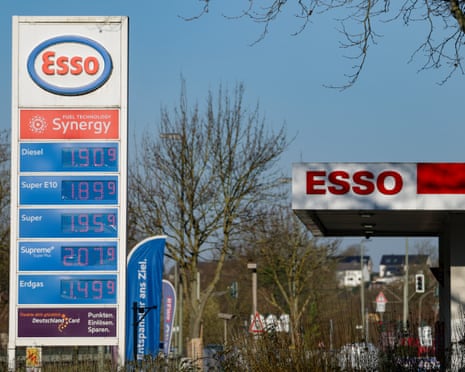
Average prices for diesel surpassed €2 per litre by Wednesday morning, the ADAC motoring club said, while the cheapest variety of petrol stood just half a cent below the €2 mark.
“We will ensure no one takes advantage of a situation which is reflected in the markets but not to this extent,” Reiche told the podcast Table.Briefings. She said she was in “close contact” with the Federal Cartel Office on the matter.
Finance minister Lars Klingbeil threatened oil companies with consequences if they tried to exploit the current crisis.
“There must be no rip-offs now, and politicians must of course take action and proceed clearly and consistently,” the Social Democratic party (SPD) leader told public broadcaster ZDF.
The SPD and CDU parliamentary groups representing the main parties in Germany’s ruling coalition said they would investigate the spike in energy prices with a view to taking action to curb it.
The premier of Saxony-Anhalt state, Sven Schulze, who faces a tough battle for re-election this year, called for relief for private households as well as companies including a “fuel price brake”.
Germany had already introduced a similar “pump rebate” after Russia’s full-scale invasion of Ukraine in 2022 drove up oil prices. The measure slashed energy taxes to bring the price of fuel down but ecological groups criticised it as offering false incentives to consumers.
First government-organised German repatriation flight from Middle East lands in Frankfurt
Deborah Cole
in Berlin
Meanwhile, the first government-organised flight carrying German travellers stranded due to the US-Israeli military operation in Iran landed at the country’s busiest airport on Thursday morning,
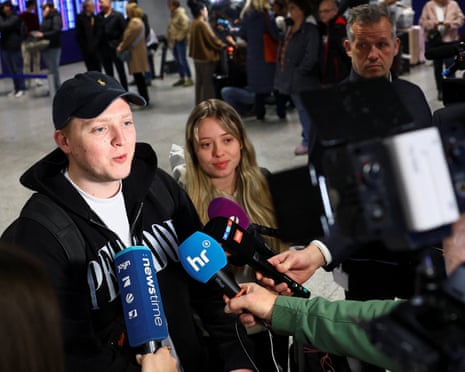
More than 250 relieved passengers touched down in Frankfurt on an Airbus A340-300 operated by Lufthansa from Oman with a nearly two-hour delay due to a late departure.
The evacuees were handpicked by the German government among tens of thousands waylaid in the Gulf. The group whose transport was deemed most urgent were first driven over land to Muscat from various points in the region.
Foreign minister Johann Wadephul, who has faced criticism for a muddled reaction to the traveller crisis, identified particularly vulnerable groups to get priority for the flights including the pregnant, the ill and children.
Further evacuations are planned in the coming days.
Other German nationals had managed to get on a severely limited number of flights offered by commercial airlines in recent days, primarily from the United Arab Emirates.
A heated debate broke out in Germany this week about the extent to which the foreign ministry was responsible for ferrying nationals out of the crisis region and whether the ministry’s travel advisories in the run-up to the outbreak of war were sufficient.
Wadephul had falsely claimed in a television interview that a travel warning had been in place for Gulf states for several days when one was only levelled for Dubai, a popular German destination, on Saturday, the day the US-Israeli military action began.
A travel warning includes a formal urgent call for nationals to leave an affected area based on a concrete threat to their wellbeing.
'We will not allow ourselves to be divided,' German FM says backing Spain after Trump's trade threats
On that note, Germany has offered its solidarity with Spain in a marked change of tone, after chancellor Friedrich Merz's previous refusal to defend the European partner in front of Donald Trump sparked some tensions between Madrid and Berlin.
German foreign minister Johann Wadephul said that Spain can rely on solidarity from the European Union, and from Germany, when it comes to the threat of new US trade barriers, Reuters reported.
“We will not allow ourselves to be divided; we stand firmly together,” he said at a press conference with his Moldovan counterpart, Mihai Popsoi.
Nato's Rutte praises Spain's role across Nato territory amid US-Spain spat
Nato’s Rutte also responded to the public spat between the US and Spain over Madrid’s refusal to back the US-Israeli attack on Iran and its reluctance to meet the 5% GDP spending target.
Rutte said that Spain had signed up to the Hague declaration just like other countries, and the debate is not on capabilities, but on spending required to meet that target.
“Practice will show, but … I am sure they will see they need to spend what is necessary,” he said.
But he also pointedly praised Spain, stressing it has deployments “all over Nato territory,” including “defending key American interests in Turkey.”
He declined to clearly side with Washington or Madrid, saying:
“When there are debates between allies I always try to stay a bit muted and therefore able, if necessary, to help [to resolve these differences] a bit,” he said.
Rutte welcomes French nuclear deterrence debate, but says US remains ultimate guarantor
In his Reuters interview, Rutte also welcomed the French president Emmanuel Macron’s speech on nuclear deterrence on Monday, which he said “is opening up our conversation within Nato on what we need to have,” and adds a layer of complexity for enemies, like Russia.
But he said the US nuclear deterrence programme remained the critical element of Europe’s security.
“However, and we all agree on this, the ultimate, supreme guarantor of our way of life, the fact that we have free media, free press, that we have elections, that we have our way of life, [all] regained so hard fought after the second world war is … the United States nuclear umbrella, and that is key.”
He also rejected any suggestion that the French move could have anything to do with doubts as to whether the US was still committed to Nato.
“I’m absolutely convinced the US is completely committed to Nato - not only because the US knows that there is a historic reason to be so much involved in European security – … but also because the US knows that to stay safe itself, the US mainland, you need a secure Atlantic, a secure Europe, a secure Arctic.”
He also praised Trump for his actions strengthening the alliance.
Nato's Rutte confirms Turkey's ballistic missile interception was 'serious'
Nato secretary general Mark Rutte is now giving an interview to Reuters, offering his reaction to the recent events in the Middle East.
On Wednesday, Turkey said Nato defences intercepted a ballistic missile launched from Iran before it entered Turkey’s airspace.
Rutte said it was a “serious and absolutely condemnable” incident, but declined to offer more details. He said it did not provide an immediate reason to trigger the mutual defence clause in Article 5.
Speaking more broadly about Iran, Rutte said that “we know that Iran was close to getting his hands on a nuclear capability … which would be a threat not only to the Middle East, and of course, to Israel, … but also a threat to Europe.”
He said the Iran war was still in “early stages,” and “it will be difficult to assess exactly how this will end in the coming weeks,” but he added:
“There is widespread acknowledgment and agreement that at least we have to be sure that going forward, Iran is not [going to be] able again to pose death threat to its neighbours, to Israel, the Middle East, to Europe, but also through its terrorist activities, exporting chaos, exporting terrorism, basically to the whole world.”
Nato’s Rutte also insisted that there is an understanding that the Iran war should not distract allies from supporting Ukraine as it continues to defend itself from Russia.
“The fact that Ukraine is now exporting [its capabilities] and making available to allies, friends, partners - it’s impressive,” he adds.
Italy will send naval assets to protect Cyprus, support Middle Eastern allies after requests for assistance, defence minister says

Angela Giuffrida
in Rome
Italian defence minister Guido Crosetto said Italy will send naval assets to protect Cyprus in the coming days as well as anti-drone and anti-missile air defence systems to Middle East countries.
Speaking to parliament before a vote on Italy sending military aid to the Middle East, he confirmed earlier suggestions by prime minister Giorgia Meloni (10:56).
”We’re not the only country facing this situation and we have all received requests for assistance,” Crosetto said.
“We are evaluating together, including how to share responsibility … we must reassess our positions in the region and respond to the requests of friendly countries in difficulty.”
Crosetto added that Italy intended to deploy a “multi-domain” presence in the Middle East, “with anti-drone and anti-missile air defence systems within the scope of our authorised operations and within the limits of our missions”.
Among of the Italian opposition parties, the Five Star Movement said its deputies would abstain from the vote.
“Europe doesn’t have enemies, Italy doesn’t have enemies, but we are fighting the enemies of others – the US and Israel are choosing our enemies,” said Five Star Movement deputy Arnaldo Lomuti.
He added that Italy ought to be “sending an aid package to Iran” and “sanctioning the US and Israel for attacking it”.