8 hours ago
13
8 hours ago
13
The house teaches you things, Lynne Eastaway says. Today, a choir of cicadas fill the scrub with a rhythm that rises and falls. On other days, there may be visits from birds, goannas, echidnas, wombats, wallabies and kangaroos.
“The bush ends, and the house begins,” she says. “You’re not the centre; you’re just part of it. That’s the thing you learn.
“Western life has forgotten that we’re not above nature. It can affect us and we can affect it too. Living here has been a wake-up call to living life.”
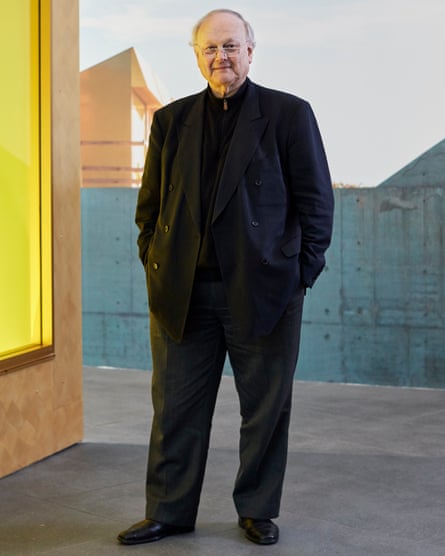
This is the kind of thing that happens when you live in a house designed by the pioneering architect Glenn Murcutt.
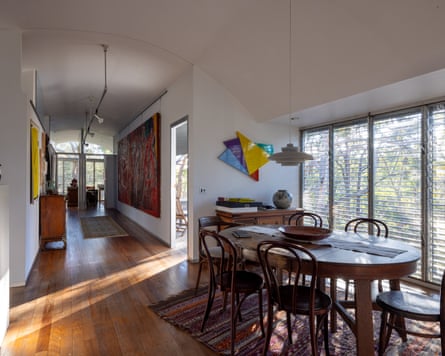
Eastaway’s house – known usually as the Ball-Eastaway House – on the 10-hectare block of dry sclerophyll forest north-west of Sydney, was built in 1983 at the request of Eastaway and her former partner, the artist Sydney Ball, in the early days of Murcutt’s career.
Since then, he has gone on to win architecture’s most storied award, the Pritzker, and is often cited as one of the pioneers of modern sustainable architecture.
When the house was commissioned, Eastaway and Ball had what would prove a short-lived romance, but a lifelong friendship. Ball had lost a studio to fire in New York and had been suddenly evicted from another studio in Sydney in 1976.
They had a modest budget but wanted somewhere to live and paint. Ball’s only demand was that it include a single, gallery-style wall on which to hang a painting.
A friend suggested Murcutt, and the three met for lunch before taking Murcutt out to see the land where the couple had been camping on and off.
Ever curious, he walked off into the bush for hours. “It was an amazing site,” Murcutt says. “It was just so beautiful. We were so careful about how we sited that house.”
Within the landscape, the key feature was a sandstone rock shelf – the obvious place to build, Murcutt says. It was already clear of trees and provided a refuge from fire, but the usual heavy-handed approach to construction was a risk.
“I thought closing it to the ground would destroy the rock and the topography,” he says.
Murcutt’s eventual design sunk 14 steel columns into the rock, suspending the whole structure above almost as though it were floating. It also ensured that, should the house ever be dismantled, there would be almost no trace it was ever there, in a way that has become part of Murcutt’s signature style.
As the jury citation for the Pritzker says, “his structures are said to float above the landscape, or in the words of the Aboriginal people of Western Australia that he is fond of quoting, they “touch the earth lightly”.
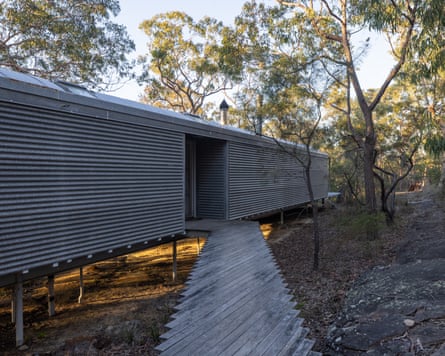
Lifting the building on stilts like this also allows air to circulate more freely, as it does with Murcutt’s own home, the Marie Short house, where itcools the house in the warm months and provides shelter for native wildlife (as the architecture journalist Katelin Butler notes, in Murcutt’s work there is usually more than one reason for each design decision).
There were other flourishes, too. Eastaway recalls Murcutt spending his time measuring eucalypt leaves to find the biggest.
These ended up determining the slope of the gutter, a system built so that, as leaves collected and were washed away in rain, they oriented themselves to form what looked like a birds’ nest at the base of the downpipe when they hit the ground.
Built out of corrugated-iron – a common but underappreciated material at the time – the modest exterior gives no hint of the light-filled home with its hardwood floors.
In addition to its two bedrooms, living and dining areas, kitchen and amenities, there were two verandas – one a social space, another enclosed on three sides so that it opens out on to the bush.
“The house is not taking you away from the environment,” Murcutt says. “There are parts in these buildings where you can remove yourself from the environment, or you can thrust yourself into it.”
Murcutt’s approach was deeply out of step with the way that Australia built in the 1970s and 80s – and even now.
But today, new generations of architects, in Australia and internationally, are influenced by his work. Francis Kéré, a subsequent Pritzker winner, has spoken of the impact of seeing one of Murcutt’s designs early in his career: “The simplicity, the openness, the comfort it created, it stayed with me.
“What struck me most was how architecture could feel so gentle and human, shaping a space that nurtures people. Later, when I met Glenn in person, I felt that we were connected in spirit, even though we come from very different places.
“His work shows that thoughtful architecture can honour culture, place and the environment all at once.”
Murcutt rejects any description of his work in political terms. What mattered, he says, was that everything was done for a reason – everything had to be “logical and sensible”.
For him, listening to the landscape and thinking about environment, climate and nature was as obvious and fundamental to the design process as thinking about water supply and sewerage.
“Why shouldn’t all buildings be prized for sustainability?” he asks. “If you get the basics right, if you start to work with nature, not manipulating nature, it starts to offer you the most beautiful solutions.
“Nature gives us the lead-in to many things that will resolve some of the questions we have – if we’re curious.”
As for Eastaway, she is slowly preparing to leave. During her tenure, the house has had some renovations thanks to the help of Downie North architects, and in February it received heritage listing by the New South Wales state government.
Now, as she enters a new stage of life, the 77-year-old says it is time to pass on custodianship.
“The bush never stays the same. The weather and animals change it,” she says. “The older you get the more you realise you’re not going to live for ever.
“You can leave things as they are, you can change things, but hopefully you change things in a way that leaves the world better.”