 2 months ago
69
2 months ago
69
I was born in Tawau, a Malaysian city on the island of Borneo, and grew up around logging camps – my dad worked in the industry. In the early 90s, a lot of the forest here started being cleared for commercial use. At the time, I just thought that was the way things were.
That changed when I began working in conservation as a teenager at the South East Asia Rainforest Research Partnership in the nearby Danum Valley. My job was to plant seedlings in places where the forest had been cut down. I began to learn about the importance of keeping the forest safe.
When I was about 19, I saw colleagues up the trees in the valley’s forest. Tree-climbers help with scientific research by measuring the height of trees and setting up cameras to monitor wildlife.
I instantly thought: I want to do that. I was afraid of heights, so it wouldn’t be easy, but I wanted to challenge myself. There are a lot of people doing conservation research on the ground, but not so many people doing the same high up in the canopy.
I have since spent my life climbing trees. In 2018, researchers from the University of Nottingham spotted a yellow meranti tree in a Borneo rainforest. It was estimated to be 100 metres tall, which would make it the tallest tropical tree in the world. Our team was tasked with finding out.
We were given a GPS location for the tree – finding it took three to four hours of wading through the thick forest. Once we made it, I remember looking up and thinking: damn! It wasn’t until three months later, in January, that I finally went to climb it. I was nervous and kept putting it off.
I took a team of 10 on the expedition. We had about 400 metres of rope with us, and used a fishing line to shoot at the tree and anchor the ropes. Two of us would climb, while the others kept watch on the ground.
The other climber and I both had climbing harnesses and used a rope‑walking system to get up there: you kind of walk up along the rope, moving from branch to branch. I had a tape measure in my harness and one of the guys on the ground was holding the other end.
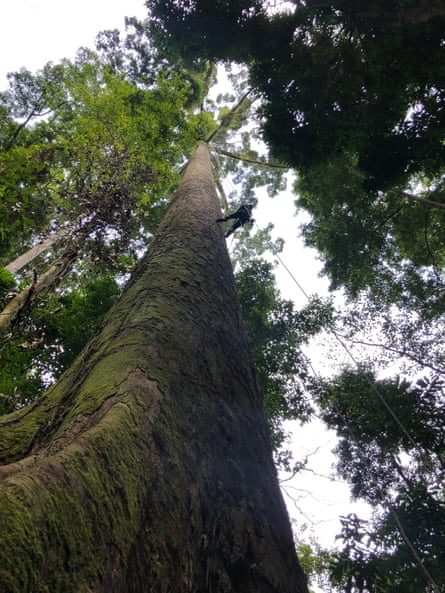
It was a slow ascent: I needed to check the tree carefully as I went, to see whether the branches were strong enough, or if there were any snakes, scorpions, wasps or other insects. One time while climbing, I happened across some bees and got attacked. A few got stuck in my helmet. I got about 100 stings on my body, and when I got down I passed out for 20 minutes. Now I never wear bright colours when I’m climbing.
This time, though, the way ahead seemed clear. My colleague and I continued the ascent. He’s a good climber, but on that day he was afraid. The tree was about 50 metres taller than the surrounding trees, so we felt very isolated.
I asked all my guys on the ground to wear orange helmets so we could see them from the top. At 70 metres we glanced down and they looked like tiny ants. Soon, I couldn’t even see the forest floor.
Once I reached 70 metres, I began to make out the wider landscape, and the fear went away.
I climbed to about 95 metres – after that, the branches were so thin that I wasn’t able to climb them any more. I held a pole to the top of the tree to measure the final height – it came in at 100.8 metres.
When I looked below me, everything was clear. I could see the many layers of the rainforest’s canopy. It was like the sea; each tree like a tiny ripple. There were clouds peering over the forest. The patterns were unlike anything I had seen before. The air was still and I could see miles of luscious green. I thought: wow! I wanted to stay there overnight just to enjoy the view. The descent was quick, but I couldn’t wait to come back another time and climb it again.
It took me more than two hours to climb to the top that first time. I’ve since done it again in about 40 minutes, while I installed cameras for research. Every minute was worth it.
I do this work because I want to show the world how important it is that we save our beautiful forests. For me, every tree tells a different story about our history. Besides, it’s so calm up there; there’s nothing else like it.
As told to Naomi Larsson Piñeda
Do you have an experience to share? Email [email protected]