2 months ago
62
2 months ago
62
Like many new parents, photographer Alexander Meininger found his world changed after he had kids. “You end up spending a lot of time observing them in playgrounds – whether you want to or not,” he says.
Meininger, who grew up in Germany but now lives in London, likes making things. So when he saw how much his young sons enjoyed the jungle gym and play forts at the local park, he made an indoor treehouse for them. That was as far as it went – until the Ukraine war. Watching the destruction of infrastructure on television, Meininger wondered what he could do to help Ukrainian children, and alighted on the idea of playgrounds. This was his first step towards creating Playrise, a charity he launched this week in London that makes flatpack play equipment and furniture for displaced families living in disaster relief zones.
“To start with I thought about collecting usable pieces from the rubble in conflict sites to make the play apparatus, but these communities need something affordable that is quick and easy to assemble,” Meininger says. “Just like when you’re renting you don’t want bespoke furniture, you need something from Ikea, in refugee camps there is no appetite for anything permanent. The problem is that a lot of people end up in this temporary accommodation for a depressingly long time.”
Meininger set to work finding a solution. He joined forces with UK architect firm OMMX and engineers Webb Yates to work on prototypes. And through the NGOs Empowerment for Development and Save the Children, he connected with displaced communities in Egypt and Ethiopia to find out what play equipment would be suitable. They went to the Aysaita camp for Eritrean refugees in Ethiopia and two sites in Egypt – a hub for the Palestinian community in Cairo and a refugee site in Karkar for Sudanese fleeing the civil war.
Hikaru Nissanke, director of OMMX, says Playrise was a good fit for the architecture firm, as it also runs a UK-focused scheme called Young Policymakers that promotes the needs of children and connects them with decision-makers in the building industry.
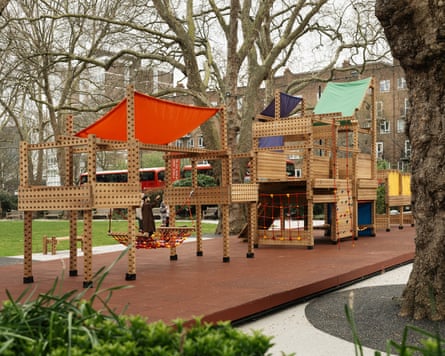
The Playrise prototype is a modular set of iroko hardwood beams and planks fixed with metal bolts, which can be customised with add-ons such as ropes, monkey bars and basketball hoops. The system can be reconfigured to meet each location’s limits and the needs of a diverse range of users. If parts break they are easily replaced. All of the bolts are fitted with playground-specific security nuts.
“The project was complex,” says Nissanke. “We needed a structure that could be mass-produced for scale, yet still feel deeply personal to each community. We were designing for everything from vast open deserts to cramped inner-city courtyards. But beneath these varied site conditions, we found a universal truth: no matter how different their circumstances, every child wanted to find joy.”
Research has found that play isn’t just fun, it is vital for child development. Outdoor play fosters the development of motor skills and teaches cooperation, teamwork and social skills such as sharing and communication. But in 2025, according to Unicef, close to 50 million children were living in forced displacement, with young people accounting for around 40% of the more than 122 million people who had to flee conflict. Nearly one in six children are now affected by war, according to the UN council of Human Rights.
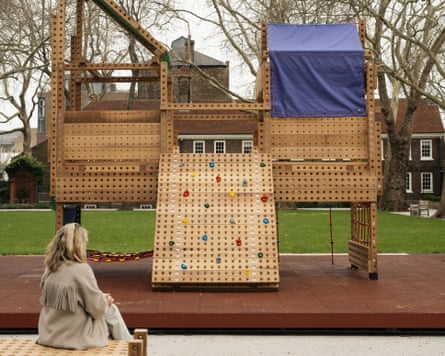
The first Playrise set will embark to the Aysaita camp in Ethiopia next month. This site was first established in 2007, so some children have been residents of the desert encampment for their whole lives. Nissanke says families at the camp report that their children helped construct the play structures they were sent to try out, gaining hands-on experience of building. “We’re equipping them with the practical skills they will one day need in order to build and maintain their own homes. This struck us as poignant, given the precarity with which they’re living.”
Meininger is looking to the future of Playrise, while trying not to get ahead of himself with ideas of meeting spaces or the possibility of community gardens. For now he wants to simply scale the project so the charity can produce and stock the play set and make sure it’s available when needed by NGOs – and by young people.
“We didn’t want to go into this with a western perspective of what kids should do, or be patronising. But from the countries I’ve visited, I’ve seen that, on a basic level, humans are humans and they wish for the same things. One of those things is that they want to see their kids thrive and play.”
-
For more information on Playrise, visit the charity website