 6 hours ago
15
6 hours ago
15
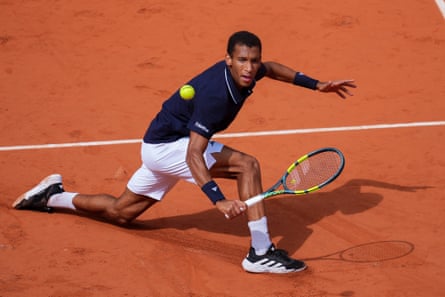
Félix Auger-Aliassime has long been one of the more measured and reflective players on the ATP Tour. He may be desperate to achieve his potential, but the Canadian also understands that improvement is often a long process and remaining patient is essential.
That is what made his reaction to defeat at the French Open so striking. As the fourth seed reeled from his desperate quarter-final loss to Flavio Cobolli, fully conscious of the fact that he had missed the greatest opportunity of his career, Auger-Aliassime was as distraught in public after a loss as he has ever been. His patience had run out.
“I can’t complain with my life, but I’m in a place right now with my tennis career that it’s tough,” he said. “I’m destroyed today a little bit. It’s tough. I usually handle losses pretty well, I have to say. Like, my whole career, I was going back to training with optimism and positivity. Now I feel as if I’m not the player I want to be, so today is a difficult day.”
Roland Garros this year played host to one of the most dramatic men’s grand slam tournaments in recent history, with the second seed Alexander Zverev emerging from the chaos to finally win his first major title. In the aftermath, quite a few other leading players in the men’s game would be smart to reflect on how badly they failed to even give themselves a chance to compete alongside the German for the title.
Before Roland Garros, Carlos Alcaraz and Jannik Sinner had shared nine consecutive grand slam titles between them, leading many to question the strength of the challengers behind. Those questions will now only increase. In a tournament where Alcaraz, the defending champion, was absent due to injury while Sinner lost in round two, most of the top players were nowhere to be seen. Zverev ended up facing only one top 20 opponent, Cobolli (the world No 14) in the final, across his seven matches.
It is nearly impossible to exaggerate the madness that unfolded elsewhere. Sinner had entered the tournament as the strongest favourite this century (other than Rafael Nadal in 2009) after rolling through tournaments in Monte Carlo, Madrid and Rome. Instead, he led Juan Manuel Cerúndolo 6-3, 6-2, 5-1 before completely crumbling physically and losing 18 of the next 20 games.
Sinner’s loss transformed the tournament, but four of the top 12 – Daniil Medvedev, Taylor Fritz, Alexander Bublik and Jiri Lehecka – were already out. Ben Shelton, the fifth seed, was out by the end of the day. The next day, 39-year-old Novak Djokovic led the 19-year-old Brazilian star João Fonseca by two sets before being outgunned in five dramatic sets. This was certainly a good tournament for youngsters, with the 20-year-old Jakub Mensik, 19-year-old Rafa Jodar and Fonseca all enjoying breakthroughs, even if they were not ready for more.
The rest of the tournament was defined by tension as the remaining players tried to seize the opportunity of a lifetime. It is hard to imagine there will ever be a day like Saturday 30 May again, where nearly every match in the top half vacated by Sinner was so tight. Five of the eight men’s matches went to five sets, including a ridiculous five-hour-58-minute win for Cerúndolo over Martin Landaluce, the longest ever five-set match with a match tie-break. After Matteo Berrettini retired from his quarter-final match with Matteo Arnaldi, Arnaldi withdrew before his scheduled semi-final match with Cobolli due to a virus. These men were mentally and physically destroyed.
One of the bleakest aspects of this tournament was the sheer number of top male players who did not even make it to the start line and so many of the absentees being contemporaries of Alcaraz and Sinner, players who really could have taken this tournament by storm. On the eve of the event, the news that the 21-year-old Frenchman Arthur Fils would be unable to compete in Paris due to a hip injury was a massive blow. Fils had been one of the best performers in the months leading up to the French Open, a champion in Barcelona and semi-finalist in Miami and Madrid. It was deeply disappointing that he did not have the opportunity to see how he would have handled the pressure.
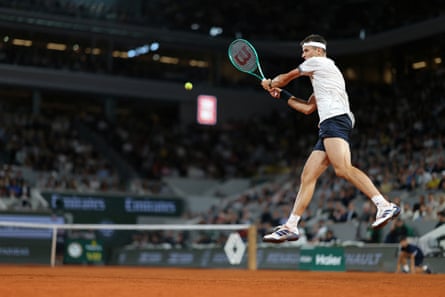
Likewise, the 24-year-old Lorenzo Musetti reached the semi-finals or better of all the big clay-court tournaments last year and would have been a contender if not for the fact that, since his retirement in the semi-final in Paris last year, he has frequently been injured. This could have similarly been a huge opportunity for 24-year-old Jack Draper, but he has been unable to stay healthy. Holger Rune, 23, is still sidelined due to the torn achilles tendon he suffered last year. The timeline of Alcaraz’s recovery from his right wrist injury remains uncertain.
Between so many injuries, some competitors being in poor form and other players not quite having the ability to push on, men’s tennis is in a curious position at the end of the second grand slam of the year and it seems like the terms of engagement will be similar at Wimbledon. Assuming there are no lasting physical effects from his Paris meltdown, the defending champion Sinner will probably begin as the heavy favourite. However, if he falters again, anything is possible.