3 months ago
69
3 months ago
69
Neither Dolce nor Gabbana would comment on the all-white casting that clouded their menswear show in January, though it seems they read the headlines. More than a third of the looks at their womenswear show in Milan on Saturday were modelled by women of colour.
Instead, they wanted to talk about identity. Not politics, but more tellingly, theirs. “Our collections speak to us, our identity, our values,” said the pair after the show. “We never wanted to follow trends.” Their aim instead, they said, was to make “instantly recognisable” clothes that “when you see [them] … you think: ‘Oh, that’s Dolce & Gabbana,’ without reading the label.”
In many ways, you can. The business partners have rarely strayed from the idealised vision of Italian archetypes on which they founded their brand in 1985. For men, it is the macho Italian beefcake. For women, it is the Sicilian widow – and the mistress.
On Saturday’s catwalk, they introduced a new woman into the fold, the gen Z hipster, wearing baggy ripped-denim jeans and a satin bra-top. Otherwise, most of the show was black, save for a red shoe, a scarlet lip or a pretty green doctor’s bag. There was fur but thankfully it was fake. (Milan and Paris are yet to join London and New York in banning animal fur on the catwalks.) Crucifix earrings and Cinema Paradiso-style baker-boy hats were among the accessories.
Never afraid to mix the sacred with the profane, Dolce & Gabbana have been making underwear for outerwear since the early 1990s. Now that the nipple has been fully freed, the focus today was on liberating the knicker. Almost half the models had theirs on display under sheer lace dresses, and one model even had a white shirt tucked into some bloomers.
The Italian brand has been beset by controversy over the years. In 2012, they were accused of romanticising slavery after sending models down the catwalk wearing earrings reminiscent of blackamoor artworks. Three years later, the label listed a pair of shoes on its website as “slave sandals with pompoms” (later renamed “decorative flat sandals”). In an interview, they once called IVF babies “synthetic” and said they did not support the right of gay parents to adopt. Their backfiring campaign in China in 2018 resulted in the brand being pulled from most Chinese-owned sites, allegedly costing the company a third of its business.
Dolce & Gabbana rarely engage with the criticism. Still, the brand – and the glamorama lifestyle it peddles – remains one of the industry’s best known, generating almost €2bn (£1.8bn) in annual revenues. It remains the most-worn menswear brand on the red carpet too, though for some reason much of today’s tailoring came back to front.
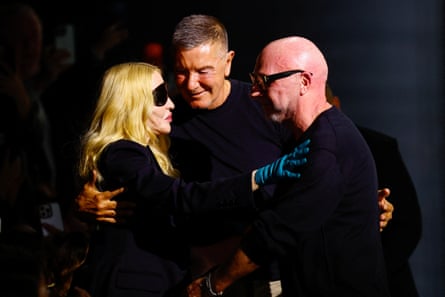
Catwalk shows are a marketing exercise that designers hope will sell clothes and remind fans why they love the brands. Two of those fans – Lauren Sánchez, who wore a Dolce & Gabbana gown at her wedding to Jeff Bezos, and Melania Trump, who chose the brand for both of her official White House portraits – were absent from the front row. More pleasingly, it was Madonna who turned up half an hour late in a pair of teal gloves and sat down next to Anna Wintour while her music played overhead.