
 1 month ago
49
1 month ago
49
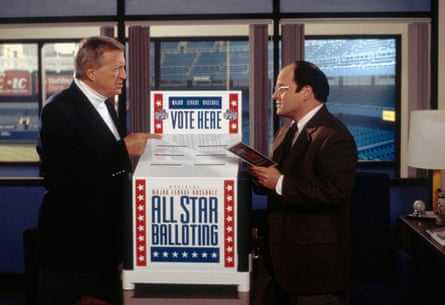
George: Right now I just sit around pretending I’m busy.
Jerry: How do you do that?
George: I look annoyed. Think about it. When you look annoyed all the time, people think you’re busy. [Rolls his eyes, slaps his forehead, does look busy.]
Does anyone remember Brendon McCullum? You know. Baz. It was a thing. People said “Bazball” in parliament. It was probably in the dictionary, one of those new zeitgeisty words, like rofl. Distinguishing marks? Hat. Jawline. A way of standing. Sports socks provocatively splayed on an ornate balcony. Look, it doesn’t really matter. But has anyone actually … seen him?
The answer to this is probably no if you’re in England or Wales, because McCullum is not currently in the country. He won’t be until 24 May, despite being head coach of an England cricket team that have just been thrashed in the Ashes, and despite the fact this is, right now, the actual English cricket season.
Instead McCullum has decided this is the perfect moment to be absent, thereby missing the opening 54 matches of the County Championship, or 43% of the first-class season, returning for a hang-about at Loughborough before the first Test against New Zealand in June.
And yes, we are by now so steeped in cool guys doing cool things that this seems fine, normal, whatever. Slack practice has been internalised. It feels like a point of pride. We’re all no-socks gentleman amateur alpha dogs here now. But still. Let’s not pretend for a moment. This is still jaw-dropping behaviour.
Most obviously it’s outrageously negligent. International sport is about energising a system. Leadership is real. Two million quid a year is real. In any other job you’re getting sacked for this. Binning off almost half the season? No, Thomas Tuchel. That’s not the deal.
And yet it is also somehow utterly gripping, even weirdly cool. In a time of mediocrity and compromise, you do have to admire the sheer ballsiness of the McCullum no-show. What we have here is the ultimate sporting screw-you-all.
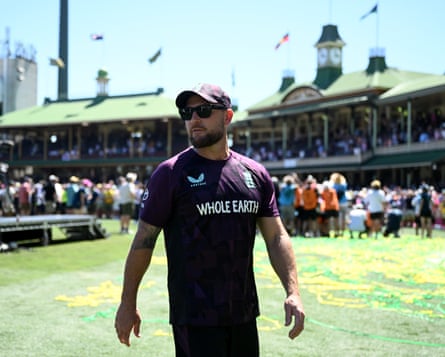
My own view of McCullum has gone full circle. I loved him at first. Everyone did. The team did outrageous things on flat pitches. Best of all this was achieved not through boring old detail, but by magic and mind tricks, some indefinable quality of having an indefinable quality.
McCullum seemed to be that vanishing breed, a Man of Destiny. He sat silently on balconies. He brooded in a vest. You never saw him doing the washing-up or organising his receipts. This was because he was a Man of Destiny in pursuit of a vision. Not perhaps a clear or easily defined vision. But definitely a vision.
Next came the fall. Declining results. Bad planning. An absence of detail. The England team is routinely described as having improved, but almost everything that matters has got worse. Which is fine. We’ll always have the great times. Sport is about cycles. What we have here is a charismatic big picture guy with one idea.
And now he’s back, baby! And McCullum 3.0 already feels like something new. Basically, this guy is incredible. He’s like water. You just can’t lay a glove on him. Refusing to be in the country while the great reconnect with the county game happens, this isn’t just gaslighting, it’s ripping the lamp out of the wall and waving it around the room. And somehow he’s still there, managing to extract employment and an ever-extending leash, not from football, which is swimming in idiot-money, but from the shrinking summer game.
It turns out this is the true nature of the Baz genius, not the nuts and bolts of cricket, but gaming his own job. McCullum is the George Costanza of sport, a Seinfeld character whose life involved drifting through endless jobs while finding ways to make himself indispensable. Although, in McCullum’s case this involves less looking busy, more not showing up at all.
It is worth recalling how we got here. The prelude to the season featured an England and Wales Cricket Board review of the Ashes disaster, dominated by emollient, job-saving noises about rebonding with domestic cricket.
“Improving connections to the county game … greater accountability around management.” These are actual quotes from the report. Rob Key, the managing director of the team, spoke fluently, soulfully, unconvincingly about how it was a mistake to turn away from the counties, how the start of the summer was a chance “for people to try and show they’re the ones”.
McCullum is paid to identify, select and develop talent. And yet, when there really is nothing else to do, even in the name of showing your face and cheering everyone up, he decides to skip the opening seven rounds of games. Best of all McCullum has done this when the captain is hors de combat, and when England have no full-time selector, Luke Wright having decided to “spend more time with his family”, the kind of line usually reserved for an MP caught naked inside a tank full of terrapins with an onion in his mouth.
Meanwhile, a hopeful public debate is rolling on over who could be the next opener if they score enough runs. Can we trust whatever ultimate decision is made when the selector who really could be doing some selecting is unwilling to at least make a show of paying attention?
You can try to rationalise this. There are well-informed people who think it’s fine. This is not football. England had a huge squad of players in Australia. They know who they like. Well, did you actually see them this winter? Was it good? Meanwhile, Asa Tribe has a new trigger movement! Do you not at least want to see what it looks like?
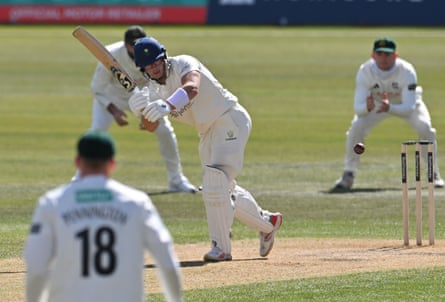
There is also a new four-person county “insight group” meeting every few months, although obviously Baz is not going to be present (admit it: he’s hilarious!). Then again, nobody in sport has ever given less of a toss about committees. There is zero chance McCullum is going to be swayed by what the widely respected Dave Sandwich has to say about promising 28-year-old opener Martin Spam-Fritter’s nuggety early-season runs.
There are two things worth saying about all this. First, on the basic process. The key idea is to rely on elite talent ID, not numbers at lower levels. You can see the point. County cricket is different. Those who have lived at the elite level do know stuff.
But has it worked? McCullum’s England have given 16 Test debuts. Many have been excellent picks: Brook-Tongue-Atkinson-Smith-Jacks-Bethell-Carse-Duckett 2.0. But seven of these came with solid county records. Jacob Bethell is the only successful smell-pick in four years. And Bethell is an outlier, so good you really would have to try quite hard – and they have – to ruin him.
By contrast the feelings choices, those without a body of first-class work, have been weaker: Livingstone-Ahmed-Overton-Hull-Bashir. The evidence of Baz’s own experiment is that it works better if you pick on county numbers. Watch more cricket. Don’t guess. Don’t miss 54 games when you’re trying to rebuild a team.
Or alternatively, do exactly that. Because this is the ECB, a place where everyone gets away with everything. Remember Giles Clarke getting us all into bed with Allen Stanford, who then went to prison for 110 years for fraud? Got away with it. Remember Tom Harrison? Got a bonus on his way out.
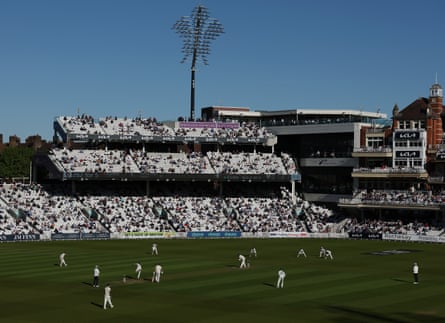
Remember how McCullum actually got the Test role, having turned up to interview for the white-ball one, like Costanza accidentally getting a job looking after the mysterious Penske File, then spending his time just transferring it into a flexible accordion-style binder (“It looks like you’ve put a lot of work into this George”). The final point is that this is all just quite sad. Baz will be left to Baz until he finally drifts away. An England team that has no real function other than to energise those who love and follow and play this funny old summer sport will continue to wall itself up in its own private garden.
The bizarre idea that if county cricket is poor it should be run down rather than improved will continue to be accepted by its executive. And McCullum will be back on the balcony in June, still shrouded in destiny, still hawking his big shiny empty box of ideas.