 6 hours ago
18
6 hours ago
18
International investors are asking where Japan’s prime minister will find the ¥370tn (£1.7tn) of extra cash that she wants to invest in 17 industrial sectors by 2040.
Such is the scale of spending by Sanae Takaichi’s coalition government that many in her own party fear she is about to blow up the Japanese economy, triggering a Liz Truss-style economic shock.
Nerves are also jangling in financial markets, where investors are stunned by the plans of a usually sober Japanese government to rewrite previous budget rules and embark on a wide-ranging and unfunded shopping spree.
The roots of Takaichi’s frustration date back to the financial crisis of 1991, when Japan’s property market bubble burst with spectacular effect. Tokyo had become the world’s most expensive place to live following the country’s export boom, but within months of the crash, banks behind much of the lending were bust.
Before the turn of the century, a second slump brought more turmoil when some of Tokyo’s largest financial institutions, unable to cope with the hangover of bad debts from the first crash, went under.
In the late 1980s, Japan’s government debts were equal to about 60% of national income, or gross domestic product (GDP). By the end of the 1990s, and after much of the financial sector had been bailed out, the debt to GDP ratio was 130%.
Since the 2008 global financial shock, the economy has stagnated. In response, the government has regularly spent 10% more than it receives in tax receipts – much of it to cope with a rapidly ageing population – and debts have continued rising. By 2020, the debt-to-GDP ratio had reached 260% before tighter budgets and a modest improvement in economic growth brought it below 230% in 2025.
Takaichi has said her investment plan will lift the productive capacity of the economy, keep Japan at the forefront of the AI revolution, and free the economy from its increasing dependence on trade with China.
The stock market has reacted with a succession of downward steps ever since the proposals were unveiled in June, though the renewal of hostilities in the Middle East and the prospect of higher oil prices have not helped.
Many investors sold up almost as soon as the government arrived in office, hitting the shares of the country’s biggest companies, among them Sony and Toyota Motor Corporation.
Sony faces intense competition from rivals in South Korea and China while Toyota has stood out against all-electric cars, and now faces being crushed by a flourishing and highly subsidised Chinese car industry.
Domestic and international lenders have pushed up the interest rate on Japanese government bonds (JGBs) to 2.8% in recent months, the highest in 29 years.
Waning international support for Japan’s economic outlook has also hit the value of the yen. More recently it is Takaichi’s boldness, which like Truss’s is often characterised as recklessness, that has acted as a heavy weight on the currency, pushing it down to 163 to the US dollar, a four-decade low.
Much of the blame for higher debt bills is connected to rising inflation, which has tracked upwards as the yen has fallen, largely because a low currency rate raises the price of imports of energy and raw materials.
Although Japan’s core inflation has remained below the BoJ’s 2% target over the last four months, analysts a jump in the last quarter to the mid-2% range on higher oil prices following the Iran war.
Kelvin Lam, an Asia specialist at the consultancy Pantheon Macroeconomics, has said what the financial markets really fear is the lack of detail about where the fresh investment money will come from.
“As long as you don’t say how you are going to finance your spending, you are on course for a Liz Truss moment,” he said, referring to the market response to the short-lived British prime minister’s plans for £45bn of unfunded tax cuts in September 2022.
“The markets were already worried about Japan’s long term fiscal health and this plan hasn’t helped.”

Takaichi’s conservative coalition secured victory last autumn with a slim majority that received a massive boost after she called February’s snap election, giving her a two-thirds majority in the lower house.
A draft plan to revive the economy included forcing the Bank of Japan to walk in lockstep with the finance ministry and rewriting how government debt is calculated. A final submission agreed by the cabinet pledged to maintain central bank independence, but as a footnote.
“To achieve a strong economy, it is very important for monetary policy to be conducted appropriately to see stable price rises,” it said.
The damage was done, much as Truss found herself in an unrecoverable situation after going head to head with both the Bank of England and the Office for Budget Responsibility.
Translated literally as big-boned policy, the Honebuto no Hoshin investment scheme is aimed at injecting cash into 17 sectors over the next 14 years to more than double Japan’s economic growth to more than 1%.
It will be a sharp break with previous leaders’ low-key policy blueprints and is in some respects reminiscent of Beijing’s grander five-year plans, which set national growth targets and direct industrial policy.
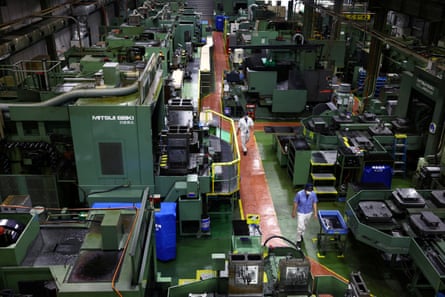
The blueprint targets areas such as AI, semiconductors, biotech, defence, energy and shipbuilding to achieve a 1% growth rate “as early as possible”.
The document emphasises “physical artificial intelligence” that combines AI with Japan’s strength in manufacturing hardware “to accelerate AI transformation in all sectors”.
Forecasts by economists typically point to growth of 0.93% in 2027 and 0.85% in 2028, falling short of the 1% target, according to the Japan Center for Economic Research thinktank.
In the background, successive governments have sought to disguise the country’s difficulties. Since 2022, the ministry of finance has spent about £160bn in efforts to limit the yen’s decline. It has also put pressure on the central bank to keep interest rates low amid a global drive to increase them to combat inflation after Russia’s invasion of Ukraine.
The BoJ has raised its policy rate to a 31-year high of 1%, but that is still low relative to its peers.
Following the Covid-19 pandemic, all central banks financed government spending by buying government debt. While most have sought to reverse the situation in recent years, the BoJ is being encouraged to go further. Japanese pension funds are also feeling heat from the finance ministry, which expects them to buy government bonds out of a sense of patriotic duty.
Takaichi said in a recent post on X that she spends all day and most of the night plotting Japan’s recovery, which is seen by many as an attempt to reverse last month’s 10-point poll rating decline.
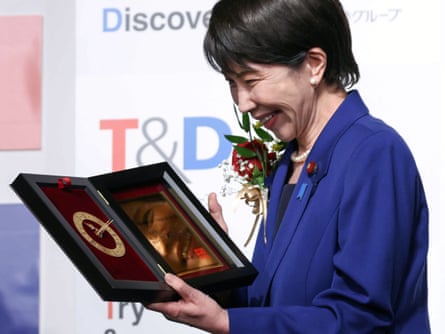
Takaichi is aware her project is fraught with danger now that financial markets have voiced their scepticism. Many are asking if an emphasis on manufacturing will prove successful as China seeks to produce more sophisticated goods, stepping into territory previously dominated by Japan, Germany and the US.
The question is whether Tokyo has the resources to go up against Beijing and carve out a big enough niche to fund itself in the 2030s. Exports rose 20% year-on-year in June, but after taking into account the yen’s depreciation, the value of the rise was almost zero.
Depreciating the currency every year to boost trade is not a sustainable policy. Maybe Takaichi’s investment plan will be.