 3 months ago
63
3 months ago
63
They say you never forget your first time, but for most of us, this doesn’t apply to cheeseburgers. We can’t really remember our first cheeseburger, because we start eating them at such an early age, before the memory centres of our brains are fully formed. In fact, in Wisconsin (“America’s dairyland”) babies are traditionally weaned on a fortifying diet of cheeseburgers, bratwurst and fondue, along with little sips of lager, just to make sure we acquire the taste.
But while I may not be able to recall the particular details of my very first cheeseburger, the sense-memories of them are embedded deep within my subconscious. The perfect flavour-chord of ketchup, mustard and pickles on molten cheese and juicy beef occupies the same psychological space as the peppery cinnamon-and-clove aroma of my father’s Old Spice and the warmth of my mother’s hug. More than mere memories, these are encoded messages: comfort comes in the form of hugs, spicy aftershave, and cheeseburgers.
But when memories are that ingrained, they often become mundane and unremarkable. Comfort foods remain comforting, but our childlike excitement for them fades, replaced by the technicolour thrill of more novel, cosmopolitan foods. However, sometimes there’s nothing so thrilling as the discovery of something new within the familiar – like when you hear a new song from your favourite band. And since I was no stranger to burgers when I moved to Los Angeles for college, I was primed to be totally captivated by that most Californian institution: the In-N-Out burger.
In-N-Out burgers are exceptional, but it’s the context and culture of In-N-Out that makes it uniquely memorable. I was only a month or two into my life in LA when I was taken to In-N-Out by my friend John, an older and more worldly boy who was incredulous that I hadn’t been there yet – a situation that had to be rectified immediately. John drove, and on the way he explained In-N-Out’s famous “secret” menu, which is actually more of a lexicon: code words that can be deployed to customise and enhance their basic offerings. The primer lasted beyond the duration of the 10-minute drive to Glendale; he was still explaining the finer points as we waited in line. Among the many bits of jargon I had to memorise before I reached the tills were the “lemon-up” (half pink lemonade, half 7-Up); well-done fries (what they sound like – extra crunchy); and, of course, the now-trademarked “Animal Style” – a decadent mixture of mustard, griddled onions, melted cheese, pickles and extra sauce that could be mortared on to both burgers and fries.
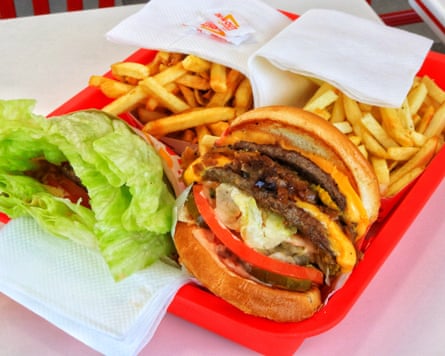
John’s tone was excited, yet serious – like a coach giving a pep talk before a big match. There was something furtive about how he spoke, conspiratorial even. The secret menu was never really a secret, but back in 2002 the internet hadn’t yet become the instantaneous demystification machine it is now. These days, you can go on TikTok or ChatGPT and find out precisely how to order at cult Tokyo ramen shops in a matter of minutes (even if you don’t speak Japanese or know anything about ramen). Things were more analog back then; you had to be in a place in order to know it, and learning the secret menu felt like studying for an unofficial LA citizenship test. In the end, I kept it simple: a Double-Double, fries and a Diet Coke. I didn’t want to run before I could walk.
The Double-Double tasted like a beautiful amalgamation of other burgers I’d loved. With its tangy sauce and crisp lettuce, it called to mind a Big Mac, but it had a loose, greasy, handmade quality that reminded me of Kewpee, my favourite burger shop back in Wisconsin. It was a near-perfect expression of burger-ness; thoughtfully constructed from concept to execution, but chaotic enough to make every bite a little different – a slice of pickle here, a well-browned morsel of beef there. This recurring element of surprise keeps your brain engaged until the very last mouthful.
For me – and for so many others – the Double-Double satisfies a burger hunger the way a key fits into a lock. And if it doesn’t do it for you? That’s what the secret menu is for. You can keep iterating and customising until you arrive at your own In-N-Out ideal. Maybe it was the ability to experiment with the secret menu that kept things interesting after so many visits, or maybe it was simply that I came to associate In-N-Out with the incomparable joy of being young, dumb and free in Los Angeles. I didn’t smoke a lot of weed in college, but I remember the first In-N-Out I had while stoned; the way the tomato seemed to sparkle on my tongue, glittering synesthetically with umami and acid. And I remember my final visit to In-N-Out, on a return visit to America in 2012. I sat across from my ex-girlfriend as I drunkenly devoured one last Double-Double under the harsh fluorescent lights of the unruly Sunset Boulevard branch, and I realised LA was not my home any more.
If I ever return to In-N-Out – and someday, I will – it will be as a tourist. But my knowledge of the lingo and the lore remains. There was more to the secret menu than John initially explained, like the exquisite Neapolitan shake, which became my go-to. At some point, I also discovered one of In-N-Out’s weirder details, something that was more of a secret than the secret menu: Bible citations printed on the packaging in hard-to-spot places, like the bottoms of soda cups. My lefty student buddies and I were mildly scandalised when we noticed these sneaky little references. Was In-N-Out run by (gasp) conservative Christians? Say it ain’t so! Back in post-9/11 America, you either watched Fox News or The Daily Show, and even then there wasn’t a lot of common ground between the two camps. We worried that In-N-Out’s owners might be aligned with fundamentalist stances, but since we couldn’t confirm this, we just shrugged and kept munching on our well-done fries.
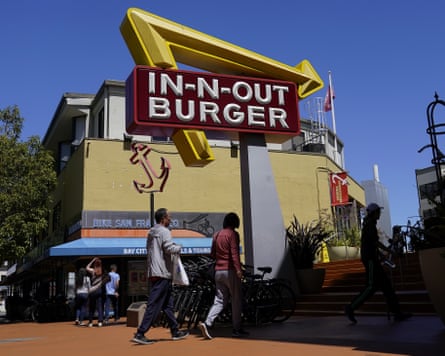
In a way, concerns like these seem quaint or even misguided now, at a time when American politics could probably benefit from a little more genuine Christianity. One of the Bible verses cited on In-N-Out’s packaging is Revelation 3:20: “Behold, I stand at the door and knock. If anyone hears my voice and opens the door, I will come in to him and eat with him, and he with me”. I’m no theologian, but that sounds positively inclusive, especially against the current backdrop.
It’s tempting to say, “ah, those were simpler times” – but were they? We were all mad back then, too. So no, the world wasn’t simpler. But I was simpler; just a rube from Wisconsin, gee-whizzing my way around LA, eating cheeseburgers and generally living out a 20th century Hollywood fantasy.
Everyone has an opinion about LA, and what I’ve come to realise is that they’re all correct – because how can anything as vast and complex as Los Angeles be understood as anything other than a constellation of individualised experiences? The same is true for burgers, or any food. In response to a reader’s query as to whether or not a particular burger he ate in college was really as good as he remembered, the New Yorker’s Helen Rosner replied with a philosophical “phenomenology of cheeseburgers”. She posited that when it comes to any given burger you’ve enjoyed, “you created it, just as much as the white-capped guy standing at the grill did. The mouth and brain and cascade of sensations were yours. There is no true burger per se … it didn’t become the burger you ate until you ate it.” Likewise, LA doesn’t become the LA you know and love until you know and love it.
Rosner concluded to the reader that, of course, you did love the burger, but more than that, “you love the person you see in your memory”. Now, I don’t often allow myself nostalgia; I think of it as a treacherous path to go down. But when I think about In-N-Out, I can’t help myself, because I do love that wide-eyed Wisconsinite chowing down on Double-Doubles under smoggy sunsets. I miss him. I miss those burgers, I miss that city, and I miss that country.