 5 hours ago
5
5 hours ago
5
Acclaimed for embodying opera’s femme fatales such as Carmen and Dalia, Aigul Akhmetshina explores womanhood more broadly on her second album, Mujer Fatal. Accompanied on piano by Antonio Pappano, the repertoire ranges from Spanish, French and Russian art song, to Broadway and beyond.
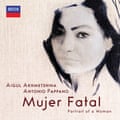
The title track, written by Elena Roussanova especially for the Bashkortostan-born mezzo-soprano, sets the tone. Akhmetshina’s supple instrument wraps itself around the languid vocal lines while Pappano’s sensitive touch draws out the music’s delicate melismas. Two of Montsalvatge’s Canciones Negras find the singer spinning long-breathed melodies, dipping down elegantly into her burgundy lower register.
She’s at her classiest inhabiting Bizet’s sultry Adieux de l’hôtesse arabe and Ravel’s hip-swaying Vocalise-étude en forme de habanera. She is, of course, entirely at home in Balakirev, Rimsky-Korsakov and especially in Tchaikovsky’s None but the Lonely Heart. On the whole, these are very fine, if perhaps a trifle restrained performances.
When it comes to letting her hair down, Akhmetshina is suitably uninhibited in a sensual Bésame mucho. If Gershwin’s The Man I Love and Bernstein’s Lucky to be Me feel a tad strait-laced, she warms nicely into Weill’s Speak Low. The recital closes with Britten’s O Tell Me the Truth About Love, a delicious party piece where she finally allows herself to have some fun.
Allow content provided by a third party?
This article includes content hosted on embed.music.apple.com. We ask for your permission before anything is loaded, as the provider may be using cookies and other technologies. To view this content, click 'Allow and continue'.
Listen on Apple Music (above) or Spotify