 2 hours ago
2
2 hours ago
2
It is the day after the night before. On Monday, Keir Starmer looked as if he was on his last political legs. At lunchtime, the Scottish Labour party leader Anas Sarwar called for his resignation, but by the evening, the troops had rallied, and the prime minister had survived the worst. At least until the Gorton and Denton byelection later this month.
Now it’s Tuesday afternoon and there’s a hush around 100 Parliament St, home to the government’s culture, media and sport department. It’s hard to know whether this is its natural state (it’s also the headquarters of HMRC), or whether the country’s politicians and civil servants are in a collective state of shock.
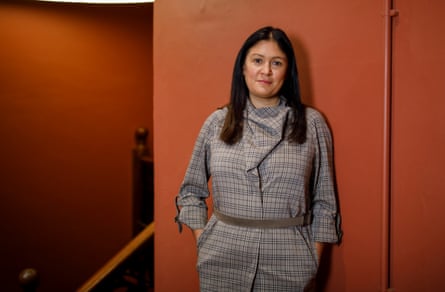
“It’s been a quiet week!” says Lisa Nandy, the culture secretary, with a big smile. Nandy is surprisingly upbeat considering her government has just had a near-death experience after less than two years in power. She introduces me to Owen, her communications adviser. “Owen is going to sit in, in case I say something really fucking stupid, and I have to apologise to the nation.” Is that likely? “Erm, it’s possible. It has been known.”
The Labour MP for Wigan shows me around her huge office. The culture is immediately obvious – a poster of Hamlet, a painting of a ginnel in Burnley and an illuminated text sculpture by the British artist Nathan Coley of George Bernard Shaw’s quote, “You create what you will.” The sport is also obvious: propped on top of a model of Trafalgar Square’s fourth plinth are a football and a rugby ball. The football belongs to Bury FC, whose financial collapse led to the establishment of the Independent Football Regulator, one of Nandy’s proudest achievements at the DCMS.
As for the media element of her title, apart from today’s newspapers arranged on a table, it’s otherwise not so visible. Critics have suggested the same could be said of her performance, at a time of BBC crises, online regulation battles and the scandal over sexualised AI images being created using Grok. She certainly seems happier talking about culture and sport.
There’s also a lovely framed photo on the wall of Tessa Jowell, who died in 2018. Jowell held the same office and was Nandy’s mentor. “They say here she was the best culture secretary within living memory. I was her PPS [parliamentary private secretary] when I first came into parliament. I was a proper awkward sod on the backbenches.” In what way? “Back then, before all the Corbyn stuff started, I was the hard left of the Labour party.” There’s a little poetic licence here. “We’d just come out of government and there’d been quite a narrow range of views at the top of the party. And I came in, and I was sort of throwing rocks at them, and Tessa said, ‘Before you decide you hate us all and want to burn this place to the ground, why don’t you come in and work with me, and see how it works?’ And it was magic.” Nandy has never struck me as a political pyromaniac. A moment later, she admits she’s indulging herself. “Actually, I’ve always been soft left. I hate that phrase. It makes me sound like a jellyfish.”
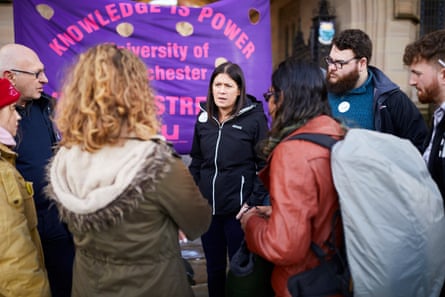
Perhaps it was inevitable that Nandy, 46, would end up in parliament. She was raised in a political, high-achieving family and realised you could make the world a better place through politics (her maternal grandfather was the liberal peer Lord Byers; her father, Dipak Nandy, is an esteemed Marxist academic who helped write the Race Relations Act; her mother, Luise Fitzwalter, was one of the first female TV producers at Granada). Today, Nandy lives in Wigan with her partner, Andy Collis, a public relations consultant, and their 10-year-old son.
As a mixed-race girl she was shaped, growing up, by the racism her family faced; as a daughter of divorced parents she understood the prejudice against single parents; and as a pupil at a comprehensive school she saw how limited opportunities were for children less privileged than her. After studying politics at Newcastle University, she worked for Centrepoint, the charity that supports homeless young people, before moving to the Children’s Society. She has represented Wigan since 2010, when she was selected to run from an all-women shortlist. Labour had just lost power, and she had to wait another 15 years before she could put her principles into practice.
The Labour party is famous for its ability to self-destruct. But its brief time in government has been something else – U-turns, financial scandals, resignations, broken tax promises, attempts to strip benefits from disabled people and pensioners, accusations of trying to out-Reform Reform, all topped off with the Peter Mandelson scandal. It was always clear Starmer was politically inexperienced, but not that he was so leaden-footed. When Starmer appointed Mandelson US ambassador, he knew Mandelson had continued his friendship with the sex offender Jeffrey Epstein after Epstein’s conviction – and also, of course, that he had been forced to resign twice before from Labour governments. Now it has emerged that Mandelson, who is being investigated by the police, may have been passing confidential government business information to Epstein.
Despite the promise of change, the Labour government looks little different from recent chaotic and deceitful Tory governments. It’s a shitshow, isn’t it, I say. “You call it a shitshow, I say it’s unforgivable,” says Nandy. She pauses. “I want to get the words right because it’s really important. It does look to people outside that we’re more interested in ourselves and less interested in preventing chaos. What was laid bare in the Epstein files is that there are a group of people in this country and across the world – powerful, wealthy people, mostly men – who control the system, look after their own interests, look after each other and screw everyone else. And that has been happening in plain sight for a really long time. Look across this country at so many things, whether it’s the taxation system, or housing or water or energy, the opportunities people have, the voice that people have, and people say the system is rigged for a reason. Because it is. It works against the interests of most people in most parts of the country.”
In the end, she says, it’s all about power – the unfair distribution of it, and the abuse of it. On a good day, Labour will talk about the redistribution of wealth. But, she says, it has to go deeper than that. “At times in our history in the Labour movement we’ve understood that our job is not just about redistributing wealth, it’s about who holds power.” And now? “I think we’ve forgotten it.”
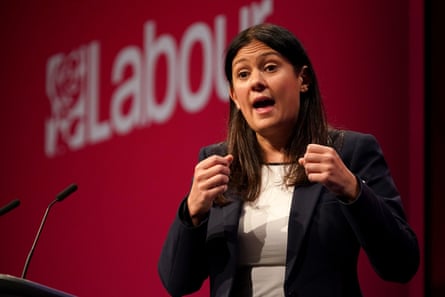
How have things become so bad so quickly? “We’ve not done enough, and this has got to be the moment of reckoning where we say not just what are we here for, but who are we here for?” Who is she here for? Nandy points out of the window. “The ones who aren’t in here, the ones who didn’t make it, can’t make it. We talk about people who feel left behind. They don’t feel left behind – they have been routinely disregarded and disrespected. And we’ve got to change that.”
But hasn’t Labour itself left these people behind? The chancellor, Rachel Reeves, said this is “not the party for people on benefits”. Nandy thinks Reeves was clumsy with her language and what she meant was that Labour is not just a party for people on benefits. But she doesn’t seem wholly convinced. “People haven’t just felt disrespected; they have been disrespected. Not just in the things that people go out and say that are crass, but look at the arts and culture funding we spend on our great national institutions – virtually all of them are in London. So that means we’re effectively saying to the whole country, bar one small part, you have no art and culture, you have nothing to contribute. Which is why one of the first things I did when we got into government was say: that’s got to change. So arts funding has had the biggest uplift in a decade, and it’s going straight into communities all over the country, not just the major cities.”
She says a government needs hope and vision to succeed. I tell her I agree, but I don’t think Labour offers either at the moment. The government seems angry rather than hopeful – angry at Peter Mandelson, angry at asylum seekers arriving on small boats, angry at Labour voters defecting to Reform, angry at the way the country has changed. What did she think of Starmer’s island of strangers speech? “I found it jarring because my dad used to debate with Enoch Powell on TV shows. What I think [Starmer] was trying to say is something I would express very differently. In this country, one of the biggest challenges we face is that we’ve lost the ability to understand one another.”
If she were going to revamp Starmer to make him more appealing to the electorate, where would she start? She looks at me, aghast.
“You know he is an actual person? You can’t revamp a person.”
OK, I say, customise him.
Her eyes widen even more. “Are you saying customise? Flipping heck, Simon, if I went to Keir and told him ‘I’m going to customise and revamp you,’ he’d tell me to fuck off.”
Seriously, I say, how does he or Labour have to change to win back the people who voted them in?
Two things, she says. “Every day we have to get up and say: how do we rebalance this country in favour of ordinary people? How do we break up this network of people who’ve had a grip on our systems, institutions and opportunities for too long? We’ve got to be prepared to think big enough to change things, not just tinker around the edges.”
Second, she says, Labour politicians must be better role models. “We’ve got to behave like the country we want to see. We want a country where people listen to one another, understand one another. We want a country where women are treated properly, with real respect and power. We want a country that has the intellectual curiosity to seek to understand people who come from different walks of life.”
But, she says, British democracy has never faced a greater threat. “We all get out of bed every morning determined to try to turn things around in this country. And we are staring down the barrel of a fascist government for the first time in British history. We are heavily aware of the responsibility on us all to sort this out, and you saw it playing out in real time yesterday with the cabinet all rallying round and making sure we didn’t do something utterly stupid for the country.”
How are they going to win back lifelong Labour voters like me who have lost the faith? “I’ll give you my starter for 10. If you look across the political landscape, do you really believe there’s a group of people who will genuinely be capable of making the fundamental change the country needs?” But it’s not good enough to tell me that all the other options are worse. That’s taking voters for granted.
I tell her I’m sick of getting messages telling me that if we don’t vote Labour we’ll get a Reform government. “Well, I would say get off social media.” It isn’t coming from social media – it’s coming from Labour party emails. She laughs. “Oh! I just get the ones asking for money.” These are the ones asking for money, I say.
If she was 18 today, who does she think she’d vote for? “Labour,” she says instantly. I say I don’t think she would, because Labour doesn’t offer young people the hope she says is vital. I bet you’d vote Green, I say. She looks appalled. “No, I wouldn’t. Not in a million years. Hand on heart. I’ve been very open with you about what needs to change. But I’ve always hated populism. It stokes people’s anger and gives it nowhere to go.”
Five minutes left, Owen says.
So what’s the answer?
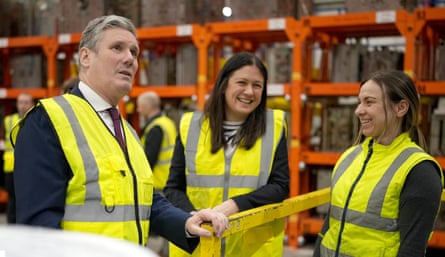
OK, says Nandy, here are examples of redistributing power. She cites an initiative from the DCMS: the youth hubs it has set up where young people make all the decisions. “We’re building youth clubs, investing in youth workers and a generation of young people. It’s not going to be us who say what you need, it’s not going to be a group of older men in the town hall either – the stipulation of the funding is that it has to be young people driving it. We’re putting people back in charge of their own lives and their own destiny.” See, she says, that’s putting power in people’s hands.
OK, three minutes, Owen says.
“I’m just trying to give my pitch to the nation!” she shouts. Nandy says the party has got to stop obsessing about individuals and remember politics is a team game. “We’re the most guilty of it in the Labour party. Since I came in 16 years ago, I don’t remember a single week going by without some discussion of the individuals who are going to ride in and save us. That’s not how politics works. It takes teams, it takes a movement.”
She talks about the time her father spent with leaders of the civil rights movement, and what he learned from them. “I remember him saying there were 14 people in the room when ‘I have a dream’ was written and Martin Luther King was not one of them. It takes a movement to create change, and I think we’ve forgotten that. I said as much to the prime minister this week. It’s not just incumbent on him, it’s all of us.”
As for the party itself, it’s got to be broader and more tolerant, she says. “We’ve got to step up and sort this out. In terms of how the culture has got to change, we’ve got to be more open and porous and respectful of different points of view.” And, she says, the plotting has got to stop. “Quite a few of us in the cabinet have read that we’re on manoeuvres. I’ve not read anything about me recently, but there has been lots about others.” In 2020 she stood for the leadership and finished third when Starmer romped home with 56% of the vote. Is she really not on manoeuvres now? “No! God no!” So why did she do the interview today? “I think there are things the country needs to hear from us; they need to understand that we see and we acknowledge our mistakes.”
What about her own mistakes? Such as, she asks. Critics say she has been invisible in her media brief, and I tell her I can quote from a satirical column by the parliamentary sketch writer Robert Hutton. You might not like it, I say.
“Oh, it’s fine.”
So I read on. “I am launching a campaign to bring back the Department of Culture … The question of who should lead this revived government department is of course up to the prime minister. Some would point to Lisa Nandy, currently minister without any discernible portfolio, though there’s no evidence that she would be interested.”
“What does it mean?”
That you haven’t done much, I suggest.
“Why, just out of interest? Is it because he doesn’t agree with what we’re doing? I’ve had criticisms about not telling the media what they can and can’t write, and what they can and can’t do. If you look at some of my social media feeds, it’s why haven’t I shut down GB News or why haven’t I shut down the BBC? I’ve been criticised for being too visible when it comes to the BBC.”
Does it bother you? “I’m not interested. Since I got appointed to this role I have been routinely briefed against. I’ve been criticised for spending too little time in London and too much time in other parts of the country. I’ve been criticised for being too outspoken for some of the things that have happened in the media and too invisible about the media. I’ve been criticised for not being a cellist, and for coming from Wigan. I kid you not!” For not being a cellist? “Let me just finish this, because I think it’s really important. I’m not here for those people. I’m here for the young people for whom we’re rebuilding opportunities and trust and the chance to live those richer, larger lives in every part of the country. I’m here for everybody in this country who’s made the most astonishing contribution to our national story and isn’t seen, heard or valued. I’m here for the football fans who’ve watched the thing they most care about taken from them because we’ve allowed a group of people with wealth and power to destroy the things that really matter. I wake up every day and fight for them, and I don’t give a stuff what people like Rob Hutton think. There you go. There’s your headline.”
Ten minutes have passed since Owen counted us down to 30 seconds. Nandy’s got an appointment with the deputy prime minister, David Lammy. “Can I be late for David?” she asks Owen. She says she agrees that the government has got to work on its message of hope, and suggests that Labour hasn’t really got used to being in power yet. “One of the challenges is going from opposition, where all you can do is rail against the system, to government.”
Does she think the government will survive? “Yes! You saw it yesterday. We all stepped up, and you can also feel that across the parliamentary Labour party. They want us to succeed, but they want us to be bigger and bolder. One thing I really do think is we came into office with so much that is broken, including people’s faith in politics to make things better. There was so much to fix. The challenge is that I think we’ve started to behave like a government of national emergency and not a Labour government. We’ve got to wear our colours on our sleeves again, because people need to know why we, in particular, are the answer to their problems.”