6 hours ago
15
6 hours ago
15
Directors don’t tend to appreciate having their films eviscerated by critics. And us critics, well practised in lobbing proverbial grenades from the safety of our pretentiously book-lined, Cahiers du Cinéma-strewn offices, don’t tend to look an artist in the eyes and tell them that their work sucks.
This is, however, exactly what I do to the Australian film-maker Anthony Frith. I’ve even prepared a zinger for the occasion. “Your film is a lemon that’s been eaten by a turkey then dumped into a vat of curdled mayonnaise,” I say.
Frith isn’t upset. He even smiles. “That’s a fair assessment,” he replies.
The production I’m sledging isn’t his well-directed, enjoyably staged and sometimes laugh-out-loud funny new documentary Mockbuster. It’s his other film, which Mockbuster charts the making-of: a pulpy, rinky-dink adaptation of The Land That Time Forgot, in which an Australian naval vessel is attacked by a Russian submarine, leaving the crew stranded on a dinosaur-populated island where they’re assaulted by unconvincing accents and various CGI beasts.
The Land That Time Forgot was produced by the Asylum, a production and distribution company that specialises in bargain basement B-movies. These often take the form of cheap imitations of blockbusters, or “mockbusters”, with titles like Transmorphers and Top Gunners. In terms of cultural impact, the average Asylum production sinks like a stone, Sharknado being a freakish exception. They are financially successful, however: made for a pittance and targeted towards undiscerning audiences.
Frith describes the target demographic as “the truck driver who’s driven 16 hours” and “just wants something crap to watch, then never have to think about again”. In Mockbuster, Paul Bales, the Asylum’s chief operating officer, puts it even more bluntly: “We make shitty movies, for people with bad taste … we’re barely above porn.”
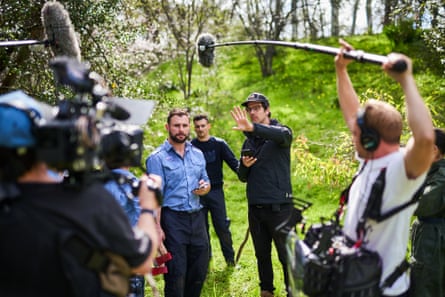
Mockbuster chronicles what happens when a bright-eyed and bushy-tailed film-maker embarks on the doomed mission of making a feature-length Asylum picture. Given a minuscule budget and a preposterously short time – just six days – to shoot the entire film, Frith went in knowing that the deck was stacked against him. But how much did he genuinely believe that he could make a good movie?
“Embarrassingly, quite a bit,” he admits. “Because you’ve got to have that bravado, right? Otherwise, why are you doing it? I felt a sense that I could actually make something quite special … There was overconfidence, which I think is almost healthy in a way. Otherwise you wouldn’t even try.”
Frith gave it an admirable crack, but now realises that “with the Asylum, no matter how much you try to push it, it invariably becomes an Asylum film”.
“Through their pipeline, they shave off all the flavour from the cast and crew. Anything goofy or silly gets shaved off pretty quickly. Anything that has any sort of humour or romance or anything like that.”
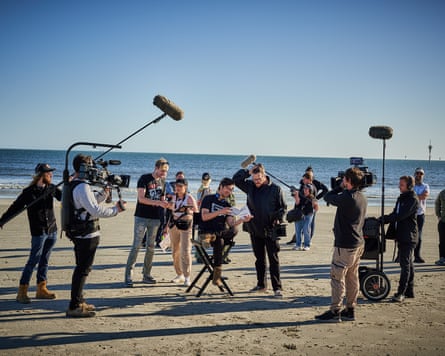
During the shoot, fiascos piled up. These included a discovery, deep into production, that all the Russian flags sewn on to the cast’s costumes were upside down. At another point, a producer is miffed to discover Frith’s intention to film in front of a garage door and pass it off as a battleship. This scene was hastily relocated to a nearby concrete wall (Frith is still prepared to die on the hill marked “garage door-gate”).
With the script written very quickly, and perhaps not with the most attention to narrative nuance, Asylum decided, after filming wrapped, to shoot additional scenes in order to address plot holes. These moments are long dialogue exchanges set in the Pentagon, which Frith believes actually created more plot holes. Even though he directed these scenes, he speaks out against them: “Every time there’s a shot of the Pentagon you can hear the audience groan … these scenes are so boring.”
The shoot may have been painful, but Frith got Mockbuster out of it – a film that has broad appeal and has been very well received by critics. He recalls the Asylum experience fondly, likening his time there to a film school on steroids: “You don’t really understand the mechanics of a story or the construction of a scene until you’ve been in the thick of it.”
He compares the company’s willingness to give aspiring film-makers a crack to Roger Corman, the schlocktastic auteur who supported up-and-comers including Francis Ford Coppola, Ron Howard, Martin Scorsese, Jonathan Demme, Peter Bogdanovich and James Cameron.
“Giving somebody a chance – that’s really incredible,” Frith says.
So, looking back, what would he do differently if he had his time again?
“I guess I’d push back on more things,” says Frith. “I still think that garage door would have been better.”
-
Mockbuster is in Australian cinemas from 27 August and on digital platforms in the US and in the UK now. Anthony Frith is on a Q&A tour of Australia; see here for dates