 6 hours ago
14
6 hours ago
14
The interim government of Venezuela has announced it will begin formal talks with the opposition aimed at “strengthening democracy” in the country.
The move is backed by the US, which says it is seeking a “democratic transition” in a country still recovering from the twin earthquakes that killed more than 4,700 people.
However, contrary to what many parties and voters had expected, the opposition will not be represented in the talks by the Nobel laureate María Corina Machado, the country’s most popular opposition figure.
Instead, its main representative will be Dinorah Figuera, who had been living in exile in Spain since 2018 but recently returned to Caracas.
The formal talks were first announced by Figuera on Tuesday and later confirmed by the president of the national assembly, Jorge Rodríguez.
Rodríguez, whose sister, Delcy, is the country’s acting president, said a joint working group aimed at strengthening democracy would begin on 1 August with former members of the national assembly elected in 2015, which was then led by Figuera.
That was the first and only opposition-controlled congress elected under Chavismo, the leftwing movement named after its founder, the former president Hugo Chávez. Many of those opposition members were eventually imprisoned or forced into exile.
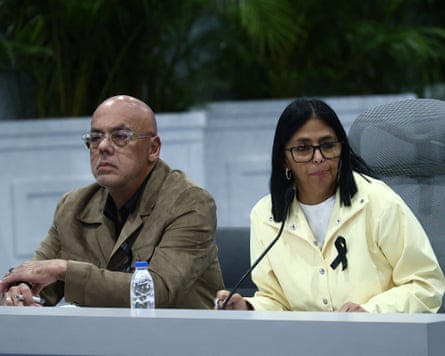
A week before the 24 June earthquakes, Figuera returned to Venezuela and held her first meeting with Jorge Rodríguez. The US state department praised that meeting as the beginning of a “roadmap for a political dialogue on a democratic transition”.
Washington has been calling the shots in Venezuela since US forces abducted the dictator Nicolás Maduro in January.
Figuera said she had returned at the invitation of the US state department, a move that caught much of the opposition by surprise. Only weeks earlier, a coalition of parties had decided that Machado would lead negotiations over new elections.
Although Machado presented her Nobel prize to Donald Trump and has repeatedly expressed her intention to return to Venezuela, the White House has so far discouraged her from doing so, reportedly out of concern that it could lead to civil unrest.
Machado announced that the parties in the opposition coalition would meet on Wednesday to “define a public position” on the announcement of talks between members of the 2015 national assembly and the regime.
The assembly’s social media account thanked the US for its support and announced that the joint working group’s priority would be “strengthening the electoral system and restoring guarantees for political participation”.
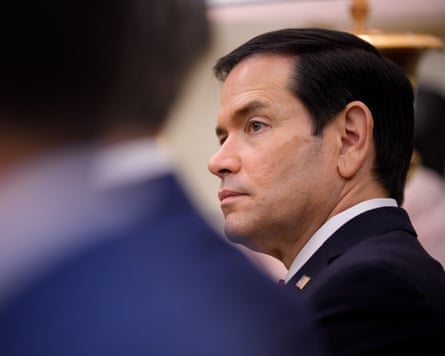
The statement was reposted by the US secretary of state, Marco Rubio, who, according to the New York Times, has in effect been running Venezuela from Washington as a “de facto viceroy”.
Despite the announcements, there is still no timetable for new elections. Maduro is widely believed to have stolen the 2024 election, and Delcy Rodríguez was his vice-president.
Public anger has been growing over what many see as the government’s botched response to the earthquakes. Even within the opposition, the expectation is that rebuilding the electoral system would take at least eight months.