
 5 hours ago
11
5 hours ago
11
Golden bands and swirling vortices have been spotted on the sun in the most detailed images ever captured of the turbulent surface of our home star.
Astronomers observed the sun with the Inouye solar telescope in Hawaii, the world’s most powerful solar telescope, and saw new features smaller than 20km (12 miles) across in a magnetically active region close to a sun spot.
The unprecedented pictures show processes on the surface that are likely to explain the decades-long mystery of why the corona, the sun’s outer atmosphere, is millions of degrees hotter than its surface.
“These are the highest spatial resolution images of the solar surface ever acquired,” said Dr Friedrich Wöger, a senior scientist at the US National Solar Observatory, which operates the telescope near the summit of the Haleakalā volcano, on the island of Maui.
Previous observations with the telescope found the sun’s surface to be a patchwork of granular structures each about the size of France. Those images picked out details as small as 30km across, but the latest are right at the limit of the telescope’s capability.
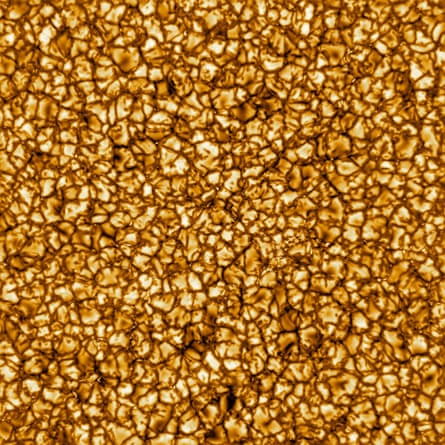
“My first reaction was: ‘Wow, how can we see such tiny, fine-scale structures on the sun?” said Dr David Kuridze, an astronomer on the team. “This is something we have never seen before in any solar observations.”
In the latest images, the small whirlpool-like structures on the sun’s surface were identified as signatures of what scientists call Kelvin-Helmholtz instabilities (KHIs). These form when fast-moving plasma slides past slower moving fluid, creating shear at the interface. This sets up small disturbances in the sun’s plasma that grow into spiralling vortices that look like breaking waves.
Scientists have seen KHIs in lakes and oceans, and in cloud formations on Earth, and even in the atmospheres of Jupiter and Saturn, but have never confirmed their existence on the sun. The details of the findings are published in Nature.
Explosive events on the sun, from solar flares and jets to coronal mass ejections, are powered by extreme, fluctuating magnetic fields in the star. The explosions can cause widespread disruption on Earth, taking out power grids, satellites, GPS positioning and global communications.
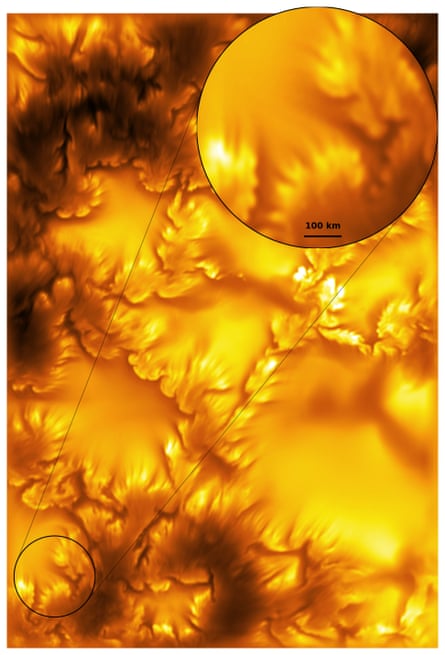
The magnetic fields are generated by the movement of hot, charged plasma in the sun, but the physics isn’t fully understood. Astronomers know that magnetic field lines can twist around each other like braided hair, creating tension that is suddenly released when the tangled lines break. What is less clear is what starts the process. The swirling vortices are now a key culprit, explaining why the field lines become braided in the first place, and perhaps why the sun’s corona is heated to a few million degrees while the surface is a mere 6,000C.
“This could solve this biggest mystery of the last half a century for solar physics and astrophysics,” said Kuridze. “When you have this instability in the system, it is very easy to cascade the energy into smaller scales. And at some point, it just dissipates as a heat. This could make hot coronas, hot outer atmospheres of the sun and similar stars.”