 18 hours ago
17
18 hours ago
17
Late last year, Tulisa Contostavlos took a good look at her life. Her relationship had come to an end and she found herself in her late 30s (she’s 38 now), wondering what next. “I started thinking about all the things I’d never done,” she says. At 20, life had got weird – Contostavlos was in the successful hip-hop group N-Dubz and became an adult just as the fame and money started coming in. By 24, she was a judge on the Saturday night TV show X Factor. If that hadn’t happened, she thinks she might have become an archaeologist – she’s obsessed with ancient history. And so last year she went travelling, to Egypt to see the pyramids, and to Peru to visit Machu Picchu.
There were other, bigger changes. She gave up smoking and started having therapy for the first time. Contostavlos sat down, she says, and “I wrote a list of what my ‘greatest self’ looked like – where she’d go, how she thought, how she felt, the things she would do. I started implementing every single thing on that list and I found through doing that, you just become her – it is actually that simple. It just takes effort and discipline.” Her greatest self, she says, “is a person of action, and she turns lemons into lemon cake”. It got her thinking about the criminal trial that left her career in freefall. “I was like, right, let’s try to do something.”
In 2013, Contostavlos was the subject of a tabloid sting by Mazher Mahmood, the reporter known as the Fake Sheikh. He had posed as a Bollywood turned Hollywood producer, and was dangling the prospect of a £3.5m movie role for her. The front page story of the Sun on Sunday alleged that she had arranged to sell him cocaine. She denied it and the evidence seemed shaky – essentially she had put Mahmood in touch with someone she thought may know how to get hold of drugs – but she was charged. It went to trial, collapsing when it emerged that Mahmood had lied in pre-trial evidence; he would later be sentenced to 15 months in prison for conspiring to pervert the course of justice. Still, she lost her house, and her job. “It was gone – the dream, the work, everything I strived for. That kid that used to bang her head against the wall at 12 years old, going, ‘I’ve got to make it.’ Everything she fought for was just down the drain.”
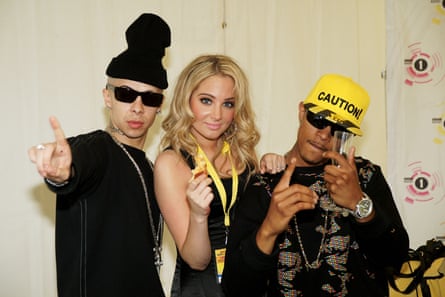
Her career never really recovered. Contostavlos remained in the public eye – she appeared on I’m A Celebrity, and there was a 2022 N-Dubz reunion – but there is still judgment, she says. “No matter what level of normality I get back to or acceptance, I’m always going to be that chick that certain brands don’t want to touch. I’m that girl that’s rough around the edges,” she says. “Which for me is why I’m like, all right, fuck you. I’m gonna do things my way.”
Contostavlos always appeared tough, but she’s also warm and funny when we talk in the Guardian’s offices. She’s unexpected, in lots of ways. She’s writing a fantasy novel, and is obsessed with The Lord of the Rings – she thinks she’s seen the films possibly thousands of times. “I’m actually a super-nerd,” she says. She devours books by spiritual leaders, and is given to spotting signs and taking note of the premonitions in her dreams. She has a lot of interests – one being the growing medical use of psychedelics (she took part in an ayahuasca ceremony in Peru). Another longstanding one is the matter of tougher press regulation, for which she is a prominent campaigner.
Contostavlos is involved with Hacked Off, the campaign group that includes Hugh Grant and has called for tighter regulation of the press. Now, she has also launched her own campaign and petition called Fix the Press, in which she calls for an “independent press regulator – one the press does not control, fund, or appoint” with powers to investigate and fine newspapers. At the time of writing, it had nearly 25,000 signatures and Paramount+ are making a three-part documentary following her life and the campaign.
The Independent Press Standards Organisation (Ipso), a rival to the government-backed regulator that no major media organisation would join, was set up after the dissolution of the Press Complaints Commission (PCC). The PCC was dissolved during the Leveson inquiry, held in 2011 and 2012, which found it was ineffective as a regulator and had failed to investigate ethical breaches such as phone hacking. Many of the biggest publishers signed up to Ipso (some, including the Guardian and the Financial Times, did not). However, Contostavlos argues that, as the organisation is funded by its member publications, and former journalists and editors are on the board, it is not independent enough. “I don’t want to have any cap on freedom of speech,” she says. But she believes Ipso is “marking its own homework”.
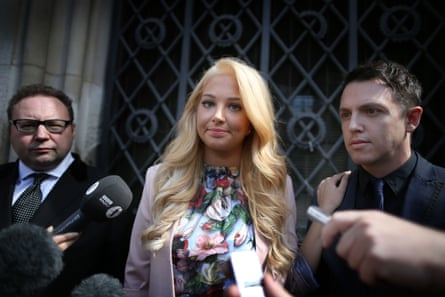
Hacked Off is also calling for the second part of the Leveson inquiry – which would have looked at the relationships between the press and the police – to be reinstated. She hasn’t met Andy Burnham (she adds: “yet”) but she hopes the new prime minister will be more sympathetic to the cause than Keir Starmer. Ten years ago, as a shadow minister, Burnham said the second stage of the Leveson inquiry, which was cancelled in 2018 by then culture secretary Matt Hancock, was “non-negotiable” . A lot has happened since then, including last month’s high court ruling against Prince Harry and other celebrities in their legal battle against Associated Newspapers Limited, the publishers of the Daily Mail and the Mail on Sunday. It remains to be seen where the press reform movement goes now.
It is understandable that Contostavlos would have a personal grievance against the press, but she insists, “This isn’t some vendetta. I didn’t wake up one day and go, ‘I want to take you down.’” She pauses, and says: “It’s just about fairness.” She has dealt with what happened to her, but says she wants “to prevent the same thing from happening to other people”.
You can be sympathetic to the people whose lives have been ruined by press intrusion and criminal activity, and also think any creeping state regulation of the press is a bad and potentially dangerous idea. Contostavlos says the concern comes down to similar things: “It’s the worry that certain people have certain powers to do certain things. Right now, mine is there are certain members that are high up in the press that have control, and your argument is: what if someone within the government has control? It’s all about it being truly independent, picking the right regulation to oversee it.”
Another criticism of Hacked Off, and by extension Contostavlos’s campaign, is that the target – newspapers – seems so out of date. However uncontrolled the tabloids were in the era of phone hacking, surely their current influence pales in comparison with social media, where people are subject to gross invasions of privacy and vitriol? “I agree that socials should be addressed. I feel like that is a whole separate campaign,” she says. But that’s not a reason not to also tackle the tabloids, she says. “I don’t really see social media breaking big news. I see the press break the news, and then social media runs with it. The source remains the same. So what do you do? Nothing at all, or start where you can?”
As a child, fame and money were always her target – money meant freedom from her childhood poverty, and fame meant love. Contostavlos grew up in Camden, north London, an only child, although she was close to her cousin Dappy, with whom she would go on to form N-Dubz, with his schoolfriend Fazer. Her parents had been musicians, but separated. Contostavlos lived with her mother, who had schizoaffective disorder, which meant caring for her during low episodes. “It’s very much shaped my personality, and it affects every area of my life – my day to day, my work, my friendships, my love life. Sometimes it can seem like I’m quite detached because I’m so independent.” She knew she wanted to be rich, “so I could get out. I used to fantasise about having my own home where I didn’t have to deal with all the shit.” If you go to her house now, she says with a laugh, everything is pristine and in its place. “That brings me peace as an adult.”
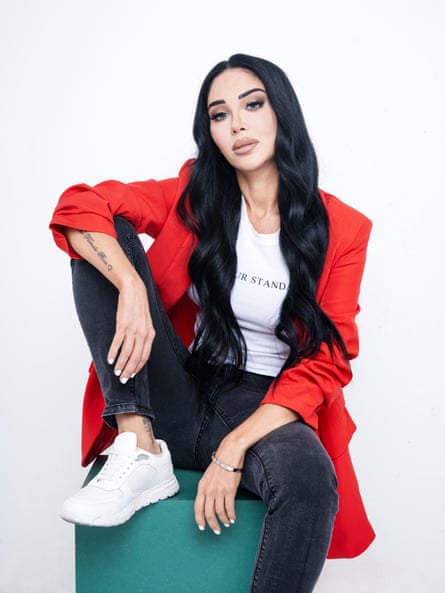
The adoration that fame brought fulfilled another need, she says. “We all walk around day to day, searching for validation in everything that we do, and I’m really trying to work on needing zero validation, knowing that all the love and light that I need is right here, inside of me. Now I’m aware of it more than ever; I have such a disinterest in fame.” She smiles. “Don’t get me wrong. I’ll do things if I get a massive cheque for it and if I don’t feel like I’m selling my soul for something.” Contostavlos is starting a property company, and ploughing money into that. It will, she hopes, “give me more freedom to never have to work in entertainment if I don’t want to”.
For a while, fame and money did make her happy. Then, in 2012, an ex-boyfriend sold a video of Contostavlos in an intimate act. “It destroyed such a huge part of my mental health, and it still affects me, and my love life, to this day.” It’s hard to remember now, post-#MeToo and sex positivity, but at the time, instead of seeing her as a victim, Contostavlos was shamed. “Back then: slag. It was, like, whore, low-class chav, all of that.”
Then, in 2013, the sting happened. Contostavlos thinks about £300,000 was spent on making her believe Mahmood was a film producer, including flying her first-class to Las Vegas and booking meetings in five-star hotels. To Contostavlos, acting represented escape. She was disillusioned with the X Factor. “I was getting really bad depression,” she says. In acting, she thought, “You can pretend to be someone else every day.”
She describes the role she was being seen for as an “urban British lead”, and says she was encouraged by one of Mahmood’s assistants to play up her Camden bad girl image. They asked her to source drugs for them, even though she says she wasn’t into drugs and had no idea how to do it. During the trial, Contostavlos was in “fighting mode, I had purpose”. It was afterwards, her career in shreds, that she struggled. She had made a suicide attempt just before she was charged, and made another after the trial. “I started to realise my life was never going to be the same, and I felt like I couldn’t change it either.”
Getting N-Dubz back together in 2022 helped, not least financially. She had been kept afloat from royalties, including from a song she had co-written which was released by Britney Spears, but there were still months, she says, “when I had to sell my Rolex to pay my rent”. In Contostavlos’s reframing, it has all been a valuable learning experience. “Going through the years of shit put me through financial difficulties that made me start valuing my money, valuing the way that I spend it … Now I have the business mind.” She used to call herself the Female Boss – she had it tattooed on her arm, and it was the title of her 2012 solo album. “Before it was just a name. Now it’s real life.”
Contostavlos has taken control in other ways. She has frozen her eggs and isn’t ruling out using a surrogate if she ever decides she would like to have a child. With the time pressure off, “I do not revolve my life around finding a man whatsoever.”
She has been through such a lot since childhood. Why has it taken her this long to start counselling? “I’ve always been someone that has been like, what the fuck can some Oxford University bookworm tell me about life when I’ve lived it?” But she says it came down to being her “greatest self”. That person is “not too big for her boots when it comes to taking outside advice”.
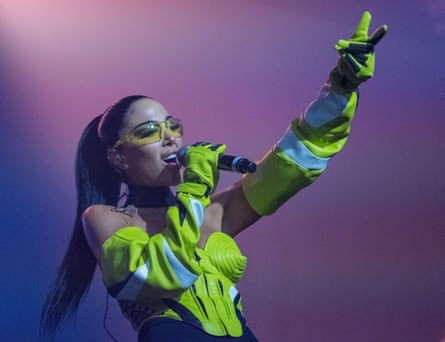
Does she feel grief, or bitterness, for the career and life she might have had? “Not in the slightest,” she says. “If I’d have carried on as I was, I would have been way less self-aware. I wouldn’t be who I am right now – and I love who I am.” Contostavlos talks a lot about alignment and the “inner work” she’s done on herself. It sounds woo-woo, but it clearly works for her. “That emptiness, that depression I’ve had all my life, that anxiety, it’s taken me to get to 38 to nail it. I’m, like, 80% sweet. Because what more luxury is there in life than having peace of mind and inner happiness, and lack of need for validation? What could be more important than that?”
She seems to be getting there, from finding financial stability to doing the things that make her happy and, in the case of her press regulation campaign, what she considers important. “Even if I’m just sparking the fire and starting the conversations, at least it can feel worth it. That’s all it is – positive meaning and purpose.”
Tulisa is filming a three-part documentary series for Paramount+, charting her campaign for stronger press regulation