 7 hours ago
8
7 hours ago
8
The day of 16 June 1976 began peacefully in Soweto. Student leaders at high schools across the sprawling Johannesburg township, to which the apartheid regime had exiled hundreds of thousands of black South Africans, took charge of the morning assemblies. They led their fellow students into the streets and began to march toward Orlando stadium.
The students were protesting against the government’s imposition of Afrikaans as a medium of instruction. Their teachers barely spoke the white minority language and the students did not want to learn the oppressor’s language. They were tired of the intentionally substandard Bantu education, tired of being second-class citizens.
By the end of the day, dozens would be dead.
The mood of the young protesters started off joyous, people who marched that winter day remembered. They sang struggle anthems, including Senzeni Na?, which asks in Xhosa: “What have we done [to deserve this]?”
“Our worst-case scenario, of course, was that they were going to throw cans and cans of teargas at us,” said Sibongile Mkhabela, then an 18-year-old pupil at Naledi high school and one of the march organisers.
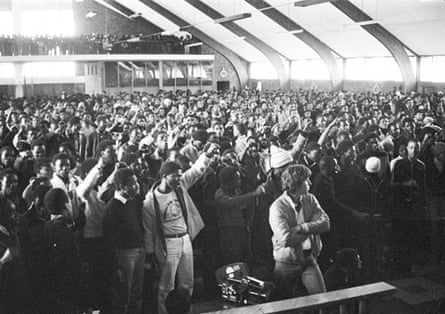
As the children moved east, more schools joined. By the time the first group reached Orlando West, where Nelson Mandela had lived before he was imprisoned on Robben Island, the students numbered in their thousands.
They faced a wall of police. The police had a loudhailer, said Oupa Moloto, then a 19-year-old pupil at Morris Isaacson high school. But none of the students could hear what was being said.
Accounts of what happened next differ. Some say a white police officer threw a teargas canister into the crowd. Moloto remembered police dogs being released to attack marchers. “Now, women students were panicking and then we took stones to retaliate,” he said. “And then the firing started.”
Moloto thought it was fireworks at first. Then he saw that a boy next to him had been shot: “I was surprised when I saw this bleeding, that these guys are really shooting.”
He did not know what happened to the boy in the pandemonium that followed. “Helicopters were hovering over, shooting teargas from up in the sky. Students were panicking, running in different directions,” Moloto said.
Among the first to die were 15-year-old Hastings Ndlovu and 12-year-old Hector Pieterson. The photograph taken by the local journalist Sam Nzima of Mbuyisa Makhubo carrying Hector’s limp, bloodied body, Hector’s sister Antoinette running beside them, face twisted in anguish, became the day’s defining image.
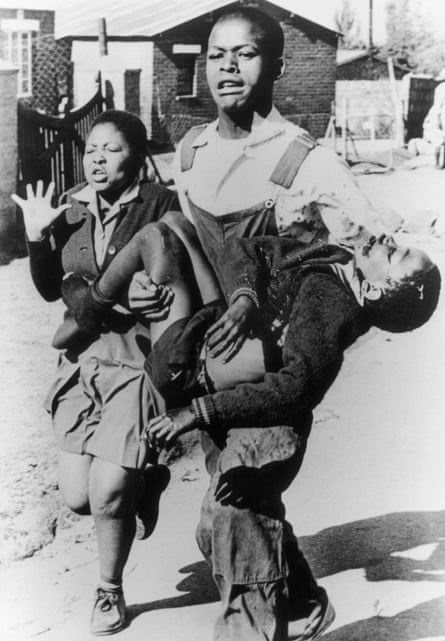
The number of people killed that day, which became known as the Soweto uprising, has never been definitively confirmed. The official figure was 23, but some estimates put the death toll at more than 200, according to South African History Online, a respected resource.
The unrest spread to other townships. Government institutions were looted and burned. The police continued to fire. A regime report in 1980 concluded that 575 people died in the months after the start of the uprising. “By the end of 1976, the entire apartheid system was on trial,” said Mkhabela, who now runs an NGO.
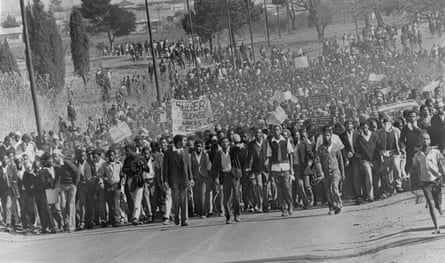
The uprising created a new generation of anti-apartheid activists, reviving a struggle that had faltered after Mandela and other African National Congress leaders were given life sentences in 1964. Thousands of students fled South Africa to join uMkhonto we Sizwe (MK), the armed wing of the ANC in exile.
Initially, Kingsley Mamabolo planned to stay in Soweto and fight. “People would accuse us of being communist, but you didn’t need people to show you what was happening on the ground,” said Mamabolo, then a 20-year-old final-year student at Naledi high school. In early August, police broke up a demonstration in central Johannesburg and several of his friends were arrested. Some got word out of prison that police were hunting him too and he decided he had to flee.
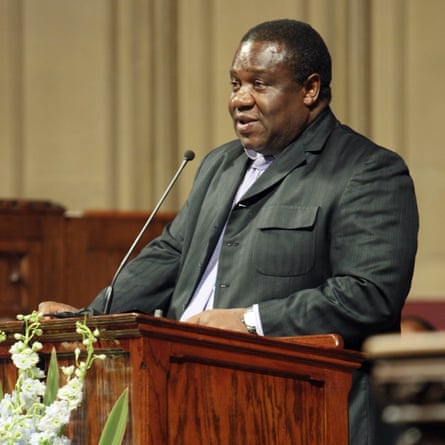
“I thought I was brave, but the coward in me said: ‘I don’t want to be dying in prison’ … There were lots of rumours and stories going about, of people who didn’t make it after they had been tortured in prison,” said Mamabolo.
So began 18 years in exile, in which he represented the ANC in Cuba, Mozambique, Tanzania and Zimbabwe. While Mamabolo was motivated by the cause, it was also the life of a refugee. He was not paid a salary, surviving on food rations from the party and donated secondhand clothes.
Mamabolo, now South Africa’s high commissioner to the UK, said he still felt guilty about not giving his three children born in exile a stable upbringing. “I’m constantly apologising for the life I gave them,” he said. “It wasn’t of my making or their making. I think they understand.”
Mkhabela was arrested at the August 1976 demonstration and put in solitary confinement for four months. Her cell was cavernous and freezing and the Afrikaner guards would beat her at any time of night. “When they hit you, you felt like a rag doll, when you are thrown from one corner of the room to the next,” she said.
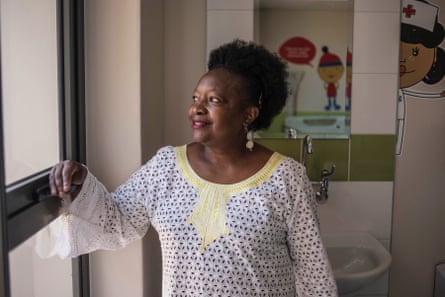
Mkhabela continued her activism on her release and was arrested again nine months later. She spent a year in prison waiting for her 11-month trial, the only woman alongside 10 men. She was one of five convicted and spent another two years behind bars, much of it in isolation.
Decades later, Mkhabela’s experiences were turned into a play by her daughter Ntsako. It helped Mkhabela to realise that her poor memory was probably a result of what she went through. “One of the things that hurt me most in prison was remembering … I had to train myself to forget what it feels like to love and be loved … but in the process the mind forgets a lot of other things that you shouldn’t forget,” she said.
Moloto did not make it out of South Africa. About a year after the uprising, he was caught trying to cross into Eswatini and spent more than three years in prison, much of it in solitary confinement. Guards would force him to stay awake for up to 10 days and mock him when he became disoriented.
“The way those guys were so brutal, at one stage it clicked in my mind … how did it come that God should create people like this?” Moloto said, sitting with his daughter Mpho in an office at the June 16 Memorial Acre in Soweto.
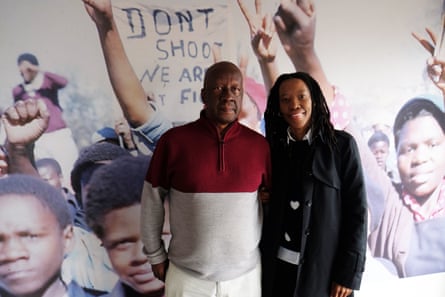
After being released, he was kidnapped and tortured by security forces, who accused him of arms dealing. “I had to withdraw from being active … Even when you sit with your old comrades, you become paranoid, you are afraid,” he said.
Moloto excused himself from the interview. “He’s always seeing danger,” his daughter said. “The paranoia, the nightmares, the physical remnants of what happened to him. He has severe asthma now. You know, I think that’s why he wanted to go out.”
Mpho, 45, is now the primary carer for her father, after his wife of 43 years, Susan Jenny Moloto, died last year. “When Mama was there, she would wake him up and calm him down and ground him and bring him back to reality,” she said. “I’ve now had to step into that role.”
Moloto’s post-traumatic stress disorder means that 16 June 1976 is ever-present for the family, even 50 years later. “It’s not just a chapter in the history books,” Mpho said. “In our lives … for me, it’s still a living, a breathing reality.”