 1 month ago
41
1 month ago
41
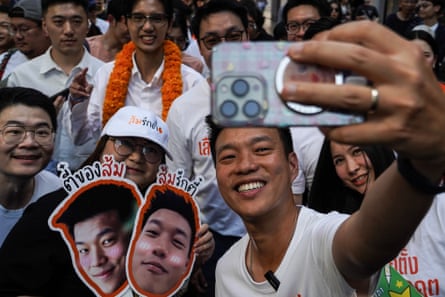
A flood of gifts are passed by adoring fans to 38-year-old Thai politician Natthaphong Ruengpanyawut. Supporters, many of them young students, hand over orange garlands, plastic oranges on string, fresh orange fruit, a bunch of bananas and some corn on the cob.
The trademark orange colour is one of the few things that has remained constant for his youthful, pro-reform party, which has been dissolved twice by Thailand’s constitutional court, and forced to regroup under new names and new leaders.
“If you define yourselves … as being on the side of democracy, give us a chance,” Natthaphong urged a crowd of supporters at a campaign rally for his People’s party in Udon Thani, in north-eastern Thailand this week. “This party loves democracy.”
People’s party, fuelled by support among young and urban voters, is leading opinion polls ahead of the election on Sunday. However, it is not expected to win an outright majority, and it may face an uphill struggle to form a coalition with rivals, which have previously blocked its bids for power. It also faces looming legal battles.
People’s party will be up against incumbent prime minister Anutin Charnvirakul, leader of Bhumjaithai, a shrewd dealmaker who has the support of royalist military conservatives, as well as Pheu Thai, the party associated with now jailed former leader Thaksin Shinawatra. Although Pheu Thai is expected to see a decline in support, the party remains a powerful political force.
Many of the voters attending the People’s party’s rally say they want structural change to Thailand’s political system. “I’ve lived through so many elections in my life, I don’t want to see the same system again. I want equality for the people, and for young people to be able to express their opinions freely,” said supporter Rattanakorn Boonchi, 46.
The movement behind the People’s party emerged only eight years ago, but has quickly captured public support by promising reforms to make the country more democratic and break up monopolies that dominate the Thai economy.
In the last election, in 2023, the People’s party predecessor, then called Move Forward, shocked its rivals in the military royalist establishment by winning the most votes and seats.
However, Move Forward was blocked by military-appointed senators from taking power, and was later dissolved by the constitutional court. Judges said the party’s promise to reform the draconian lese-majesty law, under which criticism of the monarchy can lead to up to 15 years in prison, violated the constitution.
‘Corruption is the first priority’
Legal cases continue to hang over the party’s members, including its leader Natthaphong, who is one of 44 former Move Forward lawmakers being investigated by the National Anti-Corruption Commission for ethics breaches for attempting to change the lese-majesty law. The party has now dropped the policy.
Natthaphong tells the Guardian he believes the case is “very low risk” and that he has done nothing wrong, adding “it is the right of the MPs to propose law amendments in the parliament.”
Polling suggests Natthaphong, a former software engineer, lacks the same rockstar appeal as Pita Limjaroenrat, the charismatic leader of the party’s predecessor who was banned from office in 2024. In Udon Thani, however, Natthaphong is given a warm welcome by screaming supporters. A fan of computer games who helped run the party’s successful online strategy in the last election, he became the youngest leader of the opposition in 2024.
The party’s priority is tackling corruption, Natthaphong says, to help attract investment and tackle Thailand’s stagnating economy.
The promise resonates with many supporters. “Corruption is the first priority and if we solve that, the rest will follow,” says first-time-voter Khatawut Sukmarach, 18. Khatawut wants the economy to be more equal, he added, with more opportunities for young people in his home town in Udon Thani. “We need job opportunities that are decentralised from the capital [Bangkok]. I want to work close to my home,” Khatawut says.
Phatcharaphon Bunyong, another first-time voter, whose friends screamed giddily when Natthaphong’s campaign car passed by, wants Thailand to move away from patronage politics, where people turn to local politicians for short-term support. “I want every Thai citizen to be able to be financially independent and not just receive money from politicians and be unable to make anything for themselves,” she says.
People’s party has been critical of patronage-style politics, saying it breeds corruption, says Dr Napon Jatusripitak, visiting fellow at ISEAS – Yusof Ishak Institute. This may win the approval of some voters, but it could also be a hard sell in a climate of slow economic growth when voters are struggling financially.
“It’s really uncertain whether voters would prefer a candidate from a party that has performed strong constituency service, a bit more patronage-oriented in terms of solving concrete problems, or whether they would prefer a party that has proposed to engage in a more structural reform of the Thai economy as People’s party has tried to do,” says Napon.
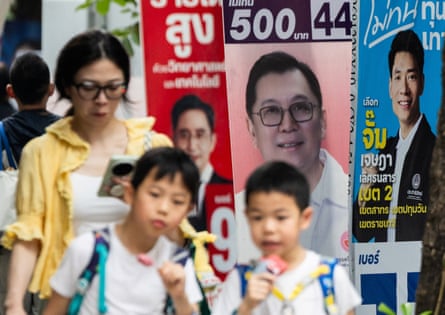
Photograph: Maxim Shemetov/Reuters
On Sunday, voters will elect 400 constituency seats as well as 100 party-list seats. Voters will also be asked if they support drafting a new constitution, a process that People’s party supports as it says it wants to make the charter more democratic.
People’s party is likely to gain enough support in urban centres such as Bangkok and Chiang Mai, but needs to also cut through in more rural areas, says Napon.
Udon Thani, which is being targeted by the People’s party, is a stronghold for former populist leader Thakin Shinawatra. In a local market, sellers say many in the area are still loyal to his party, Pheu Thai. “I have been voting Pheu Thai since I was 18 and now I’m about 50,” says Kamjan Pohsaeng.
She admits she is tired of Thailand’s political upheavals – this is the fourth time the prime minister could change since the 2023 election – but she will go out to vote, she says.
People’s party is trying to convince its supporters to do the same.
After posing for selfies with a line of supporters, Natthaphong tells the Guardian. “I truly believe that if we have a turnout of more than 80% in this election, we can bring real change to bring back the politics in Thailand to belong to the people.”