 4 hours ago
14
4 hours ago
14
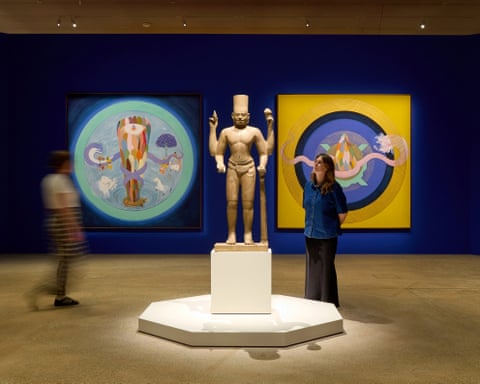
Fifteen centuries of south and south-east Asian art has been devoted to Vishnu. The Hindu god is depicted in many forms, from the man-lion Narasimha to blue-skinned Krishna.
Sydney’s Art Gallery of NSW is displaying hundreds of ancient and modern interpretations of Vishnu’s image through a landmark exhibition, Avatar: Forms of Vishnu, running from 20 June to 5 October.
Words by AGNSW curators Melanie Eastburn and Dr Chaitanya Sambrani, with Emma Joyce
Fri 19 Jun 2026 17.00 CEST
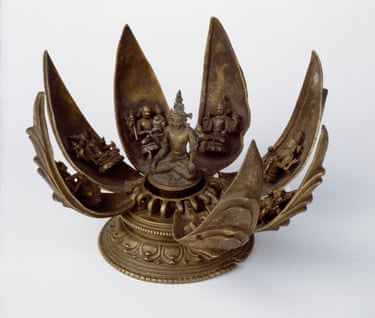
Vishnu in the lotus (bronze, East India or Nepal, 1100s)
The lotus is a symbol of purity and spiritual growth, and this 12th-century bronze shows Vishnu in the centre, surrounded by petals of his avatars, including Varāha the boar and Narasimha the man-lion. The central figure is holding a padma (lotus), shankha (conch shell), a mātulunga (citron or sweet lime) and an unidentified object.Photograph: University of Oxford/Art Gallery of NSW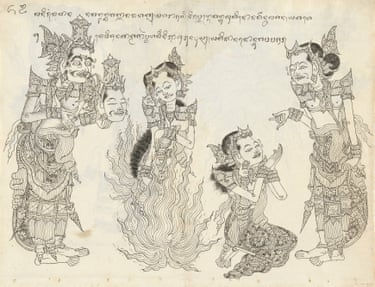
Scene from a Ramayana kakawin manuscript (prasi) (Chinese ink on English paper, Indonesia, early 1800s)
This 19th-century ink drawing is from a Ramayana manuscript created for the regency of Klungkung, which was Bali’s political and spiritual centre from the late 17th to the early 20th century. The manuscript depicts Rāma winning Sinta’s (Sita’s) hand in marriage, encounters with demons and allegiances with monkey armies on the journey to rescue her, and Sinta’s eventual release from the clutches of Rawana (Rāvana). Photograph: National Gallery of Australia/Art Gallery of NSW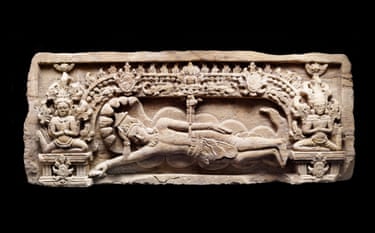
Lintel depicting Vishnu reclining on the serpent Ananta Shesha (Anantashayin) and the birth of Brahma (sandstone, Cambodia, c100–800)
In the centre of this sandstone sculpture, the creator god Brahma is seated atop the lotus blossom emerging from Vishnu’s navel. On either end are celestial beings with their palms pressed together in a gesture of veneration; the extended position of their legs indicates that they are in flight.Photograph: The Metropolitan Museum of Art/Art Resource, NY/Art Gallery of NSW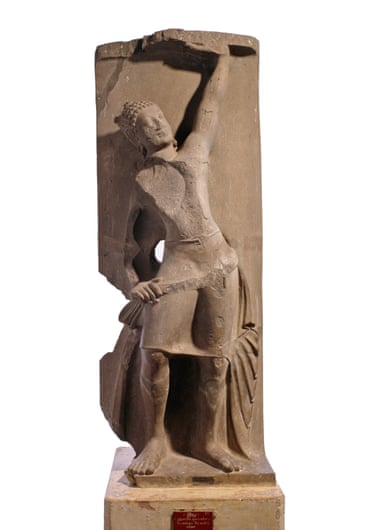
Krishna Govardhana (sandstone, Cambodia, c100–800)
Carved from a single block, this sandstone sculpture shows Krishna lifting Mount Govardhana to shelter villagers from a storm, bringing to life a key episode in Hindu mythology. Shown in a dynamic pose, Krishna raises one arm to support the mountain, capturing a moment of heroism.Photograph: John Gollings/Art Gallery of NSW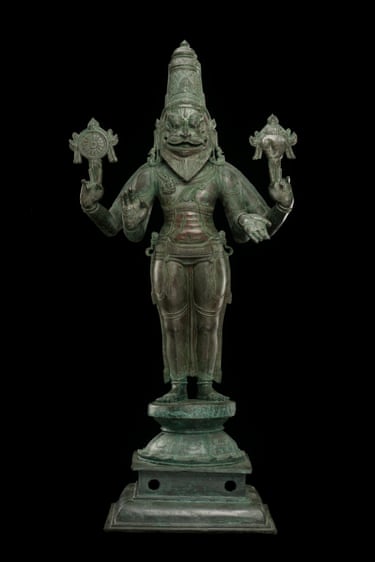
Narasimha (bronze, India, c1529–1736)
This bronze of man-lion avatar Narasimha is holding symbols of cosmic authority, the shankha (conch) and chakra (discus). His lower hands are in a gesture signifying reassurance, protection and generosity. A tiny Lakshmi figure appears on Narasimha’s chest, where, in legend, she would stay for eternity.Photograph: CSMVS/Art Gallery of NSW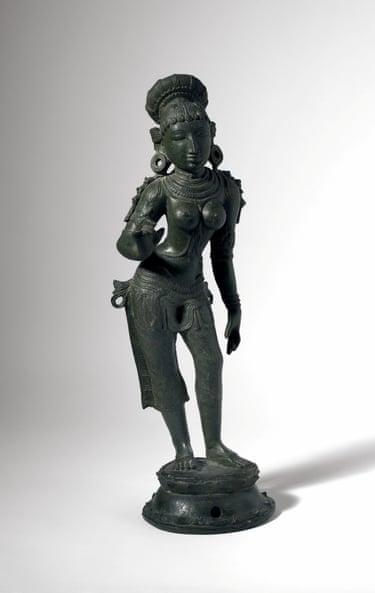
Sita (bronze, lost-wax casting, India, 1400s)
Sita is the heroine of the Ramayanaand the devoted wife of Vishnu’s avatar Rāma. Found in the ground when she was a baby, and often believed to be an avatar of the goddess Lakshmi and the daughter of earth goddess Bhu Devi, Sita grew into a princess of beauty and strength. Here, her right hand forms the kataka mudra, a gesture associated with holding a flower. Her elaborate crown-like hairstyle is one of her distinctive features.Photograph: Art Gallery of NSW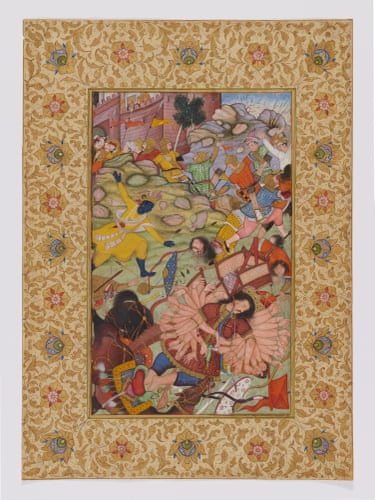
Krishna defeats the demon Bāna (opaque watercolour and gold on paper; India or Pakistan; margins completed in Lucknow, late 1700s)
Written about 2,000 years ago, the Harivamsa describes the life of Krishna along with stories from early Hindu mythology. It was later translated into Persian as part of an initiative to share legends of India through illustrated manuscripts. Here, in this watercolour, blue-skinned Krishna holds a dynamic pose with one arm raised and his gaze fixed on his opponent Bāna, shown in the middle of a chaotic battlefield.Photograph: Art Gallery of NSW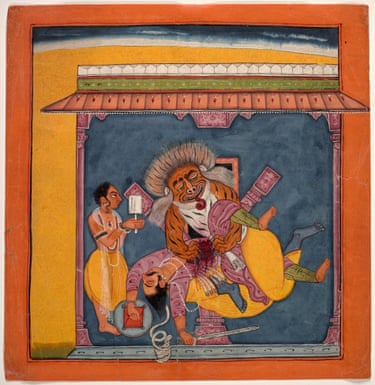
Vishnu as the man-lion Narasimha killing Hiranyakashipu (opaque watercolour and gold on paper, India, c1690–1700)
The demon Hiranyakashipu could not be killed indoors or outside, by man or beast, on earth or in the sky, by day or by night, and by no weapon. Using every loophole possible, Vishnu’s man-lion avatar Narasimha killed him at twilight, on a threshold, neither on the ground nor in the sky, and without weapons. Depicted here against a dusky blue sky, Narasimha suspends the demon upon his thighs and tears him open with his claws.Photograph: Diana Panuccio/Art Gallery of NSW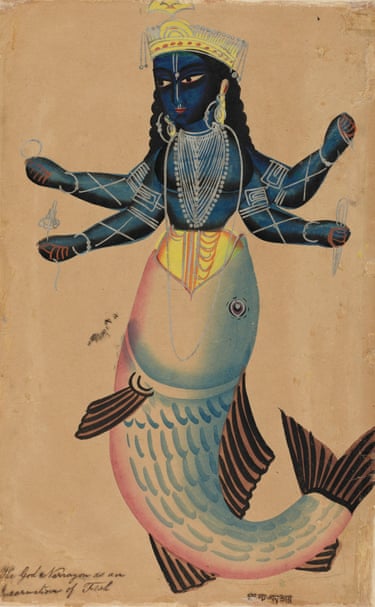
Vishnu as Matsya the fish (watercolour with silver paint on paper, India, 1880–99)
Matsya is the fish avatar of Vishnu. Between the 1830s and 1850s, a distinctive painting style known as Kalighat developed around the newly built Kali temple in Calcutta (now Kolkata). Painted quickly in watercolour on inexpensive commercial paper, the pictures have a distinctive animated immediacy. Most show gods and legends with simplified, standardised iconography.Photograph: Christopher Snee/Art Gallery of NSW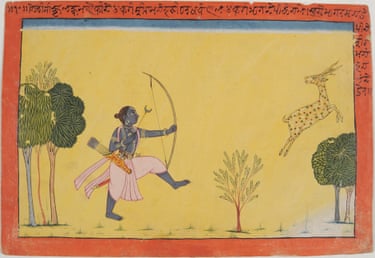
Rāma chasing the golden deer Maricha (opaque watercolour on paper, India, mid 1700s)
The artist of this folio uses painterly means to evoke a supernatural illusion cast by the asura (demon) Maricha. At the behest of Rāvana the king of Lanka, Maricha appears as a miraculously golden deer to entrance Sita, who asks her husband Rāma to capture it for her. This is a crucial juncture in the Ramayananarrative, as Rāma pursues the deer deep into the forest, enabling Rāvana to abduct Sita.Photograph: Art Gallery of NSW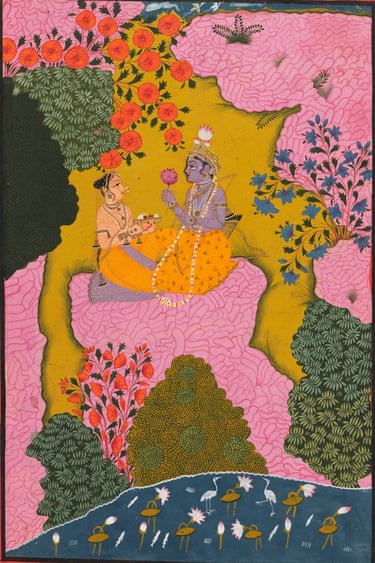
Sita offering fruits to Rāma in the Dandaka forest (opaque watercolour on paper, India, late 1700s)
While in exile from the kingdom of Ayodhya, Rāma and Sita encountered the Dandaka forest, which became their home for 14 years. Some Ramayananarratives represent their forest life as idyllic, while others emphasise its dangers. Here, in a moment of quiet, Sita and Rāma sit surrounded by flowering trees and enjoying the fruits of the forest.Photograph: Art Gallery of NSW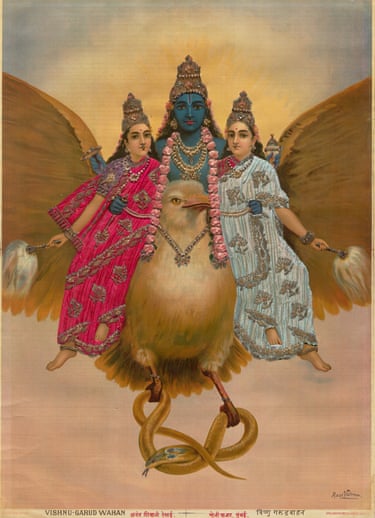
Vishnu-Garud Wahan (oleograph with fabric and zardozi embroidery, India, c1894–1930)
In 1894, artist Raja Ravi Varma imported a lithographic press and began producing affordable prints of his paintings in Mumbai (Bombay), assisted by his brother Raja Raja Varma. Although Ravi Varma Press was sold in 1901, it continued to operate long after the artist’s death. This print of Vishny with the goddesses Lakshmi and Bhu Devi flying on Vishnu’s vahana (vehicle) Garuda was hand-embellished with cloth, embroidery and sequins.Photograph: Nicholas Umek/Art Gallery of NSW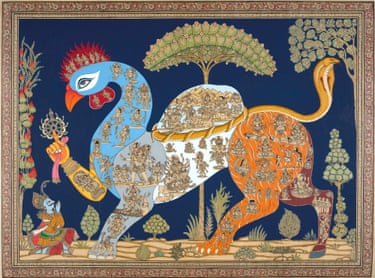
Navagunjara (natural pigments on tussar silk, India, 2025) by Gitanjali Das
Gitanjali Das is among very few women in Odisha, eastern India, who practice pattachitra, an act of storytelling on cloth often used to depict Hindu narratives and mythology. This painting shows Navagunjara, a manifestation of Vishnu or his avatar Krishna. Representing cosmic power, the creature is composed of nine animals, including a rooster’s head, a peacock’s neck, a bull’s humped back a lion’s torso.Photograph: Jenni Carter/Art Gallery of NSW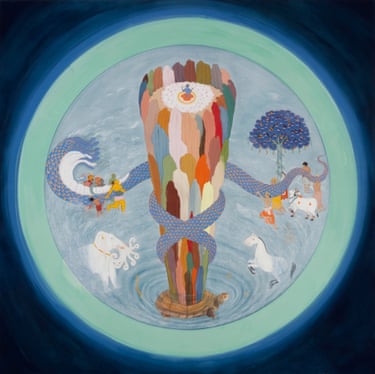
Samudra Manthana, Churning of the Ocean of Milk (natural pigments and gold on birch board, England/India/Australia, 2026) by Desmond Lazaro
Desmond Lazaro’s paintings reinterpret a legend in which Vishnu takes several forms. After a curse weakens the gods and causes the celestial treasures to sink into the ocean, Vishnu instructs them to work with the demons to retrieve the treasures, especially the amrita, elixir of immortality. Vishnu manifests as Kurma the tortoise and dives beneath Mount Mandara, placed in the ocean by Garuda, to support it.Photograph: Art Gallery of NSWExplore more on these topics