2 hours ago
1
2 hours ago
1
Pina Bausch had a pair of secret weapons in Matthias Burkert and Andreas Eisenschneider, who jointly sought out music to match her uncanny dance-theatre and make it so indelible. In Sweet Mambo, the German choreographer’s 2008 production for Tanztheater Wuppertal, their eclectic compilation complements the seductive elegance of set designer Peter Pabst’s huge, billowing white drapes and the sumptuous gowns provided by Marion Cito.
Track by track, an entrancing through-line is found in Sámi joiking, torch song, folk, electronica and ambient music. The mix extends to the unclassifiable party sound of Hazmat Modine’s Bahamut, harmonicas and tuba boosting a late burst of loosey-goosey abandon from dancer Daphnis Kokkinos while his colleagues are wrapped and spun upside down in those curtains.
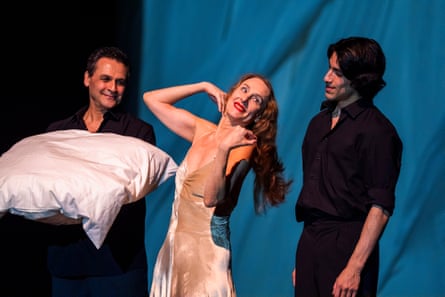
An altogether more serene opening bids us to listen closely as Naomi Brito, a dancer who gets better and better, plays a golden singing bowl. Andrey Berezin is duly drawn on stage, moth to her flame. Men pestering women, attraction and repulsion, were lifelong Bausch motifs and made for some hard-to-stomach scenes but here he is swatted gently away before Brito’s beatific solo, with long, silky lines and a luxurious full flow. It sums up the softer edges of Sweet Mambo, where the women’s solos frequently have an inner stillness and the dancers even drift away in hammocks.
The handful of harrowing episodes mostly involve Julie Shanahan, who enters caressing herself and adopting stylised poses à la Roy Lichtenstein’s pop art that morph into supernatural malevolence. Later, she is caught in a vicious circle of locked then liberated movement. In a reprised sequence, she strives to reach the end of the stage, repeatedly carried back to the start by men with implacable expressions – either acting dutifully or cruelly. The scenes with Julie Anne Stanzak dragged around the stage by her hair equally evade clearcut definition: it is done at her request and, as they run in circles and a storm rages, the sense is that we are all in this mess together and need each other.
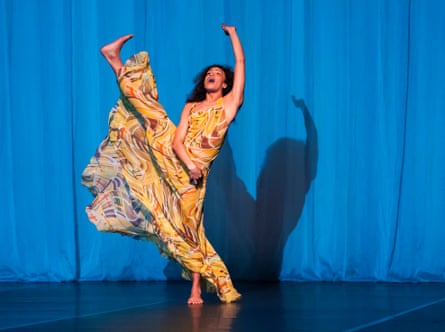
But Sweet Mambo is also one of Bausch’s funniest shows: Nazareth Panadero, blissfully daft, laughs into a plastic bag and seals it for later use then delivers eccentric aphorisms and tall tales about her neighbour’s parrot. “I feel so empty,” she laments, brandishing a used water-cooler bottle. Berezin returns to a sequence suggesting a helpless plummet through air and this void is at the heart of Pabst’s masterly minimalist design as gusts fill and sculpt a diaphanous sheet, with solos performed inside or adjacent.
The billowing backdrop becomes a screen for a projected 1930s German film featuring suave actors but, really, with dancers like this who needs to be distracted by other performers? After the interval, replaying selected routines risks diminishing returns yet the work has concentrated unity – it’s less sprawling than some of the choreographer’s other pieces – and results in a swooningly beautiful night. Pina Bausch coinciding with Valentine’s Day is a Sadler’s Wells tradition and these dancers treat the audience like lovers, asking us to never forget them, tell them our problems, help them unzip a dress. For newcomers it could be a coup de foudre; long-term Wuppertal watchers may fall in love all over again.