 3 months ago
79
3 months ago
79
One Battle After Another, Paul Thomas Anderson’s counterculture comedy about a washed-up revolutionary trying to protect his daughter from a ruthless military officer, has dominated the Baftas, taking home six awards including best film, best director, best cinematography, best editing, best supporting actor and best adapted screenplay.
The film, inspired by Thomas Pynchon’s Vineland, was nominated for 14 awards going into Sunday’s ceremony, the most of any contender – including nods for stars Leonardo DiCaprio, Sean Penn, Benicio del Toro, Chase Infiniti and Teyana Taylor.
Anderson said: “Anybody who says movies aren’t good anymore can piss right off, because this is a great fucking year. We have a line from Nina Simone we stole in our film. She says, ‘I know what freedom is, it’s no fear.’ Let’s keep making things without fear.”

Accepting the award for best director earlier, Anderson also paid tribute to the film’s late producer Adam Somner, who died in 2024. “You may think your greatest export was Alfred Hitchcock or Charlie Chaplin, but to me it was Adam Somner,” he said.
“Three weeks into our film he found out he was sick, and he made it through production. If you’ve ever worked with somebody who is very ill, it is very miraculous, it makes you pay attention and it reminds you of the privilege of this work we do. Thank you for sending him to me.”
Meanwhile Sinners, Ryan Coogler’s vampire thriller exploring racial and cultural erasure, took home three awards, for best original screenplay, best original score and best supporting actress.
Hamnet, Chloé Zhao’s adaptation of the Maggie O’Farrell novel about William Shakespeare, his wife Agnes and the tragic death of their son, took home two awards, including outstanding British film and leading actress for Jessie Buckley.
Buckley is the first Irish performer to win a leading actress Bafta. Critics widely praised her raw and intimate performance of a mother grieving the loss of her 11-year-old son. She is also in the running for a best actress award at the Oscars this March.
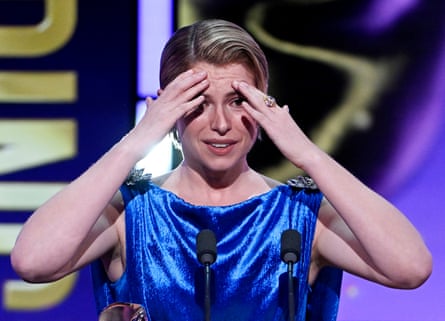
“This is such an incredible honour,” she said. “I love what I do, I love cinema. I believe in storytelling to bring us together as a community, I believe in women’s voices to tell us those stories. Chloé Zhao, you are making history tonight as a storyteller, thank you for your uncompromising artistry. And Maggie O’Farrell, thank you for this gift of a role.”
Buckley said she was sharing the award with her daughter, who “has been with me since she was six weeks old on the road with this. It’s the best role of my life, being your mum, and I promise to continue to be disobedient, so you can belong to a world in all your mad, complex, wildness as a young woman.”
In one of the biggest upsets of the night, Robert Aramayo beat the favourite Timothée Chalamet, as well as Leonardo DiCaprio, Ethan Hawke and Michael B Jordan, in the best actor category for his performance in I Swear, the British Tourette syndrome biopic about writer and campaigner John Davidson.
Through tears, a clearly shocked Aramayo, who had earlier won the EE Bafta rising star award, said: “I absolutely can’t believe it, I can’t believe I’m in the same category as you never mind being stood here.”
I Swear, which was nominated in five categories, also won the prize for casting. Cumming thanked the audience for their understanding after a number of outbursts from Davidson during the show, including shouting the n-word when Michael B Jordan and Delroy Lindo presented the award for best visual effects to Avatar: Fire and Ash.
Coogler was the first Black winner in the best original screenplay category. “I didn’t expect that,” he said. “Joachim [Trier] was my mentor, he showed me how to be a better writer and film-maker.”
Coogler expressed gratitude for being a part of communities that loved him. “For all the writers staring at a blank page, think of who you love, think of someone you see in pain and help them feel better,” he added.

The British-Nigerian actor Wunmi Mosaku won best supporting actress for her role as a hoodoo practitioner and healer in Sinners, beating the likes of Taylor – the favourite for her role in One Battle After Another – and Carey Mulligan. “I found a part of myself in Annie,” she said. “A part of my hopes, my ancestral power and connection, part of myself I thought I lost or tried to dim as an immigrant trying to fit in.”
Mosaku said her character had given her capacity to hope in the face of grief and this “harsh” world. “Ryan [Coogler], like preacher boy, your gift comes from home, and it’s big. Conjuring gifts from past and future, I felt the presence of the ancestors’ pride and joy daily on your set. Your commitment to artistry, truth and humanity is to be treasured and protected at all costs.”
Penn won best supporting actor for his performance as the chilling military villain Colonel Steven J Lockjaw in One Battle After Another. His win was one of the bigger upsets from the night, in a category that also included Paul Mescal and Stellan Skarsgård. He was not present to pick up his award.
The Bafta for best documentary went to Mr Nobody Against Putin, about a Russian teacher, Pavel Talankin, who secretly documented his school becoming a war recruitment centre during the Ukraine invasion. Co-director David Borenstein paid tribute to Talankin: “Two years ago he was a schoolteacher, now he’s a Bafta winner. Thank you for showing me that no matter how dark things get, whether in Russia or the streets of Minneapolis, we always face a moral choice. No matter who we are, there is power in our actions, to quote JRR Tolkien, courage is found in unlikely places.”
The award for outstanding debut by a British writer, director or producer went to Akinola Davies Jr for My Father’s Shadow. “I acknowledge the path my ancestors past, present and future have laid before me and I’m forever grateful,” the director said. To those watching at home, he said: “Archive your loved ones, archive your stories, yesterday, today and forever. For Nigeria, for London, the Congo, for Sudan, free Palestine.”
Guillermo del Toro’s Frankenstein, which had received eight nominations, won three on the night, for costume design, production design and make-up and hair.
Sentimental Value, Joachim Trier’s Norwegian drama about two sisters’ relationship with their narcissistic, estranged father, played by Stellan Skarsgård, was nominated for eight Baftas. It converted just one of those into an award, for best film not in the English language. “It’s the first time a Norwegian film wins a Bafta. We’re hugely better at skiing but here we are,” Trier said.
He added: “It’s clear we live in a time where images are thrown at us at a rapid speed. A lot of these images are trying to sell us ideas, ideology.” The films this year, Trier said, were “made for deep, humanist viewing” and encouraged empathy and curiosity.

The ceremony was opened by Cumming, who took over the reins from David Tennant this year. He said watching this year’s films had been “like taking part in a collective nervous breakdown”, before recapping some of the biggest awards season contenders.
“Then I thought, I know, I’ll watch a nice animated film to relax me and cheer myself up. Do you know the plot of Zootropolis 2?” he said. “Lies, corrupt leaders, poisoning and persecution of a race. Too soon, Disney. Cut us some slack here. Whatever happened to escapism? I’m exhausted. It’s almost as though there are events going on in the real world that are influencing film-makers. Ring any bells for you Americans in particular?”
Zootropolis 2 later won the award for best animated film. Director Jared Bush said stories “have incredible power, they can bring joy, exhilaration and wonder”, something the world needs right now. “We wanted to tell a story about differences, and the fact that sometimes in this world right now we can be made to think that our differences are something bad, or insurmountable or a problem,” he said.
Clare Binns, creative director of Picturehouse Cinemas, was awarded the Bafta for outstanding contribution to cinema. “I’ve been told to keep this short, which is advice I’d like to extend to film-makers,” she said to cheers and applause from the audience, echoing comments she first made to the Guardian.
Donna Langley, the British film executive behind hits such as Oppenheimer and Wicked, was awarded the Bafta fellowship, the organisation’s highest honour, from Prince William. She is the first Hollywood studio boss to receive the award.