 1 month ago
39
1 month ago
39
When Sam Beaumont sees a flash of red up a tree on his Lake District farm, he feels a swell of pride. He’s one of the few people in England who gets to see red squirrels in his back garden.
“I feel very lucky to have them on the farm. It’s an important thing to try and keep a healthy population of them. They are absolutely beautiful,” he said.
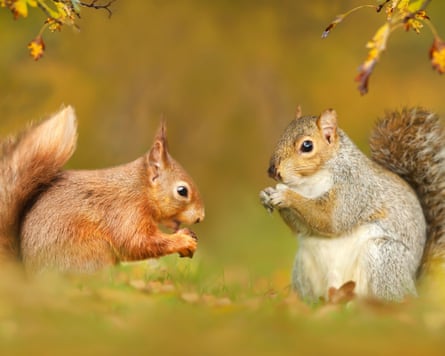
Most of us are much more familiar with their sturdy, grey American cousins. But once there were 3.4 million red squirrels in the UK, and with their glossy auburn fur, delicate frames and big tufty ears, they are the endangered animal whose loss Britons perhaps feel most deeply.
The non-native grey squirrels, which were introduced from 1876, have pushed their way into every corner of England, outcompeting the reds for food and carrying a disease called squirrelpox, which does not affect them but is fatal to the red population. However, some campaigners have raised welfare concerns over what they see as a “demonisation” of grey squirrels.
Red squirrels also face habitat loss as they thrive in the ancient woodland that has been cleared from most of the UK. Because of this, there are estimated to be only 287,000 left. Around 75% are found in Scotland, with the population in England thought to be as low as 38,900, including a healthy population on the Isle of Wight.
According to campaigners, this backdrop makes the government’s new squirrel action plan for England even more important. Published last week, the plan contains provisions to increase woodland habitat and remove grey squirrels from the areas in which reds still survive, mostly in the north of England and Scotland.
The nature minister, Mary Creagh, said: “Non-native grey squirrels cause huge damage to our trees and native wildlife. So we’re stepping up action to tackle their threat while protecting our iconic, endangered red squirrels. We’ll be working with landowners and conservation partners to better manage grey squirrel populations, and engaging in promising research into fertility control.”
Methods proposed by the government include new contraceptive vaccines for greys to stop them breeding, and incentivising landowners to remove grey squirrels from their land and create woodlands.
On the few hundred acres he controls, Beaumont is already doing this to protect his red squirrels. Part of the Nature Friendly Farming Network, he works with a local ranger to monitor the population – and eliminate any greys.
“He comes to the farm quite regularly and has put cameras up to monitor them,” Beaumont said. “And if there are any grey squirrels he will shoot them.”
Most of all, Beaumont says it is important to preserve habitat for red squirrels: “They love the ancient woodland, which has all the things they like to eat, like hazel and larch.”
The introduction of grey squirrels to the UK and subsequent decimation of the red squirrel population can be traced back to the 11th Duke of Bedford, Herbrand Russell.
He was fascinated by the larger American squirrels and released them on his property in Woburn Park, as well as across various London parks. He also gave them to other aristocratic friends, who released the then exotic creatures on their own land around the country.
This, said Matt Larsen-Daw, CEO of the Mammal Society, had left the red squirrel population “on a knife edge” two centuries later.
“What is clear is that in the last decade some areas where red squirrels were still present in the north of England have become increasingly vulnerable to encroaching grey squirrels, and are more vulnerable than ever,” he said.
Most of the squirrel monitoring is being done by volunteers such as Beaumont and his ranger. “It is a constant effort to monitor and control grey squirrel numbers,” Larsen-Daw said.
While a plan was welcome, he said more funding was required to support the community groups and landowners who were doing their best to protect the red populations, which thrive in isolation from the greys.
The grassroots campaign Save Our Reds also argues the plan does not go far enough.
Marie Carter-Robb, founder of Save Our Reds, said: “This policy statement is a welcome step forward, and it matters that it acknowledges both the scale of the problem and the role of volunteers on the ground.
“But a policy paper is not the same as protection. The question now is whether these commitments translate into measurable delivery in the woods, where red squirrel strongholds are still fragile, and where woodland quality and biodiversity must be protected as a matter of urgency.”
One “glimmer of hope” was the contraceptive vaccine, Larsen-Daw added. “This will not be available any time soon but innovative ‘gamechanger’ projects like this are the best chance for a long-term solution to grey squirrel presence,” he said.
The government also hopes to return pine martens in areas where there are too many grey squirrels. This was good news, Larsen-Daw said. “It has already been shown that in Ireland and Scotland red squirrels have benefited when pine martens establish in their habitat, and it is hoped that the same will be true in England.”
The nimble reds were able to stay out of the clutches of the pine martens, but the greys were “easy prey” for the carnivorous creatures, Larsen-Daw said.
He added: “Although it is hard to feel optimistic for the swift recovery of red squirrels in England, I do feel confident that the combination of research-driven solutions such as the fertility control vaccine, and the success with pine marten recovery, offers hope for the future.”