 5 hours ago
10
5 hours ago
10
Deep within a dark warehouse in Hillsborough, North Carolina, there sits a severed head. Encased in plastic, perfectly preserved and seemingly begging to be reanimated, it belongs to an American soccer legend.
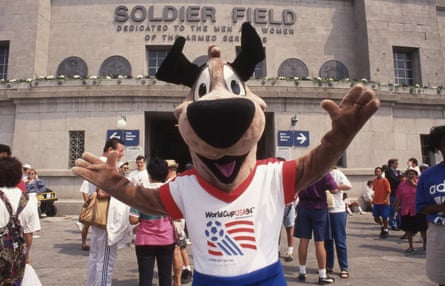
For a seismic summer 32 years ago, Striker the dog was more ubiquitous than any of World Cup 94’s players, plastered all over billboards, Coke cans, key chains, caps and hundreds of other items. Kids carried around Striker dolls. Grown men played Striker-themed pinball machines and Super Nintendo games and posed for photos with the pup in stadiums.
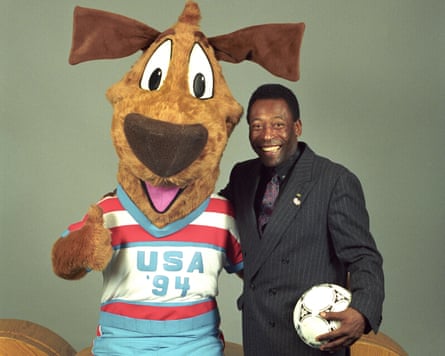
As Striker’s remains – the foam and felt head, torso and limbs – lie in darkness at the US Soccer Hall of Fame archives, this summer’s World Cup has had its own trio of mascots. Canada’s Maple the Moose, America’s Clutch the Bald Eagle and Mexico’s Zayu the Jaguar seem caught in some bizarre liminal space between realism and cartoon fantasy, residents of a mascot version of the uncanny valley.
That trio feel like AI slop, though. Striker? US Soccer chose a much simpler path with him, whipping together a cartoon dog. Years later, that choice has made him the one of the most memorable mascots in World Cup history.
John Over and Joey Banaszkiewicz are responsible for some of the most well-known pieces of American animation of the late 20th century. They were young artists at Warner Brothers in the mid-90s, right around the time Steven Spielberg was leading that studio through an animation renaissance.
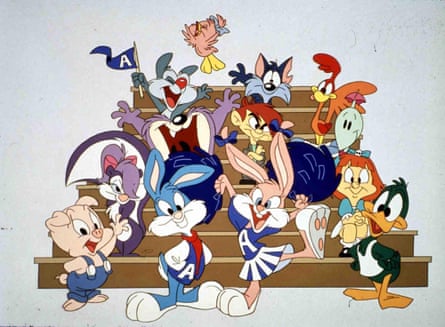
The two had a hand in crafting the storylines and artwork for Animaniacs and Tiny Toon Adventures, drawing characters that would become familiar to an entire generation of American children. Their work wasn’t always for kids – the first episode of Animaniacs that Over ever worked on was quickly pulled after Buster Bunny and Plucky Duck got drunk and stole a police car.
The culture at Warner Brothers back then, Over and Banaszkiewicz will tell you, was something akin to the island of misfit toys.
“I feel like some people got there right out of prison,” says Banaszkiewicz, who landed at the studio after graduating from Cal Arts. Over arrived after working for John Kricfalusi, the creator of another iconic piece of 90s animation: the Ren and Stimpy Show.
“The currency there was ‘how hard could we make each other laugh,’” Over says. “We were just a bunch of 20-year-olds that were let loose. People were just doing foul drawings of each other and seeing how far you could milk a joke or an embarrassing situation. But it was fantastic, because that’s really how you get your creativity built up.”
In the summer of 1992, in between seasons of Tiny Toons and Animaniacs, animators found themselves with nothing to work on. For a few weeks, they’d pass the time by taking hours-long lunch breaks or “playing several rounds of miniature golf across the street”, Over remembers, but eventually, higher-ups within Warner Brothers suggested laying employees off or furloughing them.
Spielberg wanted nothing to do with that idea. At his insistence, staff were kept on, and Spielberg told executives to find them other work.
Right around that time, the organizing committee for the 1994 World Cup was searching for a mascot. Alan Rothenberg, the US Soccer Federation president, picked up the phone and set a meeting with Jean MacCurdy, the president of Warner Brothers Animation.
Thirty years earlier, Reginald Hoye and Richard Culley, employees at a London-area marketing agency, were handed their own brief. The 1966 World Cup was rapidly approaching and the two were tasked with doing something entirely new: creating a mascot.
It’s hard to imagine, but World Cups to that point were largely bereft of the consumerism that so thoroughly permeates them today. There were barely any advertisements at all, really, or merchandise. And certainly no mascots.
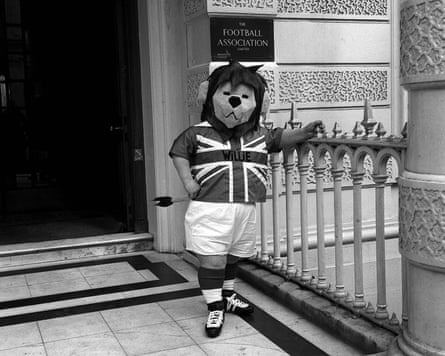
In 10 minutes, Culley and Hoye whipped up World Cup Willie, the first-ever World Cup mascot. There are layers to Willie. He sports the union jack and his shaggy, charming appearance was in line with England’s broader moment, as the country’s perception moved away from its staid past and migrated towards that of a cultural tastemaker. This was the era of the Beatles, the Stones and James Bond.
Willie fit right in; he was an instant smash, and others followed. In 1970, Juanito – a small Mexican child decked out in a sombrero – was the first human mascot, a trend that continued into the 1974 and 1978 World Cups.
Then came the produce. Spain rolled out Naranjito, an anthropomorphic orange, in 1982 and Mexico came back with Pique, a mustachioed jalapeno pepper, in 1986.
Then things got weird. In 1990, organizers in Italy hosted a design competition and received 50,000 entries, portraying everything from dogs to eggplants to an anthropomorphic piece of ziti. A panel of judges, including such luminaries as famed Ferrari designer Sergio Pininfarina, settled on an entry from Lucio Boscardin, an unheralded painter and sculptor.
Boscardin came up with his idea at a traffic light. He took the word “Italia”, broke apart the lettering and assembled it into a stick figure of sorts, employing a soccer ball as the figure’s head. The end result was Ciao, a modern art fever dream.
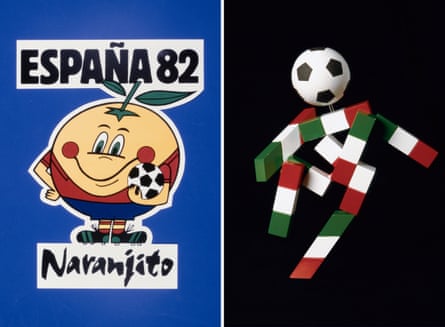
Tournament organizers quickly realized that Boscardin’s cubist vision was impossible to represent in costume, so they just threw together a dozen or so sculptures of Ciao, toting him around from stadium to stadium.
The designers of Striker weren’t going to make that same mistake, though their early concepts were just as terrifying.
“There were a bunch of people trying to do a soccer ball thing,” Over says. “People didn’t know what to call it really. I think Joey’s version was called Soccerey Bally or something like that. It was like a humanoid soccer ball with arms and legs. Joey’s storyboards are always funny and outrageous, so he had like soccer players taking the thing out to romantic candlelit dinners, and there’s just balls sitting everywhere. The player is in bed with a ball, he’s having sex with a ball, he’s everywhere with a ball.”
US Soccer was not in any rush to peddle soccer-based cartoon pornography, and thankfully animators at Warner Brothers began to explore about a dozen other possibilities, “both animal and humanoid”, said MacCurdy. There were space creatures. Cats. Cougars. Bears.
“In the end we just ended up looking at a lot of the old World Cup mascots,” Over says. “A lot of them were just awful. One was just a giant orange? And a lot of them had historical significance or whatever. Soccer was sort of not super popular here, so we thought let’s do this ‘underdog’ kind of idea. That’s when we started doing versions of, you know, ‘soccer dog’.”
With that, the two embarked on a design process that left them bruised and battered. Hearing Over prattle on about what happened will feel familiar to any artist or creative who has ever applied their craft to a commercial endeavor.
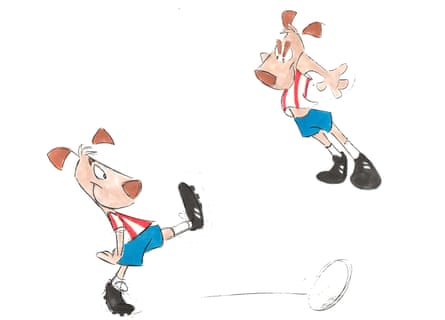
“We ran into problems with these dorks at [US Soccer],” says Over, laughing. “They’d look at your drawings. As an animator you’re always exaggerating things. Somebody kicks a ball and you have the leg go way up. They would say – well, ‘a child could never kick a ball that hard.’ Like, it’s a freaking soccer dog, dude. It is a cartoon dog!”
“It ended up being sort of a design by committee thing,” Banaszkiewicz says. “And in the world of animation, that’s always death. Pretty soon it’s ‘I don’t like these fingers’ or ‘I think his ears are too sharp’ or ‘can you give him a bigger smile?’ Pretty soon you don’t even recognize him any more.”
The pup we now know as Striker was at that point still being called Soccer Dog over at Warner Brothers and the slightly more clever World Cup Pup in the halls at US Soccer, not exactly the kind of names that move merchandise. So the World Cup organizing committee, headed up by Rothenberg, decided to let the public name the mascot. They bought advertising space in hundreds of local and national newspapers, encouraging fans to call their vote via a 1-900 number ($0.95 per call, in case you were wondering) or mail-in ballot. To keep things simple, the organizing committee narrowed the list down to four names: Striker, Sweeper, Champ and Sidekick.
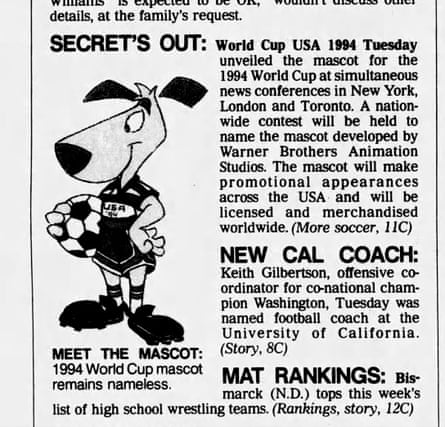
About 25,000 people cast their vote over the six-week campaign, with Striker the clear favorite. At a cost of $2,500 each, the organizing committee ordered a dozen Striker costumes, thrown together by Scollon Productions, a mom-and-pop costume shop based in White Rock, South Carolina. They made a few refinements to his look, swapping out a rugby-inspired jersey for a soccer kit and positioning the ball at the dog’s feet instead of forcing him to carry it around in his hands.
The pup needed a backstory, so the organizing committee put their best wordsmiths on the assignment, and they did not disappoint. Striker was birthed by Mr and Mrs Mutt, they wrote, graduating with honors from obedience school. His favorite song? Hound Dog, by Elvis Presley. As for whether Striker has a significant other – he’s officially listed as single. “Playing the field,” as they say.
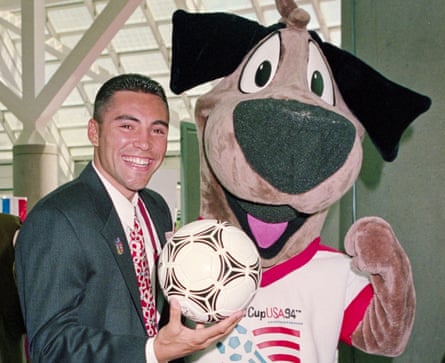
“He best represents sports and this country,” Rothenberg said at the time. “And, being crass and commercial, we want to sell as much merchandise as possible.” Tournament organizers estimated that they’d make more than a billion – yes, a billion – dollars off of merchandise bearing Striker’s likeness.
One curious detail about Striker’s origin story is that promoters suggested the dog was neither male nor female. That idea didn’t seem to stick, though: the pup got male pronouns nearly every time he was mentioned.
Striker’s boots are a size-24 wide, if you’re wondering. Huge shoes to fill. But somebody had to. That task fell to Carlos Parada. Back in 1986, Parada was a wide-eyed teenager with a dream to go to the World Cup in Mexico. So he did what any irresponsible college student would: he got a high-interest credit card and bought the next flight out, hoping to crash with a few friends he had south of the border.
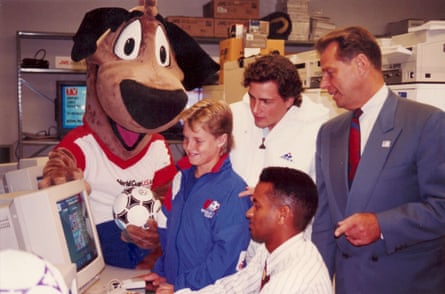
Parada ended up scoring free tickets to nearly every match at the Azteca. He watched Diego Maradona score with his “Hand of God” and then watched him score arguably the greatest goal in the history of the tournament moments later. He was there for the final, among the best ever played. He returned home to Los Angeles, determined to involve himself in soccer.
“When the [organizing committee] moved from Chicago to Los Angeles before the World Cup,” Parada says, “I knew I had to get involved. You know. To get free tickets.”
Parada signed up as a volunteer, then took a part-time post at the organizing committee’s headquarters, one that put him in the office at 6am, around the time Rothenberg arrived – “to get a jump on the east coast folks,” Parada remembers. The two became chummy, and when a full-time marketing position became available, Parada got the job.
He was tasked with safekeeping two of the tournament’s icons. One was the World Cup trophy. The 27-year-old went continent hopping with it for months, always flying in first class. “One seat for me,” he remembers, “and one for the trophy, right next to me.”
The other was Striker. Parada, assisted by Joann Klonowski, the tournament’s head of marketing, put together guidelines for those inhabiting the costumes –mostly volunteers, as Parada once was.
“He never speaks,” Klonowski told a reporter at the time. “He is not allowed to remove any part of his costume in public; for instance, he can’t remove his head. That takes away the aura for the kids who see him. He – the character, actually – is neither male nor female. The character never acknowledges that there is a person inside. The character communicates through mime movements, or through a personal escort, who always accompanies the character.”
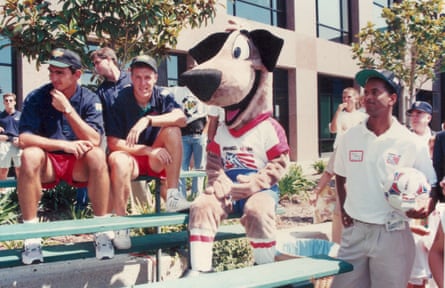
Parada also contributed a training film which, like the guidelines, is a little surreal, with Parada cheering his volunteers along as they run through the motions in and out of costume.
Striker was unveiled in front of Mann’s Chinese Theatre in Hollywood in October 1993, where he sank his paws into the wet pavement beneath him, as is the tradition with any big star. He was at pre-tournament friendlies, hobnobbing and posing with fans, even crossing the Atlantic for promotional events. He was at the World Cup draw, and everywhere else, plastered all over billboards, TV ads, airplanes and a boatload of other merch.
One place he wasn’t: the opening ceremony. Folks at US Soccer had visions of throwing Striker alongside Oprah Winfrey, Bill Clinton, Diana Ross and the rest of the crew but Striker was banished, collateral damage after a war between Disney (the original organizers of the ceremony) and Opryland USA (the company that ended up putting it on). Striker, said one Opryland employee, “is not here because we think he’s stupid.”
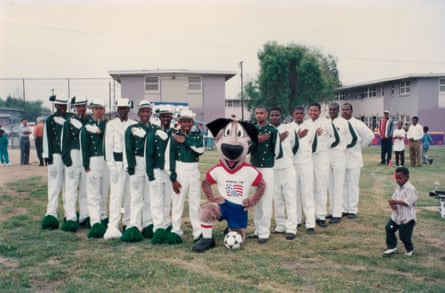
Many others did not find this soccer dog stupid. Mexico goalkeeper Jorge Campos, Parada remembers, developed a strange fascination with the mascot and was insistent on standing next to him before matches. The Argentina squad also took a liking to Striker. In one of the tournament’s more remarkable off-field scenes, they tracked Striker down after crushing Greece 4-0 in their group-stage opener, throwing him in the air in celebration. After their next game against Nigeria, Maradona was led off the field for a drug test, one that ended his international career.
Kids and adults alike were equally obsessed, in part owing to the fact that the dog could actually play soccer.
“I learned pretty quickly that if you got a kid who played soccer in the costume and put him in Sambas, you could have pretty good control of his feet,” Parada says. “People would go insane when they saw Striker juggling a ball, which he could do pretty easily.”
After the World Cup ended, after the banners came down and the collectible pin sets, hats and sweatshirts were shoved into drawers or sent to thrift shops, Striker drifted back into the ether. Others followed in his footsteps: a rooster (Footix, France 98), a lion (Goleo VI, Germany 06), a leopard (Zakumi, South Africa 10), a wolf (Zabivaka, Russia 18), a trio of aliens (Ato, Kaz and Nik, South Korea/Japan 02). By the time Qatar rolled around in 2022, we got La’eeb, a floating garment, albeit an adorable one.
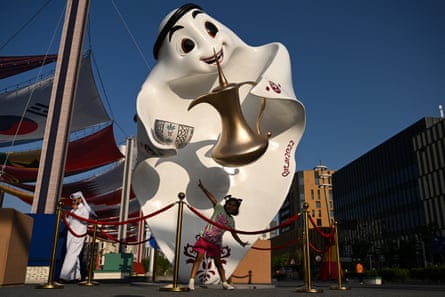
As the tournament has become more and more bloated and more and more commercialized, Striker evolved into a symbol for a simpler time, when the teams were fewer and the tickets were cheaper.
Rothenberg, though, more or less forgot about him – when reached for this piece, he conceded that he didn’t remember anything about the mascot’s development. Neither did MacCurdy – the animation head at Warner Brothers – or Klonowski, the marketing head who ran the project for the organizing committee.
Over and Banaszkiewicz had no idea whatsoever that Striker had had any sort of impact on a particular generation of soccer fans in America, not until they were contacted at least. Banaszkiewicz put it bluntly: “I had no idea anybody cared, honestly.”
Over remembered the short-term effects, yes – seeing his co-creation on the side of an American Airlines 747, at games and on light-pole banners – but that was more or less the end of it for him. When Over and Banaszkiewicz hopped on a call together and chatted for the first time in years, though, the memories came flooding back.
Neither artist feels a terribly strong sense of attachment to Striker. There were talks of an animated series at some point, but in the end the dog was just a drawing to them, or an intern in a costume.
“I remember Jean MacCurdy and I went down to watch them unveil Striker, when he put his feet in the cement at Mann’s Chinese Theater, right next to Humphrey Bogart’s [hand prints.] It all felt so … forced. This love for this character was sort of forced. So it doesn’t rank that high as far as the stuff I’ve done, because you’re not infusing it with any personality as a film-maker. There’s no story to it, it’s sort of a graphic placeholder.”
For an entire generation of American kids, though, Striker was part of that magical summer, one where they fell in love with the sport of soccer and never turned back.
Not bad for a soccer dog.