2 months ago
83
2 months ago
83
Violence has continued across much of the Middle East a day after Donald Trump said the US was in “very good” talks with Iran to end the war in the region soon.
Iranian barrages targeted Israel, Gulf Arab states and northern Iraq on Tuesday, while Israeli and US warplanes continued to carry out strikes across Tehran and on other targets in the Islamic Republic.
Multiple official sources in Tehran have denied any talks are under way. The Iranian parliament speaker, Mohammad Bagher Ghalibaf, who has been cited as a potential interlocutor with the US, said in a social media post: “No negotiations have been held with the US … fake news is used to manipulate the financial and oil markets.”
Tehran distrusts any US offer of negotiations, in part because it was in talks with the US before the surprise attack that started the war and killed the supreme leader Ali Khamenei and dozens of senior officials. Iran was also in talks last year when the US and Israel attacked its nuclear facilities, starting a 12-day war.
“We must think wisely,” Esmail Kowsari, a member of the Iranian parliament’s national security and foreign policy committee, was quoted as saying by the semiofficial Fars news agency. “Their nature is to sow discord so that they can make people distrust officials and believe that such actions have taken place, whereas no such action has occurred.”
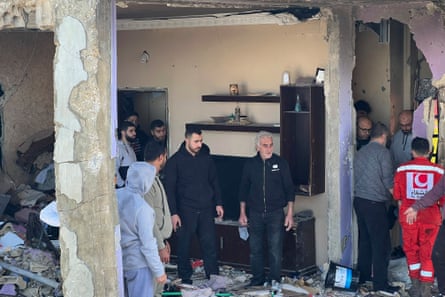
However, potential intermediaries including Pakistan, Oman, Egypt and others have confirmed tentative efforts to establish channels of communication between Washington and Tehran. Analysts point out that there are deep divisions among surviving senior officials in Tehran, which could explain some of the defiant Iranian reaction.
Iran’s foreign minister, Abbas Araghchi, has been talking about the war in recent days with his counterparts in Azerbaijan, Egypt, Oman, Pakistan, Russia, South Korea, Turkey and Turkmenistan, his office said.
In Islamabad, officials raised the prospect of a meeting between Iranian officials and Steve Witkoff, Trump’s special envoy, Jared Kushner, the president’s son-in-law, and JD Vance, the US vice-president. A European official told Reuters that while there had been no direct negotiations between the two nations, Egypt, Pakistan and Gulf states were relaying messages.
The sudden diplomatic activity came after the US and Iran traded threats over the weekend of strikes that could have cut electricity to millions in Iran and around the Gulf and knocked out desalination plants that provide many desert nations with drinking water.
On Monday, Trump delayed a deadline for Iran to open the strait of Hormuz for shipping or see its power stations targeted by airstrikes, briefly driving down oil prices and boosting stocks. The deadline will now expire on Friday.
The US continues to reinforce its military forces around Iran, with about 5,000 marines en route for the region, and to launch new attacks.
Iranian media reported on Tuesday that Israeli-US strikes targeted two gas facilities and a pipeline, hours after Trump stepped back from his threat to attack power infrastructure. The facilities in central Iran were “partially damaged”, said the Fars news agency, which did not provide a source and was Iran’s only news outlet to report the incident. It said an attack also targeted the gas pipeline of the Khorramshahr power plant, in the country’s south-west.
Benjamin Netanyahu said Israel would continue to strike Iran and Lebanon, where its offensive targets Hezbollah, the Iran-backed Islamist militant movement, even as the US considers a ceasefire. “There’s more to come,” the Israeli prime minister said.
Iran fired several waves of missiles at Israel early on Tuesday, and there were reports of an impact in the country’s north.
In Tel Aviv, a missile with a 100kg (220lbs) warhead escaped Israeli defences to slam into a street in the centre of the city, blowing out windows of a neighbouring apartment building and sending smoke billowing.
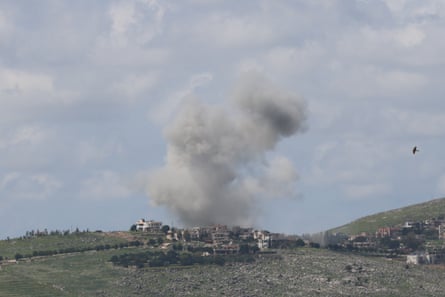
Earlier in the day, Israel pounded Beirut’s southern suburbs, saying it was targeting infrastructure used by Hezbollah.
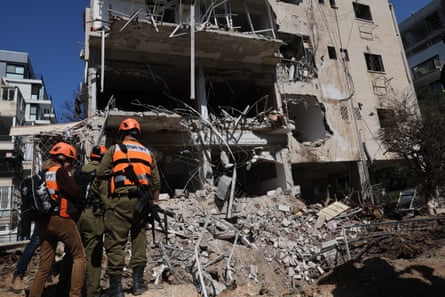
A strike on a residential apartment south-east of the Lebanese capital killed at least two people, according to the Lebanese health ministry.
In Kuwait, power lines were hit from air defence shrapnel, causing electricity outages. Missile alert sirens sounded in Bahrain, and Saudi Arabia’s defence ministry said it had destroyed 19 Iranian drones targeting its oil-rich Eastern province.
Oil prices rose to $104 (£77) a barrel in morning trading, up more than 40% since Israel and the US started the war on 28 February. Analysts are warning of durable and deep disruption to the supply of oil and gas from the region even in the event of a rapid end to hostilities, with severe economic consequences around the world.